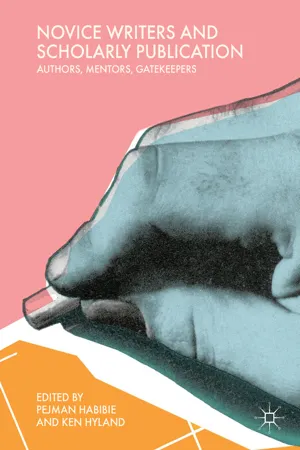
This book draws on the perspectives of authors, supervisors, reviewers and editors to present a rich, nuanced picture of the practices and challenges involved in writing for scholarly publication. Organized into four sections, it brings together international experts and junior scholars from a variety of disciplines to examine both publishing experiences and current research in the field. In doing so, it challenges the view that Native English speakers have a relatively easy ride in this process and that it is only English as an Additional Language (EAL) scholars who experience difficulties. The volume highlights central themes of writing for publication, including mentoring and collaborative writing, the writing experience, text mediation, the review process, journal practices and editorial decision-making, and makes a strong case for taking a more inclusive approach to research in this domain. This edited collection will appeal to students and scholars of applied linguistics, English for academic purposes, academic writing, and second language writing.
eBook - ePub
Novice Writers and Scholarly Publication
Authors, Mentors, Gatekeepers
- English
- ePUB (mobile friendly)
- Available on iOS & Android
eBook - ePub
Novice Writers and Scholarly Publication
Authors, Mentors, Gatekeepers
About this book
Information
© The Author(s) 2019
Pejman Habibie and Ken Hyland (eds.)Novice Writers and Scholarly Publicationhttps://doi.org/10.1007/978-3-319-95333-5_11. Introduction: The Risks and Rewards of Scholarly Publishing
Pejman Habibie1 and Ken Hyland2
(1)
Faculty of Education, University of Western Ontario, London, ON, Canada
(2)
School of Education and Lifelong Learning, University of East Anglia, Norwich, UK
Just as for well-established members of academic discourse communities, writing for scholarly publication includes a mixed bag of merits, motivations, risks, and pressures for junior scholars and doctoral students. Kamler (2008) argues that “if students publish in their formative years, they are more likely to do so as established academics or informed professionals in their chosen fields of practice” (p. 292). Watts (2012) views writing for publication as part of doctoral research experience within doctoral education. She states that “the extent to which, for example, publishing can contribute to a ‘de-stressing’ of the assessment process, particularly the viva element, is one consideration” (p. 1104) that needs to be taken into account in exploring the merits of publishing during candidature. She also refers to the significance of negotiation with gatekeepers, observing that
the opportunity to engage in a dialogue with reviewers can provide insight and different perspectives on doctoral work that may not emerge in supervision. Through the critical exchange of ideas and receipt of challenging feedback, this instrumental approach to publishing has the potential to shape the thesis and the general direction of the research in creative ways. (p. 1104)
Wellington (2010) refers to both extrinsic and intrinsic motivations for scholarly publication during doctoral candidature. Enhancing one’s resume and profile, and achieving status and credibility in a research domain, are among the extrinsic motivations. Boosting self-confidence, gaining self-satisfaction, and developing and organizing ideas are some of the intrinsic ones. Barnacle and Mewburn (2010) argue that scholarly publication also contributes to shaping and establishing a scholarly identity and persona.
On the other hand, pointing out the significance of scholarly publication for doctoral students, Paré (2010) highlights the risk of “pre-mature” publication and warns that “[a]lthough the imperative is undeniable, and the desire to help students is laudable, the dangers of rushing students into the public exposure of publication need to be considered” (p. 30). Similarly, Watts (2012) refers to the “risk-laden” nature of writing for publication and points out that doctoral students need to be informed of the risks involved in this academic endeavor. She highlights high rejection rates by journal gatekeepers and the time-consuming nature of refashioning and resubmitting a paper to an alternative journal without a definite chance of success. She also underlines that “guidance about rejection rates, review processes and the likely timeline from submission to publication is valuable” (p. 1105), and argues that it is a significant, yet overlooked, responsibility of supervisors to inform students about relevant and target journals in their fields.
Literature also highlights extensive pressure for scholarly output in the course of doctoral candidature. Academic publication has serious implications for future academic lives and careers of junior scholars in the competitive context of academia (Kwan, 2010). “The literature provides no doubt that the competitive ‘bar’ for doctoral students is rising in terms of both quantity and quality” (Jones, 2013, p. 89). Casanave (2010) notes that “we seem to take it for granted now that (a) it is important to publish work from dissertations and (b) it is important not to wait to do this until we have diplomas in our hands” (p. 47). Hesitant about “jumping on the publishing bandwagon” (p. 48) during the doctorate, she enumerates heavy teaching loads, personal responsibilities, family obligations, long commutes, financial issues, health problems, exhaustion, and limited faculty-student and student-student contact, and consequently minimal support and feedback as a number of pressures and challenges that her doctoral students were dealing with. Underlining “an increase in publication-related anxiety among graduate students”, Paré (2010) believes that the anxiety related to academic publication can be counterproductive for students rather than helpful.
In spite of the ever-increasing expectations and pressures on junior scholars and inherent (dis)advantages of early academic productivity for junior scholars, writing blocks and publishing impotency are common problems in the context of the doctoral education and among doctoral students (Jones, 2013; Lee & Kamler, 2008). This highlights the urgent exigency of an in-depth understanding of discursive and non-discursive challenges that these scholars encounter in communicating their research as well as macro and micro policies, interventions, and strategies that can alleviate those struggles and support novice academics’ visibility and participation in global forum. There is no doubt that such knowledge base requires further scholarly discussions about and empirical inquiry into scholarly publication practices of novice scholars in different geo-linguistic contexts. By the same token, this book addresses the complex yet under-represented topic of writing for scholarly publication by doctoral students and junior scholars. It approaches this topic in a novel way, bringing together international experts and junior scholars themselves from a variety of disciplines to discuss both research in the field and personal publishing experiences.
Drawing on the perspectives and experiences of authors, supervisors, reviewers, and editors, it seeks to present a rich and nuanced picture of the practices and challenges faced by both Anglophone and English as an additional language (EAL) junior scholars in writing for publication . The book will raise the key issues for writers and their mentors, addressing some topics for the first time, and challenge the unexamined view that it is only EAL scholars who experience difficulties in writing for scholarly publication. The volume, therefore, highlights central themes of writing for publication , including mentoring and collaborative writing, the writing experience, text mediation, the review process, journal practices, editorial decision-making, and so on. It also makes the strong case for taking a more inclusive approach to research in this domain than in the past, ensuring that the voices of both native English speaking and non-native English speaking scholars are heard. Thus, by sharing the voices of both Anglophone and non-Anglophone novice scholars, it aims to present a balanced picture of scholarly publication landscape, open a forum for further discussion of scholarly publication practices of Anglophone novice scholars, and offer useful theoretical, methodological, and pedagogical implications for research and practice in this domain.
In sum, the book is a serious attempt to explore the experiences of different participants in the process of scholarly publication, both through empirical research and personal histories. In particular, the book intends to illuminate some of the following key issues:
- 1.The Anglophone vs. EAL dichotomy and the supposedly linguistic advantage of Anglophone scholars as a reductionist explanation for the complexities of scholarly publication,
- 2.The discursive and non-discursive challeng...
Table of contents
- Cover
- Front Matter
- 1. Introduction: The Risks and Rewards of Scholarly Publishing
- Part I. Perspectives on Scholarly Publication
- Part II. Perspectives of Authors
- Part III. Perspectives of Mentors
- Part IV. Perspectives of Assessors
- Back Matter
Trusted by 375,005 students
Access to over 1.5 million titles for a fair monthly price.
Study more efficiently using our study tools.
Frequently asked questions
Yes, you can cancel anytime from the Subscription tab in your account settings on the Perlego website. Your subscription will stay active until the end of your current billing period. Learn how to cancel your subscription
No, books cannot be downloaded as external files, such as PDFs, for use outside of Perlego. However, you can download books within the Perlego app for offline reading on mobile or tablet. Learn how to download books offline
Perlego offers two plans: Essential and Complete
- Essential is ideal for learners and professionals who enjoy exploring a wide range of subjects. Access the Essential Library with 800,000+ trusted titles and best-sellers across business, personal growth, and the humanities. Includes unlimited reading time and Standard Read Aloud voice.
- Complete: Perfect for advanced learners and researchers needing full, unrestricted access. Unlock 1.5M+ books across hundreds of subjects, including academic and specialized titles. The Complete Plan also includes advanced features like Premium Read Aloud and Research Assistant.
We are an online textbook subscription service, where you can get access to an entire online library for less than the price of a single book per month. With over 1.5 million books across 990+ topics, we’ve got you covered! Learn about our mission
Look out for the read-aloud symbol on your next book to see if you can listen to it. The read-aloud tool reads text aloud for you, highlighting the text as it is being read. You can pause it, speed it up and slow it down. Learn more about Read Aloud
Yes! You can use the Perlego app on both iOS and Android devices to read anytime, anywhere — even offline. Perfect for commutes or when you’re on the go.
Please note we cannot support devices running on iOS 13 and Android 7 or earlier. Learn more about using the app
Please note we cannot support devices running on iOS 13 and Android 7 or earlier. Learn more about using the app
Yes, you can access Novice Writers and Scholarly Publication by Pejman Habibie, Ken Hyland, Pejman Habibie,Ken Hyland in PDF and/or ePUB format, as well as other popular books in Languages & Linguistics & Higher Education. We have over 1.5 million books available in our catalogue for you to explore.