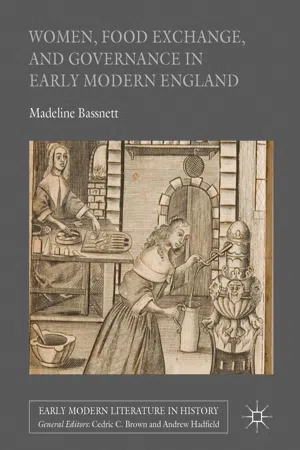
This book is about the relationship of food and food practices to discourses and depictions of domestic and political governance in early modern women's writing. It examines the texts of four elite women spanning approximately forty years: the Psalmes of Mary Sidney Herbert, Countess of Pembroke; the maternal nursing pamphlet of Elizabeth Clinton, Dowager Countess of Lincoln; the diary of Margaret, Lady Hoby; and Mary Sidney, Lady Wroth's prose romance, Urania. It argues that we cannot gain a full picture of what food meant to the early modern English without looking at the works of women, who were the primary managers of household foodways. In examining food practices such as hospitality, gift exchange, and charity, this monograph demonstrates that women, no less than men, engaged with vital social, cultural and political processes.
- English
- ePUB (mobile friendly)
- Available on iOS & Android
eBook - ePub
Women, Food Exchange, and Governance in Early Modern England
About this book
Information
© The Author(s) 2016
Madeline BassnettWomen, Food Exchange, and Governance in Early Modern England Early Modern Literature in History10.1007/978-3-319-40868-2_11. Introduction
Madeline Bassnett1
(1)
Dept. of English and Writing Studies, University of Western Ontario, London, Ontario, Canada
In 1598 the European traveller Paul Hentzner enjoyed the special privilege of visiting Elizabeth’s presence chamber at Greenwich, where he observed the symbol-laden ritual of the Queen’s public dining. Reporting on this event in his Journey into England, Hentzner highlights the close involvement of women in handling and managing foodstuffs in an account that simultaneously communicates a woman’s political power and control:
A Gentleman entered the room bearing a rod, and along with him another bearing a table-cloth, which after they had both kneeled three times, with the utmost veneration, he spread upon the table…Then came two others, one with the rod again, the other with a salt-seller, a plate, and bread…At last came an unmarried Lady, (we were told she was a Countess) and along with her a married one, bearing a tasting-knife; the former was dressed in white silk, who when she had prostrated herself three times, in the most graceful manner approached the table, and rubbed the plates with bread and salt, with as much awe, as if the Queen had been present: When they had waited there a little while, the Yeomen of the Guard entered…bringing in at each turn a course of twenty-four dishes, served in plate most of it gilt; these dishes were received by a Gentleman in the same order they were brought, and placed upon the table, while the Lady-Taster gave to each of the guard a mouthful to eat, of the particular dish he had brought, for fear of any poison.…At the end of all this ceremonial a number of unmarried Ladies appeared, who with particular solemnity lifted the meat off the table, and conveyed it into the Queen’s inner and more private chamber, where after she had chosen for herself, the rest goes to the Ladies of the Court.1
Hentzner’s immortalizing account of royal grandeur hints at many of the gendered and political dynamics of food exchange explored in this book. While the men carry in tableware, it is the women who take charge of the food, first cleansing the plates with bread and salt and then scooping up morsels for the guards to taste. This odd interaction presumably ensures that the guards do indeed eat: they have a witness and enforcer in the body of the woman offering them the tasting-knife. From this perspective, the event might also recall a scene of infant-feeding, reminding the audience of women’s powerful primordial link to nourishment and their corresponding ability to influence the bodies of others. Yet all these rituals overreach the domestic, for they establish a female ruler’s wealth, importance, and authority over household, court, and country. One might imagine this performance, witnessed at the end of four years of stark food shortages, to be a conscious representation of a regulated and plentifully fed nation. The Queen’s distribution of her dinner to the ladies who serve her demonstrates the smooth circulation of food from the greatest to the lowest, and models an integral relationship of mutual exchange, dependence, and support: invaluable virtues, especially during periods of dearth. Although like any good woman the Queen disappears into religious contemplation—Hentzner notes that she is at prayers during these preparations—it is, as Hentzner remarks, ‘as if the Queen had been present’. Each carefully choreographed interaction with the bountiful table reminds visitors of the obedience and reverence due to the reigning monarch.
The Queen was not the only woman to understand and use the performance of food exchange as a means of communicating or establishing political power. As I argue in this book, elite women frequently depict and discuss food practices, which depend on the relational and political acts of giving and receiving, in relation to concepts of virtuous governance. To investigate these dynamics, I examine the texts of four elite women spanning approximately forty years: the Psalmes of Mary Sidney Herbert, Countess of Pembroke (completed by 1599); the maternal nursing pamphlet of Elizabeth Clinton, Dowager Countess of Lincoln (published 1622); the diary of Margaret, Lady Hoby (written 1599–1605); and both parts of Mary Sidney, Lady Wroth’s prose romance, Urania (published 1621; manuscript continuation c. 1630). Influenced by the Protestant and providential belief that food was a gift from God, these women envisioned female-mediated exchanges, such as hospitality, gift-giving, and charity, to reflect and extend that gift. Closely related physiological concepts, which understood ingestion to affect body, mind, and spirit, further guided their perception that food was a key regulator of the self, defining the ability to function in a godly manner and thereby positively guide and affect others. Although many of the scenes of food exchange I discuss might be understood to comment more broadly on governing ideals, these literary moments also illuminate elite women’s own contributions to a network of governing opportunities. Repeatedly, these authors situate food exchange in the countryside and on country estates, reflecting their own positions as managers of sizeable rural households and drawing attention to the close relationship between a bountiful God and the women who administer his nutritional blessings. In aligning themselves with ‘our Nourisher’, as Adam so evocatively names God in Paradise Lost, these authors both suggest that virtuous women of their class perform God’s work, and imagine female involvement in multiple spheres of border-crossing authority: from country estate and regional community, to the national polity and the complex networks of transnationalism.2
In examining food exchange in women’s writing, I hope both to elucidate the overlooked relationship between food practices and women’s political agency, and to establish women’s writing as fundamental to scholarly discussions about early modern food. Critical examinations of women’s writing frequently identify female authority and the gendered negotiation of power as rooted in the household, especially in light of women’s legal and biblical subordination to men. Conduct literature, household manuals, and popular culture all repeatedly relegated women to the home and lectured readers on the evils of challenging male authority or gossiping too readily with female friends. As Margaret Ezell argued in 1987, however, early modern women should be understood not simply as oppressed and downtrodden, but as active arbiters of patriarchal authority, especially in the household.3 Despite the socially accepted ‘little commonwealth’ model of domestic regulation, with the husband ruling over wife, children, and servants to maintain and model a household discipline that reflected idealized hierarchies, women found numerous ways to wield influence. Wendy Wall’s attention to the subversive violence of the domestic sphere, especially in the realm of the kitchen, and Catharine Gray’s adoption of the term ‘counterpublics’ to recognize the ‘fluid and porous nature of the public/private divide’, usefully exemplify recent scholarship that foregrounds the permeability of the household and private life and the contributions of these realms to the public sphere.4
This scholarship is nuanced by historical and literary research that examines the political lives of women, especially those belonging to the elite and landed classes. Barbara Harris’s influential and groundbreaking work on the political engagement of Tudor noblewomen is particularly invaluable for the assumptions I bring to this book. As Harris argues, we should properly interpret the activities of noblewomen’s domestic lives as constituting publicly significant ‘careers’. Women accrued considerable political influence through commonly held duties that included property management, supervision of household staff, administration of estate expenses, and oversight and charitable care of tenants and neighbouring families. They further maintained and arranged political alliances, managed marriage negotiations, and participated in social exchanges such as hospitality, gift-giving, and patronage.5 Because men were frequently absent from estates, wives were required to act in their husbands’ steads, conducting the family’s interests in local and regional affairs and becoming significant partners in running the business of the estate.6 Such women often acted, as Julie Crawford observes, as ‘mediatrixes’, or ‘go-betweens for the various interests and offices that made up political life’, and supervised their households as ‘bases of operations’ to further their own religious and political agendas.7 For women of a certain class, therefore, the work of the household was both public and political. Whatever the theoretical division of gendered spheres imagined by male writers of treatises and manuals, elite women’s experience reveals how misguided it is to separate public from private, political from domestic.8
The careers of Sidney Herbert, Clinton, Hoby, and Wroth actively illustrate these scholarly observations of politicized domesticity. Although none of the writers I discuss wielded official political power, each is remarkable for her independent management of country seats and properties. Elizabeth Clinton and Mary Wroth both wrote as widows, a status that allowed them to assume unquestioned the role of householder. Margaret Hoby, a remarried widow, was unusual in retaining ownership over her Hackness estate, inherited from her deceased husband Walter Devereux. Guarding her privilege of sole ownership ...
Table of contents
- Cover
- Frontmatter
- 1. Introduction
- 2. Providential Gifts and Agricultural Plenty: The Psalmes of Mary Sidney Herbert
- 3. The Milk of Wholesome Government: Elizabeth Clinton’s The Covntesse of Lincolnes Nvrserie
- 4. Prayerful Dining: The Diary of Margaret Hoby
- 5. The Quintessence of Good Governance: Humanist Hospitality in Mary Wroth’s Urania
- 6. Shaping the Body Politic: Mobile Food and Transnational Exchange in Urania
- 7. Epilogue
- Backmatter
Trusted by 375,005 students
Access to over 1.5 million titles for a fair monthly price.
Study more efficiently using our study tools.
Frequently asked questions
Yes, you can cancel anytime from the Subscription tab in your account settings on the Perlego website. Your subscription will stay active until the end of your current billing period. Learn how to cancel your subscription
No, books cannot be downloaded as external files, such as PDFs, for use outside of Perlego. However, you can download books within the Perlego app for offline reading on mobile or tablet. Learn how to download books offline
Perlego offers two plans: Essential and Complete
- Essential is ideal for learners and professionals who enjoy exploring a wide range of subjects. Access the Essential Library with 800,000+ trusted titles and best-sellers across business, personal growth, and the humanities. Includes unlimited reading time and Standard Read Aloud voice.
- Complete: Perfect for advanced learners and researchers needing full, unrestricted access. Unlock 1.5M+ books across hundreds of subjects, including academic and specialized titles. The Complete Plan also includes advanced features like Premium Read Aloud and Research Assistant.
We are an online textbook subscription service, where you can get access to an entire online library for less than the price of a single book per month. With over 1.5 million books across 990+ topics, we’ve got you covered! Learn about our mission
Look out for the read-aloud symbol on your next book to see if you can listen to it. The read-aloud tool reads text aloud for you, highlighting the text as it is being read. You can pause it, speed it up and slow it down. Learn more about Read Aloud
Yes! You can use the Perlego app on both iOS and Android devices to read anytime, anywhere — even offline. Perfect for commutes or when you’re on the go.
Please note we cannot support devices running on iOS 13 and Android 7 or earlier. Learn more about using the app
Please note we cannot support devices running on iOS 13 and Android 7 or earlier. Learn more about using the app
Yes, you can access Women, Food Exchange, and Governance in Early Modern England by Madeline Bassnett in PDF and/or ePUB format, as well as other popular books in Literature & British History. We have over 1.5 million books available in our catalogue for you to explore.