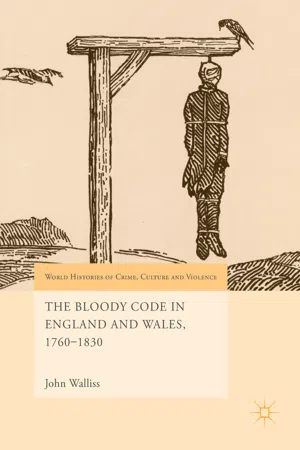
Between 1688 and 1820, the number of capital crimes in England and Wales increased exponentially from fifty to over 220. As one leading opponent of capital punishment, Sir
Samuel Romilly told the House of Commons in 1810, “there is probably no other country in the world in which so many and so great a variety of human actions are punishable with loss of life as in
England ”.
1 Males and females found themselves facing the gallows having being convicted of crimes ranging from murder, through burglary and housebreaking and horse, cattle and sheep theft to theft of goods over twelve pence. Males were hanged for rape as well as sodomy and buggery and, on occasions, for bestiality. Females were burned at the stake for murdering their husbands (the crime of petit treason) and hanged for falsely impersonating the wife of a seaman in order to claim his pension. Those who fled a sentence of transportation also ran the risk of a capital conviction, as did those who (in)famously had been in the company of gypsies for a month. The list of capital crimes that made up the Bloody Code, as it later came to be known, went on and on: arson, sending a threatening letter, destroying (or even removing without permission parts of) Westminster Bridge.
2 “Every page of our statute book smelt of blood”, wrote Charles Phillips almost half a century
after Romilly’s speech,
We hanged for everything — for a shilling — for five shillings — for forty shillings — for five pounds — for cutting down a sapling! We hanged for a sheep — for a horse— for cattle — for coining — for forgery — even for witchcraft — for things that were, and things that could not be. [Lord] Coke’s ‘cursed tree of the gallows,’ was planted, and prospered in every county throughout the land; and ‘Christian men and women’ swung on it, ‘thick as the leaves in Vallambrosa.’ 3
In practice however, the Bloody Code, as it subsequently came to be known, was significantly less brutal in practice than Phillips implied. While those convicted of murder more often than not expiated for their crime on the gallows, the majority of those convicted of lesser offences were often pardoned, receiving instead a sentence of transportation or even imprisonment. 4
To date, the majority of the scholarship on the Bloody Code has revolved around the debate between Marxist historians and others over the extent to which it operated as a tool of the ruling elite to protect property interests. In his 1975 essay “Property, authority and the criminal law”, Douglas Hay argued that the Bloody Code played a crucial ideological role during the period, by, on the one hand, legitimising the status quo and maintaining bonds of obedience and deference, and, on the other, protecting private property in the absence of a police force. According to Hay, this occurred through the interaction of three aspects of the law: the majesty of the law reinforced through the pomp and ceremony, rituals and regalia of the assizes; the abstract notion of justice wherein the law was represented as being objective of human relations and class interests; and, finally, the prerogative of mercy, which, by being represented as a form of benevolent grace, served to maintain the spirit of paternalism and deference central to ruling class power. 5
Eight years later, in his “Albion’s Fatal Flaws”, John Langbein presented a polemical response to Hay , dismissing the “ruling class conspiracy” that he claimed was at the heart of Hay’s thesis. The “little crooks” tried at the English assizes, Langbein averred, were not “class warriors”, and to see them as such “one must wear rose-coloured glasses of the deepest hue”. While accepting that those on trial were often poor, he argued that so too were the prosecutors; the courts, in other words, were not full of members of the propertied elite prosecuting the poor and marginal. Indeed, he argued, “the whole of the criminal justice system, especially the prosecutorial system, was designed to protect the people, overwhelmingly non-elite, who suffered from crime”. Langbein also argued that Hay underemphasized the role of jury discretion, particularly the way in which petty juries regularly returned partial verdicts, thus mitigating the severity of the law. More broadly, Langbein asserted that Hay’s thesis was ultimately non-falsifiable: the execution of a rich man “proved” the thesis as much as if he had been pardoned, while the execution or pardon of a poor man did the same in reverse. 6
In a more measured critique of Hay’s thesis, Peter King argued that the variety of actors within the criminal justice process, many of whom were not members of elite groups, undermined the potential that the law could have been used as the exclusive tool of elites. While accepting “that the law was ultimately controlled by a small gentry elite”, King nevertheless argued that the criminal law during this period was better conceptualized “as a multi-use right within which the various groups in eighteenth-century society conflicted with, cooperated with and gained concessions from each other”. Victims, for example, were central actors within the criminal justice process and had a variety of options open to them, such as whether or not to prosecute and what charges to pursue. They might also fail to prosecute the case or wilfully present their case poorly so as to engineer an acquittal. Finally, if their prosecution resulted in a capital conviction, they might then support a petition for a pardon. Similarly, petty juries could return partial verdicts, finding a person guilty of a lesser, non-capital offence (often in the face of obvious evidence of guilt). King also showed how the judicial decision over which felons left to hang expiated for their crimes on the gallows was influenced by a variety of factors—such as the youth of the offender, their previous conduct or whether or not an example needed to be made to deter others—rather than exclusively dominant class interests. 7
In addition, the historiography of the Bloody Code has also largely been focused on London and the southeast. John Beattie, Peter Linebaugh and Robert Shoemaker and Tim Hitchcock have all published monographs exploring the administration of justice in the capital during the era of the Bloody Code. 8 Similarly, Simon Devereaux has recently published two lengthy analyses of patterns of executions and pardons at the Old Bailey from the mid-eighteenth century until the decline of the Bloody Code in the late 1830s. 9 Devereaux’s work in turn extends upon and offers a critique of earlier work by V. A. C. Gatrell on patterns of capital convictions and executions at the Old Bailey between 1701 and 1840. 10 Moving from the capital to the Home Circuit, John Beattie has also published a monograph on the administration of justice in Surrey and Sussex between 1660 and 1800, while Peter King has written extensively on Essex (most notably his monograph, Crime, justice and discretion in England 1740–1820). 11 In addition to this, a large historiography has also developed focusing on the role played by various (typically London -based) elite actors in the reform movement and the eventual repeal of the Bloody Code in the 1830s and 1840s. 12
On one level, as Simon Devereaux has recently argued, this state of affairs is perfectly understandable. By the turn of the eighteenth century, London had become the most populous city in Europe and by 1815, with a population of over 1.4 million persons, in the world. As the central court for both the City of London and the county of Middlesex, during the height of the Bloody Code the Old Bailey possessed the largest criminal jurisdiction of any court in Europe. Between 1674 and 1837 almost 113,000 persons were tried in this one court, with an estimated 9474 being capitally convicted. London also executed more felons than any other city or region in the western world: an estimated 584 persons in just the years 1775 through 1786 (or almost one execution per week). It was this experience of large numbers of capital convictions and executions that informed both the views of elites and public debate on capital punishment during the period. 13 Another, more practical reason for the focus on the Old Bailey—and more broadly the Home Circuit—is that, in contrast to many provincial circuits, its records are remarkably well preserved. The Proceedings of the Old Bailey have also been digitized and are easily available alongside supporting primary sources on an attractive and accessible website. 14 This state of affairs has, nevertheless, resulted in a marked skew within the historiography towards the southeast, the metropolis and the Old Bailey.
In a recent article, however, Peter King and Richard Ward have drawn our attention to what they term the geography of the Bloody Code; that is the often stark differences between how the capital code was administered between the centre and the periphery. 15 Several other studies of the administration of justice across both English provinces and Welsh counties have highlighted how the Bloody Code was administered differently in these places than in the capital. While an average year during this period would have seen dozens of felons go to the gallows in the capital, in the provinces—and particularly in Wales—the gallows were utilized much more sparingly. 16 In their analysis of the administration of the Bloody Code across England and Wales between 1750 and 1775, King and Ward showed how the execution rate for property offenders per head of population decreased the further that one moved away from the capital. While the annual execution rate per 100,000 population for property offences was 2.01–3.85 in London and Middlesex, in Leicestershire it was 0.15–0.34, while in Westmorland, Durham and Northumberland and much of Wales it was 0.00–0.14. In describing this sta...