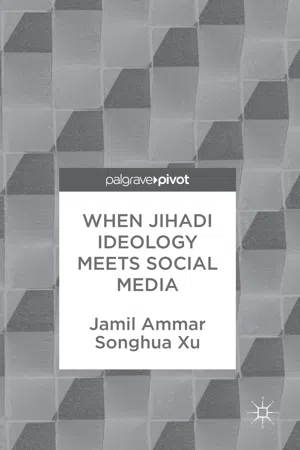
This book is designed to provide specialists, spectators, and students with a brief and engaging exploration of media usage by radical groups and the laws regulating these grey areas of Jihadi propaganda activities. The authors investigate the use of religion to advance political agendas and the legal challenges involved with balancing regulation with free speech rights. The project also examines the reasons behind the limited success of leading initiatives to curb the surge of online extreme speech, such as Google's "Redirect Method" or the U.S. State Department's campaign called "Think Again." The volume concludes by outlining a number of promising technical approaches that can potently empower tech companies to reduce religious extremist groups' presence and impact on social media.
- English
- ePUB (mobile friendly)
- Available on iOS & Android
eBook - ePub
When Jihadi Ideology Meets Social Media
About this book
Information
© The Author(s) 2018
Jamil Ammar and Songhua XuWhen Jihadi Ideology Meets Social Media https://doi.org/10.1007/978-3-319-60116-8_11. Who Speaks for Islam? Extreme Religious Groups, the Exception that Proves the Rule
Jamil Ammar1 and Songhua Xu2
(1)
Rutgers School of Law–Newark, Newark, NJ, USA
(2)
New Jersey Institute of Technology, Kearny, NJ, USA
Abstract
This chapter examines the streams of thought contributing to the emergence of the Jihadi Salafism. It highlights the scholarly works of key Salafi scholars who have shaped the ideology of the al-Salafiyya al-Jihadiyya movement as we know it. While the primary sources of Sharia law provide written codes explaining a number of issues capable of being brought before a court, this chapter discusses how the final interpretation of key issues is largely determined by the presiding cleric (sheikh). The scholarly work of those radical clerics effectively enables extremist groups to ideologically justify the use of violent means to achieve their “political” ambitions. Treatment of civilians is a notable example where radical scholars have effectively re-written their own ideologically based rules of war to justify atrocities against innocent population.
Keywords
Al-Salafiyya Al-JihadiyyaWahhabismSalafismSayyad QutbThe Islamic StateIbn TaymiyyahThis chapter lays the foundations for the discussion that follows. It provides a brief ideological background of religious extreme groups in general and the so-called Islamic State and its roots in particular. Special attention is paid to the philosophy of prominent controversial theologians and political figures whose teaching has so far significantly shaped the narrative of extreme groups as we know them. For years, those radical scholars have systemically and meticulously blended the political survival of jihadi groups with the survival of Islam itself. By doing so, a criticism of the action of an extreme group is intentionally mischaracterized as an attack on Islam as a “faith.”
Who speaks for Islam in terms of its relation with other ethnicities and Western countries is a question that so far has noticeably shaped the relationship between Muslims in the Middle East and the rest of the world. For the so-called Islamic State and like-minded groups, who decides who is a “true” believer and who is “not” is anything but trivial. It is about the political “survival of the fittest” among theologically driven organizations aim to re-examine and outright other subgroups. It is also about shoring up the base to ensure a steady stream of recruits. Put differently, speaking for Islam is a must have strategy without which few radical groups would survive, let alone prosper.
The difficulty of determining who truly speaks for Islam and Muslims lies in the fact that, unlike other monotheistic religions, Islam does not embrace a particular formal hierarchical religious structure. With the option of consulting specialists from all walks of life, the leader of an Islamic country or a group of people for that matter is both its political and religious leader and has the authority to adapt a particular interpretation of faith. For example, Turkey, Indonesia, and Saudi Arabia are all Muslim countries. Yet, in so many ways, they are world apart.
For religious extremist groups, the lack of a central unifying religious authority is a blessing in disguise. It enables them to maintain their own scholarly authorities. It also empowers them to boast about the legitimacy of their otherwise questioned code of conduct when waging wars against other groups. Abu Muhammad al-Adnani , the former official spokesman of the Islamic State highlighted this point. He stated, “if one wants to get to know the agenda of the State, its politics, and its fatwas, one ought to consult its leaders, its public statements, its own sources, rather than the sources of its enemies.” 1
For millennium, the question of who represents Islam has widened the division and fueled the tension between extremist groups and the Muslim and non-Muslim worlds at large. In particular, the lack of central authority has inadvertently empowered prominent controversial theologians and political figures not only to shape the narrative of extreme groups , but more importantly, to cement their theologian legitimacy and thus boost their popularity on social media and beyond. To understand how religious extreme groups have managed to win the loyalty of many followers, a very brief look at how Islamic jurisprudence functions would be helpful.
Most nations follow the common law or civil law legal traditions. To Western readers familiar with the terminology and process of those legal systems, the principles of Sharia law can be confusing. While Sharia law has written codes 2 that specify some matters capable of being brought before a court, the applicable procedure and, sometimes, the appropriate punishment for each offense is largely determined by the presiding cleric (sheikh). As a result, in the way he chooses to interpret the Quran or hadith, a cleric plays an enormous role in shaping Sharia law . Before the Internet era, the ideological impact of an extreme group and its scholars was limited to the geographical area it controls. This is not anymore the case. In the previous few years, evens have shown us that a fatwa issued by a radical cleric in the Middle East and posted on social media platforms could have ramifications in France, Germany, or the USA as opposed to Syria or Iraq.
To explain this point, we first start by briefly highlighting the sources of Islamic law and its hierarchy. The goal of this part is twofold: first, to identify the sources of Islamic Law that bind Sunni Muslims all over the world. Understanding the streams of thought contributing to the emergence of the Jihadi Salafism however is not possible by merely looking at the primary sources of Sharia law . The emergence of the al-Salafiyya al-Jihadiyya as we know it is credited to a number of contemporary Salafi scholars. The second goal of this discussion therefore is to examine the scholarly works of those clerics, in particular, a number of controversial principles and fatwas that have contributed to the rise of religious extremist groups. To this end, we briefly examine the work of four key scholars who have influenced and sometimes shaped the ideology of contemporary extreme groups .
There are four major sources of Islamic law. In descending order, these are the Quran, the Sunna, Ijma, and Qiyas. 3 If the legality of an issue was not addressed in the first source, then Muslim jurists consider the second source and so forth.
- The Qur’an is the oldest and most sacred text of Islam that was revealed to the Prophet Muhammad. Muslims believe the Quran to be the eternal and indisputable word of Allah and for this reason it is the most fundamental source of Islamic jurisprudence. If the Quran does not elaborate about a certain issue, it is permissible for Muslims to turn to the second source of Islamic law, namely, the Sunnah (customs and beliefs that make up a tradition). 4
- The Sunnah is the normative practices of the Prophet Muhammad including, but not limited to, his habits and practices for living the life of a decent Muslim and the hadiths; which are simply the sayings of the Prophet transmitted by his companions and others. Because hadith were transmitted orally, some disagreement arose about the words and deeds of the Prophet. Again, if the Sunnah of the Prophet does not provide guidance or a solution to a given issue, then Muslims are expected to turn to the third primary source of Islamic law, namely consensus or agreement—Ijma. 5
- Consensus is sought when it is not possible to find a specific legal ruling in the Quran or Sunnah. In this case, the Ijma of the legal scholars within the community as to how to solve the issue in concern is preferred. The principle of Ijma is spiritly debated. Whose opinions are relevant for Ijma is a question that is still relevant to most ideologically driven groups....
Table of contents
- Cover
- Frontmatter
- 1. Who Speaks for Islam? Extreme Religious Groups, the Exception that Proves the Rule
- 2. The Rise of Religious Extremism in the Middle East: A Triptych View?
- 3. Extreme Groups and the Militarization of Social Media
- 4. Extreme Groups Propaganda War Under a Free Speech Lens: The Unwinnable Battle
- 5. Technology to the Rescue: A Software-Based Approach to Tackle Extreme Speech
- Backmatter
Trusted by 375,005 students
Access to over 1.5 million titles for a fair monthly price.
Study more efficiently using our study tools.
Frequently asked questions
Yes, you can cancel anytime from the Subscription tab in your account settings on the Perlego website. Your subscription will stay active until the end of your current billing period. Learn how to cancel your subscription
No, books cannot be downloaded as external files, such as PDFs, for use outside of Perlego. However, you can download books within the Perlego app for offline reading on mobile or tablet. Learn how to download books offline
Perlego offers two plans: Essential and Complete
- Essential is ideal for learners and professionals who enjoy exploring a wide range of subjects. Access the Essential Library with 800,000+ trusted titles and best-sellers across business, personal growth, and the humanities. Includes unlimited reading time and Standard Read Aloud voice.
- Complete: Perfect for advanced learners and researchers needing full, unrestricted access. Unlock 1.5M+ books across hundreds of subjects, including academic and specialized titles. The Complete Plan also includes advanced features like Premium Read Aloud and Research Assistant.
We are an online textbook subscription service, where you can get access to an entire online library for less than the price of a single book per month. With over 1.5 million books across 990+ topics, we’ve got you covered! Learn about our mission
Look out for the read-aloud symbol on your next book to see if you can listen to it. The read-aloud tool reads text aloud for you, highlighting the text as it is being read. You can pause it, speed it up and slow it down. Learn more about Read Aloud
Yes! You can use the Perlego app on both iOS and Android devices to read anytime, anywhere — even offline. Perfect for commutes or when you’re on the go.
Please note we cannot support devices running on iOS 13 and Android 7 or earlier. Learn more about using the app
Please note we cannot support devices running on iOS 13 and Android 7 or earlier. Learn more about using the app
Yes, you can access When Jihadi Ideology Meets Social Media by Jamil Ammar,Songhua Xu in PDF and/or ePUB format, as well as other popular books in Politique et relations internationales & Politique du Moyen-Orient. We have over 1.5 million books available in our catalogue for you to explore.