Belonging to Hebrew Wisdom literature, the Song of Songs offers a fresh look at love and relationships through its main female character, the Shulamite, which profoundly differs from traditional religious approaches to love and sexuality. Drawing from exegetical as well as philosophical sources, Abi Doukhan follows the Shulamite's journey away from patriarchy to her own self-individuation as she discovers a wisdom of love that is deeply personal and feminine.
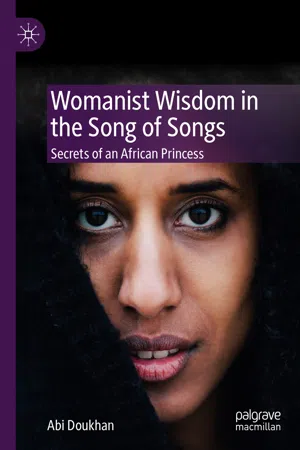
- English
- ePUB (mobile friendly)
- Available on iOS & Android
eBook - ePub
About this book
Information
Topic
Theology & ReligionSubtopic
Christian Theology© The Author(s) 2019
A. DoukhanWomanist Wisdom in the Song of Songshttps://doi.org/10.1007/978-3-030-30052-4_8Is God a Woman?
Abi Doukhan1
(1)
Queens College, CUNY, Flushing, NY, USA
Abi Doukhan
A reflection on the Song of Songs would not be complete if it did not address the traditional mystical reading of the text.1 And although the approach of this chapter has been to read the text on a strictly horizontal level as the stage of a human love shared between a man and a woman, there is, I believe, a dimension of depth to the Song that has been noted by both rabbinic and ecclesiastic commentaries alike. There is a deeper layer in our Song which reveals an even more profound wisdom, a deeper secret, than the one we have been excavating so far. This secret has to do with our text being read as an allegory for the shocking, unheard of, preposterous love story between God and humanity. Read in this light, our text would lift the veil on a romance that has for the most part remained hidden and undisclosed in the pages of human history. A love that dare not come to the light of day, that prefers the intimacy of poetry whispered between kisses to the official recordings of historians.
Such is the secret love that the traditional allegorical interpretation has tried to systematically unveil in our Song and this in both the Jewish and Christian traditions of interpretation. Thus, according to the allegorical interpretation, God is played by the man in our story and humanity is represented by the woman. This interpretation is in turn confirmed by the Hebrew Bible itself where God is oft depicted as a bridegroom and Israel as his bride.2 Thus, deep beneath the twists and turns of this love story, one might then read the deeper drama of the love between God and humanity. As such, the woman represents the pining of humanity for God and the man represents the God who is finally conquered by the unrelenting faith and worship of his creation. The erotic encounters between the lovers must then be re-interpreted as those between God and his people, giving rise to new and fecund new interpretations of the way that God relates to humans.3
As such, the Song anticipates the experiences of the great mystics in both traditions, who, in fact, often refer back to our text in order to make sense of their own search for God.4 Again, it is interesting to note that in most cases, if not all, the mystic is described much like that of the woman in our Song: As one engaged on a long, painful quest for her beloved; in this case, the divine presence which, after a long dark night of the soul, manifests itself fully and in all of its light. Moreover, the stance of the mystics is often described as a feminine stance of receptivity and openness to divine light, again strengthening the case that God is male and that the faithful believer is female. As such, it is no wonder that our Song, with its predominant feminine character, has become one of the main references in the works of the mystics, again in both Jewish and Christian traditions.
This is not, however, the line of interpretation that I wish to adopt here in this mystical reading of our text. Our Song is, in my view, way too subversive in character to bend to this kind of patriarchal reading. On the contrary, I would suggest that a number of clues in our text point to a reading of the Song in which it is the woman who represents God and the man who represents humanity.5
The first clue that in the divine romance the woman plays a central role,6 and as such, perhaps a divine role, is the centrality given to the woman in our text. The woman is in control of the relationship from beginning to end, she is the alpha and omega of our Song. The text opens and concludes with her words whereby she lures the man to herself: “Kiss me with the kisses of your mouth,” and whereby she releases him at the end of the Song: “Come away my lover, be like a gazelle” (Song 8:14).7 As such, she resembles the God of Israel much more than the man who is given a rather secondary role in our text. Moreover, the woman is given a central role in arousing the man and not vice versa: “Under the apple tree I roused you; there your mother conceived you” (Song 8:5). In this passage, the man is not only roused by the woman, he is birthed by her. Both roles however are divine roles: God birthing humanity in an act of creation and then arousing it to love him.
The second clue which, in my view, points to the woman playing the divine part is the passion that animates her. She is clearly the more emotional one, constantly pining, suffering, longing for her beloved. The Song climaxes in the end with her passionate plea for a love as strong as death, which no waters can conquer. As such, however, she again resembles the God of Israel in a more profound way than the man who seems rather dispassionate throughout the Song. A glimpse at the poetic rants of the prophets reveal striking similarities between the woman and a God himself always pining, suffering, longing after an elusive, dispassionate people: “My people … have forsaken me,”8 “have I been a desert to Israel … why do my people say ‘we are free to roam,’”9 “I am now going to allure her; I will lead her into the desert and speak tenderly to her.”10 The God here depicted by the prophets of Israel is much closer in character to the passionate woman of our Song, who is “sick with love” than to the man.
This line of interpretation of God as woman puts me at odds however with more traditional lines of interpretation. But I believe that this inversion of the roles—God as woman and the human race as male—is in line with the Song of Song’s general impulse. We have seen how our Song calls for a re-evaluation and re-imagining of traditional roles and patterns. Its reversal of the male and female roles—the woman playing a more active role and the male a more passive one—opens a whole new era of interpretation, opens up a scope of new possibilities, of new dynamics of interactions between men and women. Why not prolong this line of thought where traditional roles are reversed to dare attempt a reversal of traditional metaphors for God too? Perhaps renewed understandings of God and of his love for us might be disclosed were we to venture on this new ground.
To think of God as woman, and especially of God as embodied by the woman in our Song, paints a totally new picture of God than the one we are used to. As such, a healthy iconoclasm might result from this in which rigid definitions of God might be shattered for fresh new insights on his nature and on his love for us. We are so used to thinking of God as a male warrior figure ever ready to fight our battles and redeem us from evil, that the idea of him being embodied by an African Princess in love seems unthinkable, even blasphemous. But why is that? The Hebrew Bible contains as many feminine metaphors as masculine ones for our exploration, notably in the prophetic works. There, God can be seen depicted as a mother feeding her infant,11 as a woman giving birth,12 as a mother comforting her child.13 To depict God as woman is as such not so far-fetched.
To depict God as an African princess, however, is a rather extraordinary turn of events! This is not a metaphor that anyone could have anticipated from reading the Hebrew Bible. And yet, our Song seems to draw the curtain on this yet undisclosed face of God. I personally rather like the idea. Have we not for far too long imprisoned God in the persona of an imperialistic and authoritarian dictator that is controlling, judgmental, superior and detached? But “God is not a Christian” judiciously affirms Desmond Tutu. “Indeed he isn’t!” would agree our Song. God is a woman in love, and an emotional woman at that! And as such, a completely different portrait of God emerges: A God who loves passionately, even recklessly without a thought for the “shoulds” and “should nots” of society. But likewise, a portrait emerges of a God who is shy, who does not want to overstep his boundaries, who understands, like the Shulamite, that patience is needed in order for his beloved to grow fond of him.14 And so, just like the Shulamite, God has two ways of approaching his beloved: Reckless abandon and discrete reserve. The exploration of these two responses to love will, in turn, draw up the portrait of a profoundly feminine God. We turn then to the first one of these: The reckless abandon of God.
The first thing that one notices about the Shulamite is her lack of prudence. She is pictured in the beginning of the text as one who has neglected her “vineyard” (Song 1:6), making her brothers angry with her. We have seen how the vineyard represents here the woman’s sexuality. To neglect the vineyard thus clearly implies that the Shulamite has not kept herself “pure,” she has not guarded her sexuality. As such, the brothers—whose job is to protect their sister’s sexual purity—are angry with her. She has not only dishonored herself but as such, she has dishonored them. That is why they are angry rather than merely concerned and pained. The woman that we encounter in the first pages of our Song is someone who clearly has no thought to her own purity, to her own honor. She does not “keep” herself, guard or protect herself as she is supposed to. Likewise, she does not wait for the man to take the initiative in the traditional way of modesty. Rather, she brazenly initiates the relationship with the shocking words: “Kiss me with the kisses of your mouth” (Song 1:1). Rather than prayerfully waiting for the man to initiate romance, the woman takes matters in her own hands and plunges, without a thought to the risks involved, into a relationship with him.
As such, she shatters all religious stereotypes as to how a God-fearing woman should act. She evades any ideal that religion might want to project upon her. She does not keep herself as required of her, she lacks modesty and discretion and she openly expresses her passion in a way that is uncharacteristic of Biblical feminine characters. And yet, here she is in the Bible. And if we were to believe Rabbi Akiba, in the holiest part of the Bible! As though we might also learn something from her, something in fact of utmost importance. As though something might be discovered here about love in its primal and wild form, before it finds itself harnessed and contained by conventions and social constructs. As such, the Shulamite’s love, although inappropriate and unconventional, does not constitute a degraded form of love, but rather must be seen as a revelation of love in its original state, in all of its wildness, before human fallenness, when all things were still new. Phyllis Trible makes precisely this observation when she defines the Song of Songs as a return to Ed...
Table of contents
- Cover
- Front Matter
- Introduction: The Unconventional Feminine
- Virginity Re-imagined
- The Art of Seduction
- A Room of Her Own
- Infidelity’s Dark Night
- Secrets of Lovemaking
- The Crucible of Grace
- Is God a Woman?
- Back Matter
Trusted by 375,005 students
Access to over 1.5 million titles for a fair monthly price.
Study more efficiently using our study tools.
Frequently asked questions
Yes, you can cancel anytime from the Subscription tab in your account settings on the Perlego website. Your subscription will stay active until the end of your current billing period. Learn how to cancel your subscription
No, books cannot be downloaded as external files, such as PDFs, for use outside of Perlego. However, you can download books within the Perlego app for offline reading on mobile or tablet. Learn how to download books offline
Perlego offers two plans: Essential and Complete
- Essential is ideal for learners and professionals who enjoy exploring a wide range of subjects. Access the Essential Library with 800,000+ trusted titles and best-sellers across business, personal growth, and the humanities. Includes unlimited reading time and Standard Read Aloud voice.
- Complete: Perfect for advanced learners and researchers needing full, unrestricted access. Unlock 1.5M+ books across hundreds of subjects, including academic and specialized titles. The Complete Plan also includes advanced features like Premium Read Aloud and Research Assistant.
We are an online textbook subscription service, where you can get access to an entire online library for less than the price of a single book per month. With over 1.5 million books across 990+ topics, we’ve got you covered! Learn about our mission
Look out for the read-aloud symbol on your next book to see if you can listen to it. The read-aloud tool reads text aloud for you, highlighting the text as it is being read. You can pause it, speed it up and slow it down. Learn more about Read Aloud
Yes! You can use the Perlego app on both iOS and Android devices to read anytime, anywhere — even offline. Perfect for commutes or when you’re on the go.
Please note we cannot support devices running on iOS 13 and Android 7 or earlier. Learn more about using the app
Please note we cannot support devices running on iOS 13 and Android 7 or earlier. Learn more about using the app
Yes, you can access Womanist Wisdom in the Song of Songs by Abi Doukhan in PDF and/or ePUB format, as well as other popular books in Theology & Religion & Christian Theology. We have over 1.5 million books available in our catalogue for you to explore.