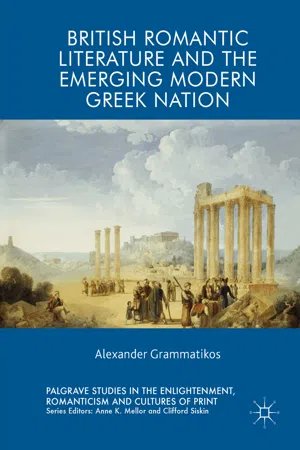
British Romantic Literature and the Emerging Modern Greek Nation makes an original contribution to the field of British Romantic Hellenism (and Romanticism more broadly) by emphasizing the diversity of Romantic-era writers' attitudes towards, and portrayals of, Modern Greece. Whereas, traditionally, studies of British Romantic Hellenism have predominantly focused on Europe's preoccupation with an idealized Ancient Greece, this study emphasizes the nuanced and complex nature of British Romantic writers' engagements with Modern Greece. Specifically, the book emphasizes the ways that early nineteenth-century British literature about contemporary Greece helped to strengthen British-Greek intercultural relations and, ultimately, to situate Greece within a European sphere of influence.
- English
- ePUB (mobile friendly)
- Available on iOS & Android
eBook - ePub
British Romantic Literature and the Emerging Modern Greek Nation
About this book
Information
© The Author(s) 2018
Alexander GrammatikosBritish Romantic Literature and the Emerging Modern Greek NationPalgrave Studies in the Enlightenment, Romanticism and Cultures of Printhttps://doi.org/10.1007/978-3-319-90440-5_11. Introduction
Alexander Grammatikos1
(1)
Langara College, Vancouver, BC, Canada
Discovering Modern Greece
British Romantic Hellenism boasts a long and rich critical tradition that includes a range of scholarship examining late eighteenth- and early nineteenth-century Britain’s multiple preoccupations with Greece, including the country’s (often idealized) ancient past and the Modern Greeks’ war of independence against the Ottoman Empire . 1 This book contributes to the field of British Romantic Hellenism (and Romanticism more broadly) by emphasizing the diversity and complexity of the Romantic-era writers’ attitudes toward, and portrayals of, Modern Greece, especially the ways that early nineteenth-century British literature about contemporary Greece helped to strengthen British–Greek intercultural relations and, ultimately, to situate Greece within a European sphere of influence. British Romantic Literature and the Emerging Modern Greek Nation primarily focuses on fictional works because, as I demonstrate, Romantic literature, more than any other network of discourses of the early nineteenth century, intervened in debates about Modern Greece not merely by documenting facts but by creating realities, portraying imagined Greek–British encounters that encouraged readers to envisage new social, political, geographical, and cultural vistas and alliances for both Greece and Britain.
The literature I discuss in this book is concerned not only with understanding and depicting Modern Greece for a British audience but, significantly, with reconfiguring and reconceptualizing Britain and Greece’s past, present, and future relations. Moreover, this book is attuned to the ways in which generic and formal experimentations in British literary works inform discussions and debates about Modern Greece. As Tilottama Rajan and Julia M. Wright emphasize in the Introduction to Romanticism, History, and the Possibilities of Genre, British Romantic writers and readers understood that genres had specific historical and cultural specificities and “ideological investments,” but that these specificities and investments were also “capable of modification” (2). “Rather than attributing fixed social or political identities to genres,” write Rajan and Wright, “we might therefore think of them as forms with a ‘sedimented content’ and history” (5). The writers I examine in British Romantic Literature and the Emerging Modern Greek Nation were aware of how genre and form were culturally and historically codified, as well as how generic and formal experimentation could foster and reinvigorate discussions about Modern Greece.
The Romantic era represented a turning point in both Modern Greek and British histories. Greece in the late eighteenth century, although still an Ottoman territory, was becoming politically, socially, economically, and culturally more prosperous. Greek merchants controlled “a considerable portion of the [Ottoman] [E]mpire’s internal and external trade” (Mouzelis 93), Greek writers published numerous fictional and non-fictional works, Greek educators established schools in main economic and cultural centers, Greek clerks in the Ottoman imperial administration began to obtain prestigious governmental positions, and Greek intellectuals attended universities throughout Europe. 2 Greece’s growing stability and affluence, in turn, encouraged Greeks to seek liberation from their Ottoman rulers and, although the Greeks’ first two attempts at independence in 1770 and 1788 ended in failure, these unsuccessful uprisings set the precedent for the 1821 Greek War of Independence that witnessed Greece in 1832 become, with substantial European support, a sovereign nation state. 3
While late eighteenth and early nineteenth-century Greeks were experiencing political, cultural, literary, and economic developments which witnessed them become more closely acquainted with the Western world and which encouraged them to seek national liberation, Britain too was undergoing dramatic political and social transformations that influenced its international relations with Greece. For a decade and a half of the Romantic era, Britain was embroiled in war with Napoleonic France , a rivalry that concluded with Britain becoming a dominant power in Europe after 1815, the year in which the British army, led by the Duke of Wellington, defeated the French at the Battle of Waterloo . 4 In 1815, Britain, Austria, Prussia, and Russia established the Concert of Europe (France later joined) at the Congress of Vienna , a federation designed to prevent further warring amongst European countries and which allowed Britain to continue to develop as an imperial power and increase its presence in the political affairs of other countries, including Greece. 5 Perhaps unsurprisingly, the 1815 Congress of Vienna, where the Concert of Europe was established, also marked the beginning of Britain’s colonial rule over the majority Greek-inhabited Ionian Islands , as Europe’s great powers agreed to make the islands a British “protectorate.” 6 The Ionian Islands ’ cession to British rule provides just one example of the ways that British and Greek geopolitical and sociocultural spheres and destinies became intertwined during the Romantic period, particularly following the conclusion of the Napoleonic Wars .
Greece’s desire for liberation from the Ottoman Empire and Britain’s expanding global power are both developments that, in turn, are related to an ideology that became increasingly popular in early nineteenth-century Europe: Romantic Nationalism . According to Joep Leerssen:
Romanticism and nationalism, each with their separate, far-flung root-systems and ramifications, engage in a tight mutual entanglement and Wahlverwandschaft in early-nineteenth-century Europe; and this entanglement constitutes a specific historical singularity. We can give this singularity a name: Romantic nationalism. And we may understand that to mean something like: the celebration of the nation (defined in its language, history, and cultural character) as an inspiring ideal for artistic expression; and the instrumentalization of that expression in political consciousness-raising. (28)
During the late eighteenth and early nineteenth centuries, European thinkers and writers began to define the “nation” as being comprised of people who share the same language, history, traditions and customs, religion, geography, and institutions, and who, importantly, have the right to independent political existence. 7 As scholars of nationalism like Eric Hobsbawm, Terence Ranger, and Benedict Anderson argue, today’s forms of Western nationalism and national identity, which have their roots in the liberation movements of the eighteenth and nineteenth centuries, developed from a shared sense of a mutual ethnic identity and a common cultural past. 8
Significantly for my own study, ideas about Romantic Nationalism were both developed by, and influential upon, eighteenth- and nineteenth-century British writers, as scholars like Anne Frey, Francesco Crocco, and Katie Trumpener emphasize in their monographs about the effects of nationalism on cultural production. 9 In Bardic Nationalism, Trumpener observes that in the British peripheries, “[n]ationalist consciousness began with the recognition of imperial occupation and with the attempt to grasp its economic, political, and cultural consequences, from the appropriation of land and the loss of self-government to the alienation of cultural inheritance” (26). As Trumpener argues throughout her study, discussions about the national in eighteenth- and nineteenth-century British literature are inextricably linked to those about the imperial. By the Romantic period, British authors writing about the national were undoubtedly conscious that they were also writing about the imperial (whether they were doing so in opposition to, or in support of, it), a point that informs my own focus on British Romantic writers’ reflections about Greek liberation and national identity. Specifically, I propose that when British writers contemplated Greek liberation and nationalism—as all the authors I discuss in this book do—they did so with an understanding of past nationalist movements in Europe (including the French, Spanish, and Italian revolutions ), as well as Britain’s cultural and geopolitical influences in Ottoman Greece, influences which each author interprets differently depending upon their national, cultural, and personal positions and beliefs. The ways in which early nineteenth-century British literature contributed to the “making” of Modern Greece begot by Romantic Nationalism , then, is a process wherein Romantic-era authors had to negotiate their personal, cultural, political, national, and ideological loyalties in writing about Greece, and one that often resulted in conflicting beliefs about, and representations of, Ottoman Greece and its people.
As I argue in this book, British Romantic writers’ representations of cross-cultural relations between Greeks and Britons gesture toward their growing sense of, and concern with, Britain’s international conduct and reputation, especially after 1815 when Britain was transforming into a dominant imperial power. 10 The writers I examine use Modern Greece and Hellenism to interrogate and understand their country’s role not only within Greece, but also within a transnational, global world, the geopolitical dynamics of which were in flux. Significantly, Romantic writers recognized that the European political domain—and, as is relevant to my study, the sociopolitical spheres of Britain and Greece—remained unstable and thus open to modifications. Europe’s unsettledness (politically, but also as a cultural construct) allowed Romantic authors to use their works to endorse a range of personal and political positions concerning the development of Greek–British relations. If the Romantic period represents an era in which a conservative, anti-revolutionary Britain grows into its role as the world’s preeminent imperial power, it is also a time during which liberalism and cosmopolitanism flourish and I argue that the tensions between conservative and liberal politics were productive in shaping ideas about Greece. True, the Tory British Government may not have initially supported Greek independence, but their official position only encouraged British liberals—who had before the Greek revolution supported causes like the Spanish and Italian revolutions and rallied for democratic rights, the culmination of which in England is perhaps the 1832 Representation of the People Act —to act and write on behalf of the Greeks. 11 In discussing Greek–British Romantic-era intercultural relations, my study focuses on the wide range of private and public political positions available to British Romantic writers and emphasizes that the Greek War of Independence and Greece’s subsequent liberation were not isolated national events, but instead the outcome of the political, cultural, and literary debates and discourses taking place for at least half a century in Europe and Greece.
This book, which examines the ways in which late eighteenth- and early nineteenth-century British writers conceptualized Modern Greece and its people and how these literary engagements with Greece produced, ratified, and complicated Britain’s ...
Table of contents
- Cover
- Front Matter
- 1. Introduction
- 2. Caught Between East and West: Negotiating Modern Greek Identity in Ida of Athens and Anastasius
- 3. “It Never Entered into My Head That You Were Going to Annex Any Romaic Specimens to Your Poem”: Lord Byron , John Cam Hobhouse , and the Politicization of Greek Language, Literature, and Learning
- 4. There’s No Place Like Homeland: Victimized Greek Women, the Greek War of Independence , and the Limits of European Philhellenism
- 5. All Roads Lead to Constantinople: Re-historicizing Greek–British Relations in The Travellers and The Last Man
- 6. Conclusion
- Back Matter
Trusted by 375,005 students
Access to over 1.5 million titles for a fair monthly price.
Study more efficiently using our study tools.
Frequently asked questions
Yes, you can cancel anytime from the Subscription tab in your account settings on the Perlego website. Your subscription will stay active until the end of your current billing period. Learn how to cancel your subscription
No, books cannot be downloaded as external files, such as PDFs, for use outside of Perlego. However, you can download books within the Perlego app for offline reading on mobile or tablet. Learn how to download books offline
Perlego offers two plans: Essential and Complete
- Essential is ideal for learners and professionals who enjoy exploring a wide range of subjects. Access the Essential Library with 800,000+ trusted titles and best-sellers across business, personal growth, and the humanities. Includes unlimited reading time and Standard Read Aloud voice.
- Complete: Perfect for advanced learners and researchers needing full, unrestricted access. Unlock 1.5M+ books across hundreds of subjects, including academic and specialized titles. The Complete Plan also includes advanced features like Premium Read Aloud and Research Assistant.
We are an online textbook subscription service, where you can get access to an entire online library for less than the price of a single book per month. With over 1.5 million books across 990+ topics, we’ve got you covered! Learn about our mission
Look out for the read-aloud symbol on your next book to see if you can listen to it. The read-aloud tool reads text aloud for you, highlighting the text as it is being read. You can pause it, speed it up and slow it down. Learn more about Read Aloud
Yes! You can use the Perlego app on both iOS and Android devices to read anytime, anywhere — even offline. Perfect for commutes or when you’re on the go.
Please note we cannot support devices running on iOS 13 and Android 7 or earlier. Learn more about using the app
Please note we cannot support devices running on iOS 13 and Android 7 or earlier. Learn more about using the app
Yes, you can access British Romantic Literature and the Emerging Modern Greek Nation by Alexander Grammatikos in PDF and/or ePUB format, as well as other popular books in Literature & Literature General. We have over 1.5 million books available in our catalogue for you to explore.