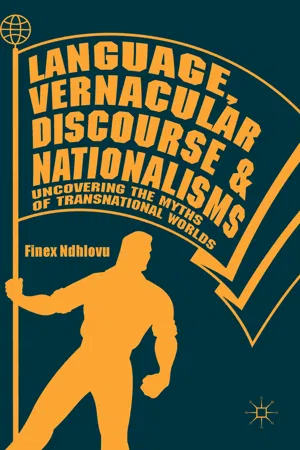
This book examines the linguistic and discursive elements of social and economic policies and national political leader statements to read new meanings into debates on border protection, national sovereignty, immigration, economic indigenisation, land reform and black economic empowerment. It adds a fresh angle to the debate on nationalisms and transnationalism by pushing forward a more applied agenda to establish a clear and empirically-based illustration of the contradictions in current policy frameworks around the world and the debates they invite. The author's novel vernacular discourse approach contributes new points of method and interpretation that will advance scholarly conversations on nationalisms, transnationalism and other forms of identity imaginings in a transient world.
eBook - ePub
Language, Vernacular Discourse and Nationalisms
Uncovering the Myths of Transnational Worlds
- English
- ePUB (mobile friendly)
- Available on iOS & Android
eBook - ePub
Language, Vernacular Discourse and Nationalisms
Uncovering the Myths of Transnational Worlds
About this book
Information
© The Author(s) 2018
Finex NdhlovuLanguage, Vernacular Discourse and Nationalismshttps://doi.org/10.1007/978-3-319-76135-0_11. Introduction—Theories, Concepts, Debates
Finex Ndhlovu1
(1)
Linguistics, University of New England, Armidale, NSW, Australia
Previous Theorisations
This Book
Organisation
References
The things that we supposedly know so foundationally about national identities, national borders , citizenship , parameters of belonging and entitlement to social and economic benefits of the welfare state, transnationalism and associated meta-languages are not as straightforward as they seem to be. We are told and believe that the world has become more and more transnational and interconnected than ever before. We are also told that societies have become superdiverse —that supposedly unprecedented and unpredictable form of diversity that is perceived to be an outflow of contemporary trends in migration where people are moving from many places, to many places, through many places (Vertovec 2007). But in the midst of all this are deep-seated sentiments—loud and muted, formal and informal—for narrow, parochial, inward-looking, autochthonous and nation-state -centric narratives and imaginings of identity and belonging . How do we explain the tensions and contradictions that emerge out of this situation? Language, Vernacular Discourse and Nationalisms seeks to address this and many other related questions. It examines linguistic and discursive elements of social and economic policies and national political leader statements as an entry point in reading new meanings into current topical debates on border protection, national sovereignty , immigration, economic indigenisation, land reform and black economic empowerment . The book is a critique of resurgent nationalism -speak that mediates social and economic policy debates in a world that is otherwise considered to be transnational and interconnected. It tells the story of tensions and contradictions between formal policy enunciations on transnationalism on the one hand and vernacular expressions of the same on the other, as they are articulated at the level of the nation-state . The book adopts the novel yet rarely used vernacular discourse approach to contribute new points of method and interpretation that help us see what we couldn’t—or wouldn’t—see before in scholarly conversations on nationalisms, transnationalism and other forms of identity imaginings in a transient world. The framework of vernacular discourse is leveraged to unpack and understand political communication in the reproduction of political power , or domination through political discourse , including the various forms of resistance or counter-power against such forms of discursive dominance. In particular, the analysis deals with the discursive conditions and consequences of social and political inequality that result from the strategic use of language by political elites, bureaucrats and other political actors, both state and non-state. Case studies include Australia , South Africa and Zimbabwe , with some passing remarks on other comparable countries around the world.
Since the signing of the Treaty of Westphalia in 1648 to end the thirty-year war among major European continental states—Holy Roman Empire, Spain, France, Sweden and the Dutch Republic—the modern world system has largely been a world of sovereign nation-states. The nation-state remains as the most enduring instrument of social and political closure. In the midst of other emerging units of analysis that are much bigger and broader, such as regionalism, globalisation and transnationalism , the nation-state appears to have mutated and taken new forms that are different from what obtained during the golden age of nationalism (1950s–1960s). During the golden age of nationalism , recognition of autonomous nation-states was a major rallying point for anti-colonial nationalist liberation movements in Africa , Asia and other regions of the Global South . The nationalist movements were pushing for political independence and self-determination in those territories that were still under European colonial occupation. However, while the nation-state could have been rightfully typified as a container in the 1950s–1960s, its present-day iteration sits rather uneasily within a world system that is now largely governed by the dictates of greater social, political, economic and cultural cooperation that are somewhat transnational in outlook. The nation-state is now under immense pressure both from below and from above. From below, the hegemony of the nation-state is being challenged by the increasing discontent and dissention of minority groups while forces of globalisation and transnational human population movements constitute a potent threat from above. It suffices to say notwithstanding these challenges posed by both local and translocal developments that are tied to forces of transnationalism and globalisation , the political significance of the nation-state seems to still remain relevant—but with its borders reconfigured, taking at least the following three forms.
First, nation-states retain clearly delineated physical borders that demarcate parameters of territorial rule, sovereignty, monopoly on the use of force and ‘collectivisation of social risks by means of a state-sponsored welfare system’ (Mau 2012: 7). This iteration of the nation-state does not depart that much from the foundational characteristic of the nation as ‘container’. The second mutation of the contemporary nation-state is one that relies heavily on citizenship as an instrument of social closure. This is not about whether one resides within or without the clearly demarcated physical borders of the nation-state . Rather, it has more to do with what Halfmann (1998, cited in Mau 2012: 8) calls the ‘civil inclusionary exclusivity’ acquired by the nation-state . This is about how the nation-state is still able to control the inclusion —and by extension, the exclusion —of people in various functional systems. Regardless of their close connection to the geographical space known as the nation-state , diverse groups of people can be treated differently according to whether they are citizens or not. In this context ‘special rules [may] apply to those persons not citizens of the state in which they live, rules that regulate the length and status of residence as well as the rights associated with their residence’ (Mau 2012: 8).
Third, the nation-state remains in symbolic and performative terms that reflect what some scholars have described as ‘vanishing borders’ and ‘borderless’ or ‘seamless’ worlds (French 2000; Krugman and Venables 1995; Ohmae 1990). In other words, the prime markers of belonging to a particular nation-state now have less to do with the physically bounded container territory and more to do with the symbolic—the national identity documents we carry, the national cuisine that we believe defines us, the national dress code that we associate with, the national day(s) we celebrate and so on. This is about nationalisms of the mind whereby the idea of belonging to a particular nation-state thrives in the hearts and minds of individuals and groups alike—regardless of where those groups and individuals reside physically. Their loyalties and allegiances are to the nation-state inscribed in their minds, and the way they are treated by the governing authorities of other nation-states is largely determined by the travel and identity documents they carry. So, in the era in which ‘more people are now moving from more places, through more places, to more places’ (Vertovec 2010: 86), the nation-state has assumed a different kind of a container—one where temporalities of closure, inclusion and exclusion coexist within highly mobile individuals. In other words, though we may not necessarily be physically located in the nation-states of our citizenship or nationality , those nation-states still play a significant role in how we live our lives because we carry them wherever we go. Thus, in its decentralised form, the nation-state ‘crosses nation-state boundaries, penetrates and is realised in the daily activities of people’ (Albrow 1996: 172).
What is of greater significance here is that in all three reconfigurations, nation-states still retain a double process of closure. That is, nation-states continue to be characterised by closure of the geographic space through border controls and closure of the social and political space for membership through the control of nationality , citizenship and access to social security and other protections by the state. These two forms of closure are mutually constitutive: on the one hand, controls of human population movements into and from a nation-state serve as an external casing that regulates access to territories. On the other hand, this casing is embedded with the space of social and political membership through which access to welfare services is managed (Mau 2012). This essentially means the boundaries of the nation-state have not yet disappeared and are most likely not going to disappear any time soon. Today, the boundaries of the nation-state are ubiquitous, temporal and continue to be drawn everywhere. They are no longer only physical, but are also largely symbolic, performative...
Table of contents
- Cover
- Front Matter
- Part I. Setting the Scene
- Part II. Language, Vernacular Discourse, Narrow Nationalisms
- Part III. Citizenship, Indigeneity, Economic Empowerment
- Part IV. Migration, Borders, Exclusion
- Part V. Conclusion
- Back Matter
Trusted by 375,005 students
Access to over 1.5 million titles for a fair monthly price.
Study more efficiently using our study tools.
Frequently asked questions
Yes, you can cancel anytime from the Subscription tab in your account settings on the Perlego website. Your subscription will stay active until the end of your current billing period. Learn how to cancel your subscription
No, books cannot be downloaded as external files, such as PDFs, for use outside of Perlego. However, you can download books within the Perlego app for offline reading on mobile or tablet. Learn how to download books offline
Perlego offers two plans: Essential and Complete
- Essential is ideal for learners and professionals who enjoy exploring a wide range of subjects. Access the Essential Library with 800,000+ trusted titles and best-sellers across business, personal growth, and the humanities. Includes unlimited reading time and Standard Read Aloud voice.
- Complete: Perfect for advanced learners and researchers needing full, unrestricted access. Unlock 1.5M+ books across hundreds of subjects, including academic and specialized titles. The Complete Plan also includes advanced features like Premium Read Aloud and Research Assistant.
We are an online textbook subscription service, where you can get access to an entire online library for less than the price of a single book per month. With over 1.5 million books across 990+ topics, we’ve got you covered! Learn about our mission
Look out for the read-aloud symbol on your next book to see if you can listen to it. The read-aloud tool reads text aloud for you, highlighting the text as it is being read. You can pause it, speed it up and slow it down. Learn more about Read Aloud
Yes! You can use the Perlego app on both iOS and Android devices to read anytime, anywhere — even offline. Perfect for commutes or when you’re on the go.
Please note we cannot support devices running on iOS 13 and Android 7 or earlier. Learn more about using the app
Please note we cannot support devices running on iOS 13 and Android 7 or earlier. Learn more about using the app
Yes, you can access Language, Vernacular Discourse and Nationalisms by Finex Ndhlovu in PDF and/or ePUB format, as well as other popular books in Languages & Linguistics & Languages. We have over 1.5 million books available in our catalogue for you to explore.