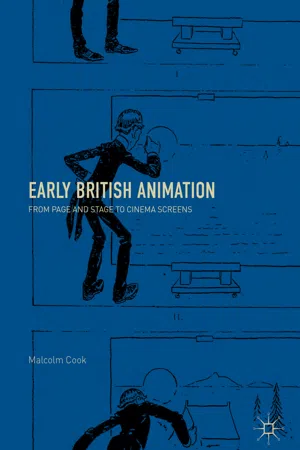
- English
- ePUB (mobile friendly)
- Available on iOS & Android
eBook - ePub
About this book
This book is the first history of British animated cartoons, from the earliest period of cinema in the 1890s up to the late 1920s. In this period cartoonists and performers from earlier traditions of print and stage entertainment came to film to expand their artistic practice, bringing with them a range of techniques and ideas that shaped the development of British animation. These were commercial rather than avant-garde artists, but they nevertheless saw the new medium of cinema as offering the potential to engage with modern concerns of the early 20th century, be it the political and human turmoil of the First World War or new freedoms of the 1920s. Cook's examination and reassessment of these films and their histories reveals their close attention and play with the way audiences saw the world. As such, this book offers new insight into the changing understanding of vision at that time as Britain's place in the world was reshaped in the early 20th century.
Information
© The Author(s) 2018
Malcolm CookEarly British Animationhttps://doi.org/10.1007/978-3-319-73429-3_11. Introduction: Early British Animation
Malcolm Cook1
(1)
Faculty of Humanities, University of Southampton, Southampton, UK
This book tells the story of the emergence of animation in Britain during the silent era.
From the earliest days of cinema, performers and cartoonists came to film to expand their artistic practice, bringing with them a range of techniques and concerns that shaped the development of British animation. Nineteenth-century entertainments provided the personnel, institutional structures and aesthetic model for the incorporation of graphic material into moving images, not only at their inception but through into the 1920s.
There are three big ideas put forward here. Firstly, that early British animation should be considered a form of artists’ film, commensurate with, but distinct from, more famous and celebrated films associated with art movements like Cubism, Dada , Surrealism and Constructivism. Secondly, that while a range of characteristics link British animation with other types of early twentieth-century filmmaking, the overriding one, the organising principle that can make coherent sense out of them, is their engagement with visual perception. Thirdly, that those perceptual concerns became increasingly bound up with discourses of the primitive. These artists and their films participated in a type of primitivism, reflecting both social and political contexts, and aesthetic movements.
Categorising these largely forgotten and unloved works as artists’ films may provoke two contradictory responses. On the one hand, the observation is incontrovertible and obvious. These people were artists. They made films. Lancelot Speed attended Slade School, studying with Alphonse Legros.1 Alexander Penrose Forbes (‘Alick P. F.’) Ritchie was a society portraitist whose work is held in the National Portrait Gallery, as is the work of Harry Furniss . On the other hand, suggesting this tradition is comparable to celebrated works of the modernist avant-garde might seem disingenuous. Aren’t these commercial artists producing generic, comfortable entertainment? The wrong type of artists, the wrong type of films? There is substantial cause to think otherwise. None of these artists were admitted to the Royal Academy of Arts , and Furniss had staged a ‘burlesque’ of Royal Academy members’ work in 1887 that might be considered a very British variation on the Salon des Refusés.2 Lightning cartoonist Tom Merry was jailed in Wandsworth Prison for bankruptcy in 1895, a penniless artist in the same year he produced one of the earliest examples of cartoon performance in moving images, for a kinetoscope film.3 British animated cartoons had some direct links with the canonical avant-garde. Alick P. F. Ritchie was described by The Bystander as ‘the originator of Cubism in the London illustrated press’ and ‘our own Cubist artist’.4 Adrian Brunel played an active role in the London Film Society and therefore was at the centre of alternative film culture in Britain, but he also served as scriptwriter for George Studdy’s ‘Bonzo’ in the 1920s.5
More than these occasional direct connections, the work examined here is abundant in the characteristics that typically distinguish artists’ film. These artists embraced formal and technical experimentation, having worked in a mass-reproduced popular art form. Lancelot Speed spent two years ‘experimenting exhaustively’ before the production of his first film.6 Walter Booth’s work incorporated a wide range of trick film techniques and combined them with a variety of materials, including chalkboard and paper drawings, scissor cut-outs, and string. Political and social engagement was fundamental to the print and performance background of these artists and it was demand for this that led to the huge growth of animated cartoons during the First World War . These artists came to film with pre-existing networks and institutions that supported their work, independent of the mainstream film industry. The challenge in recognising these as artists’ films is not only to re-evaluate this tradition of British animation, but also to think critically about the criteria of categorisation and valuation used to define particular films.
These artists used the new medium of cinema to engage with the modern concerns of the early twentieth century, and especially to interrogate and play with perception. A Victorian music-hall performance, the lightning cartoon act, takes centre stage here in demonstrating that while the physiology of visual perception may not change, our historical understanding of it certainly does. To present-day eyes an entertainment in which someone draws a cartoon on stage might seem rather mundane, but this only serves to indicate that our expectations of art and entertainment are the product of historical and cultural specificity. As the audience tried to discern what would appear from the lines on the page or chalk on the blackboard, they became alert to the process by which the brain resolves ambiguous images. When Professor Thornbury or Erskine Williams drew faces upside down it was a sensation – how many earlier works of art had posed this perceptual challenge to its viewers? The guessing game involved in the lightning cartoon played upon audiences’ basic visual perception, drawing attention to the newly recognised role of the observer in constructing what is seen. However, a fundamental tension arises here between inherent perceptual faculties that only change on evolutionary timescales and the rapid and far-reaching upheaval of modernity.
Ultimately, this is best approached through close attention to specific historical and cultural shifts, which determined many of the changes evident in British animation in this period. Britain’s relationship with the rest of the world was being transformed during this time and this influenced how animation developed in both economic and aesthetic terms. The First World War stimulated demand for topical and political films, and cartoonists were well placed to satisfy this, resulting in the growth of animated cartoons seen in the period. The war also cemented American control of the film industry, creating stiff competition domestically and closing overseas markets. This resulted in a set of expectations about what animation was and how it should be judged, and British animated cartoons were increasingly seen as primitive in comparison to American equivalents.
That primitivism of British animated cartoons extended beyond simple aesthetic judgements. The perceptual concerns seen in earlier animated cartoons became bound up with ideas of the primitive that provide another point of comparison with better-known modernist artists’ films. The representation of other cultures through stereotypes and discriminatory images seen in some films is undoubtedly objectionable. However, it was also an exploration of more than just a derogatory cultural primitivism, embracing evolutionary, developmental and perceptual implications. Such ideas would become central to Ernst Gombrich and Sergei Eisenstein in their analyses of the appeal of cartooning and animation. Eisenstein’s ideas of the ‘plasmatic’ nature of animation are here found to be derived from a long intermedial history that is highly applicable in the British context. The ‘plasmatic’ is also more clearly distinguished from mere transformation, recognising its source in basic perception, adding to scholarship on this influential writer and his foundational animation theories . These theories provide insight into the process by which the modernity of 1920s British cartoons was paradoxically expressed as a form of primitivism.
Readers will be forgiven if they express surprise at discovering this history, as it has been almost wholly hidden from view. If pushed to name examples many people will remember that, before Aardman appeared in the 1980s, the Halas & Batchelor studio was synonymous with British animation, especially their celebrated 1954 feature Animal Farm.7 Amongst the credits for that film is the name S. G. (Sid) Griffiths, who was by then a veteran of the industry. Griffiths had been responsible for Jerry the Troublesome Tyke, an animated star of the 1920s, indicating the longer history of British animation to which the Orwell adaptation belonged. Similarly, Bonzo, a peer of Jerry’s in the 1920s, also has a lingering half-life. As well as a steady trade in memorabilia and collectables in antiq...
Table of contents
- Cover
- Front Matter
- 1. Introduction: Early British Animation
- 2. Alternative Artists’ Films
- 3. The Lightning Cartoon: Animation from Music Hall to Cinema
- 4. Perception, Modernism and Modernity
- 5. The First World War: British Animated Cartoons and Their International Contexts
- 6. The ‘Primitive’ Appeal of Cartooning and Animation
- 7. Primitive Animation: British Animated Cartoons in the 1920s
- 8. Conclusion: British Animation, Talkies and the Cinematograph Films Act 1927
- Back Matter
Trusted by 375,005 students
Access to over 1.5 million titles for a fair monthly price.
Study more efficiently using our study tools.
Frequently asked questions
Yes, you can cancel anytime from the Subscription tab in your account settings on the Perlego website. Your subscription will stay active until the end of your current billing period. Learn how to cancel your subscription
No, books cannot be downloaded as external files, such as PDFs, for use outside of Perlego. However, you can download books within the Perlego app for offline reading on mobile or tablet. Learn how to download books offline
Perlego offers two plans: Essential and Complete
- Essential is ideal for learners and professionals who enjoy exploring a wide range of subjects. Access the Essential Library with 800,000+ trusted titles and best-sellers across business, personal growth, and the humanities. Includes unlimited reading time and Standard Read Aloud voice.
- Complete: Perfect for advanced learners and researchers needing full, unrestricted access. Unlock 1.5M+ books across hundreds of subjects, including academic and specialized titles. The Complete Plan also includes advanced features like Premium Read Aloud and Research Assistant.
We are an online textbook subscription service, where you can get access to an entire online library for less than the price of a single book per month. With over 1.5 million books across 990+ topics, we’ve got you covered! Learn about our mission
Look out for the read-aloud symbol on your next book to see if you can listen to it. The read-aloud tool reads text aloud for you, highlighting the text as it is being read. You can pause it, speed it up and slow it down. Learn more about Read Aloud
Yes! You can use the Perlego app on both iOS and Android devices to read anytime, anywhere — even offline. Perfect for commutes or when you’re on the go.
Please note we cannot support devices running on iOS 13 and Android 7 or earlier. Learn more about using the app
Please note we cannot support devices running on iOS 13 and Android 7 or earlier. Learn more about using the app
Yes, you can access Early British Animation by Malcolm Cook in PDF and/or ePUB format, as well as other popular books in Mezzi di comunicazione e arti performative & Arte generale. We have over 1.5 million books available in our catalogue for you to explore.