This volume brings together a selection of Juri Lotman's late essays, published between 1979 and 1995. While Lotman is widely read in the fields of semiotics and literary studies, his innovative ideas about history and memory remain relatively unknown. The articles in this volume, most of which are appearing in English for the first time, lay out Lotman's semiotic model of culture, with its emphasis on mnemonic processes. Lotman's concept of culture as the non-hereditary memory of a community that is in a continuous process of self-interpretation will be of interest to scholars working in cultural theory, memory studies and the theory of history.
eBook - ePub
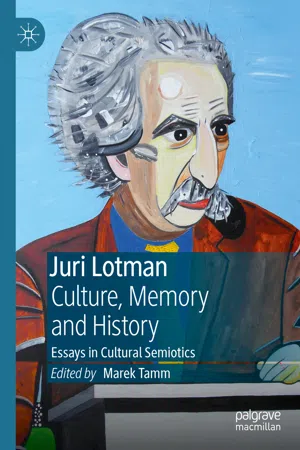
Juri Lotman - Culture, Memory and History
Essays in Cultural Semiotics
- English
- ePUB (mobile friendly)
- Available on iOS & Android
eBook - ePub
About this book
Information
Topic
Ciencias socialesSubtopic
Biografías de ciencias sociales© The Author(s) 2019
M. Tamm (ed.)Juri Lotman - Culture, Memory and Historyhttps://doi.org/10.1007/978-3-030-14710-5_11. Introduction: Juri Lotman’s Semiotic Theory of History and Cultural Memory
Marek Tamm1
(1)
Tallinn University, Tallinn, Estonia
Marek Tamm
The central aim of this volume is to introduce the work of Juri Lotman (1922–1993) into contemporary debates on cultural history and cultural memory studies. Lotman is widely read and highly renowned in the fields of semiotics and literary studies, but his innovative ideas about history and memory, formulated mostly in the 1980s and 1990s, remain little known among historians, historical theorists and collective memory scholars, especially in the English-speaking world. Thus, for instance, we do not find Lotman’s texts included in English anthologies of memory studies or cultural history. Nor can we find contemporary introductions to memory studies or historical theory that enter into dialogue with his thinking. This volume, which offers English translations of some of the most important articles from the late period of Lotman’s scholarly work, seeks to demonstrate how current discussions in the aforementioned fields would benefit from engaging with Lotman’s writings.
Juri Lotman: Life and Work
Juri Lotman was born on 28 February 1922 in a family of Russian intelligentsia of Jewish descent in Petrograd (now Saint Petersburg).1 In 1939, Lotman enrolled in the Faculty of Philology at Leningrad State University. Among his teachers were such prominent scholars as Boris Tomashevsky, Boris Eikhenbaum, Vladimir Propp, and Grigory Gukovsky. After his first academic year, he was drafted into military service due to the outbreak of the Second World War. During the war, Lotman worked as a signal operator in an artillery regiment and reached Berlin with his regiment. After demobilization in 1946, he resumed his studies at the university and began actively to engage in research.
In 1950, Lotman graduated from Leningrad State University, but because of the Stalinist anti-Semitic campaign, he was unable to continue his doctoral studies or to find an academic position in his hometown. At the suggestion of his friends, he managed to become a lecturer at the Teachers’ Institute in Tartu, Estonia, in a province far enough from the Soviet center to escape the politics of anti-Semitism. He worked at the institute in the years 1950–1956. However, from the very beginning of his time in Estonia, he established close contacts with the University of Tartu, taught courses in the Department of Russian Literature from 1950 to 1953, then became associate professor and in 1963 was promoted to professor of Russian literature.
Lotman began his scholarly life as a historian of eighteenth- and nineteenth-century Russian literature and culture. His early academic career is marked by a series of important monographs on nineteenth-century Russian literary culture: first, his candidate’s dissertation, defended at Leningrad State University in 1952: A. N. Radishchev in the Struggle with the Social and Political Views and the Bourgeois Aesthetics of N. M. Karamzin (unpublished, for a summary, see Lotman 1951), second, his first monograph, Andrei Sergeevich Kaysarov and the Literary and Social Struggle of His Time, published in Tartu in 1958 (Lotman 1958), and third, his doctoral dissertation defended at Leningrad State University in 1961, Paths of Development of Russian Literature in the Pre-Decembrist Period (unpublished, for a summary, see Lotman 1961).
In 1960, Lotman became the chair of the Department of Russian Literature at the University of Tartu. Two years earlier, he had initiated a new book series, Trudy po russkoi i slavjanskoi filologii (Studies in Russian and Slavic Philology), published by the university’s press, followed in 1964 by another series, Trudy po znakovym sistemam (Sign Systems Studies). After his predominantly archival and empirical studies of Russian literature, Lotman began, from the late 1950s onward, to pay more and more attention to theoretical and methodological questions related to the study of literature, especially to structuralist linguistics and literary theory. In 1958 he started to lecture on structural poetics and semiotics, publishing in 1964 his first theoretical monograph, Lectures on Structural Poetics, as the opening volume of the series Trudy po znakovym sistemam (Lotman 1994a [1964]). Under the editorship of Lotman, a total of 25 volumes were published in this series, based partly on the papers delivered at the so-called Semiotics Summer Schools that, from 1964, began to be held annually in the Kääriku Sports Centre of the University of Tartu. Thanks to the location of the University of Tartu on the margins of the USSR, Lotman was able to invite to Tartu and to Kääriku all of the most brilliant semiotically minded Soviet scholars, mostly from Moscow, and also to offer them publishing opportunities. This group of scholars, which included Boris Uspenskij, Vyacheslav Ivanov, Vladimir Toporov, Boris Gasparov, Alexander Piatigorsky, and Isaak Revzin, frequented the semiotics summer schools, and gradually developed what is now known as the Tartu-Moscow Semiotic School (see Grishakova and Salupere 2015; Pilshchikov and Trunin 2016). Maxim Waldstein, author of the first history of the Tartu-Moscow School, notes, “Ultimately, Tartu and Estonia appeared to be Lotman’s primary organizational and political resources. An opportunity to meet periodically in a distant place and to publish in a practically uncensored series was more than the Muscovites could wish for at that point” (Waldstein 2008, 36).
As a result of their collective work, the Tartu-Moscow scholars established a theoretical framework for the semiotics of culture. In the early 1970s, Lotman published a series of important contributions to the semiotics of literature and culture: The Structure of the Artistic Text (Lotman 1998 [1970], Eng. trans. 1977), Analysis of the Poetic Text (Lotman 1972, Eng. trans. 1976a), Studies in the Typology of Culture (Lotman 2000a [1970]), and Semiotics of Cinema and the Problems of Cinematic Aesthetics (Lotman 1973, Eng. trans. 1976b). However, he never abandoned his historical research on Russian literature, regularly publishing articles on Mikhail Lomonosov, Nikolai Gogol, Pyotr Vyazemsky, Fyodor Tyutchev, Ivan Turgenev, Fyodor Dostoevsky, and many others. In the late 1970s, Lotman wrote three consecutive monographs about Alexander Pushkin, his favorite literary figure: Pushkin’s Novel in Verse Eugene Onegin (Lotman 1975a), The Novel Eugene Onegin by A. S. Pushkin: Commentaries (Lotman 1980), and Alexander Sergeevich Pushkin: A Biography (Lotman 1982a). In the 1980s, he devoted himself to the study of Nikolay Karamzin, publishing a new annotated edition of Karamzin’s Letters of a Russian Traveller in 1984 (Karamzin 1984) and a biographical study of Karamzin, Creating Karamzin, in 1987 (Lotman 1987). In 1986, at the invitation of Estonian National Broadcasting, he launched a TV lecture series with the title Conversations about Russian Culture. This consisted of 35 episodes (about 40 minutes each), divided into five thematic units. Lotman later prepared these lectures for print, and the volume appeared shortly after his death in 1994: Conversations about Russian Culture: Life and Traditions of the Russian Nobility (Eighteenth–Beginning of the Nineteenth century) (Lotman 1994b).
During the final years of his life, in late 1980s and early 1990s, Lotman immersed himself in elaborating his semiotic theory of culture; some of his most important articles on this subject are made available in English translation in this volume. In 1990, at the request of the publishing house I. B. Tauris, he published an English monograph of his semiotic theory of culture, titled Universe of the Mind (Lotman 1990). But in parallel he was already working on some new book projects, focusing on the dynamic, explosive, and unpredictable mechanisms of culture. In 1992, the last book published during his life, Culture and Explosion (Lotman 1992e, Eng. trans. 2009), appeared; his very last manuscript, The Unpredictable Workings of Culture (written in 1990–1992), was published posthumously only in 2010 (English trans. in 2013). These last books were prepared by dictation, since Lotman’s eyesight was seriously impaired after 1989. Lotman died in Tartu on 28 October 1993 after a long illness. He was buried in the Raadi cemetery next to his wife Zara Mints.
Lotman’s written legacy consists of many thousands of pages of academic prose on various topics, including more than 20 books and more than 500 articles. To date, the largest collection of Lotman’s works in Russian includes the nine thematic volumes of his selected works published in Saint Petersburg in 1994–2003. Only a small, albeit substantial, fraction of Lotman’s oeuvre is available in English (see Kull 2011; Kull and Gramigna 2014). The present volume comprises a selection of Lotman’s most important articles in the field of cultural theory, cultural memory studies, and histori...
Table of contents
- Cover
- Front Matter
- 1. Introduction: Juri Lotman’s Semiotic Theory of History and Cultural Memory
- 2. Translator’s Preface
- Part I. Culture
- Part II. Memory
- Part III. History
- Back Matter
Trusted by 375,005 students
Access to over 1.5 million titles for a fair monthly price.
Study more efficiently using our study tools.
Frequently asked questions
Yes, you can cancel anytime from the Subscription tab in your account settings on the Perlego website. Your subscription will stay active until the end of your current billing period. Learn how to cancel your subscription
No, books cannot be downloaded as external files, such as PDFs, for use outside of Perlego. However, you can download books within the Perlego app for offline reading on mobile or tablet. Learn how to download books offline
Perlego offers two plans: Essential and Complete
- Essential is ideal for learners and professionals who enjoy exploring a wide range of subjects. Access the Essential Library with 800,000+ trusted titles and best-sellers across business, personal growth, and the humanities. Includes unlimited reading time and Standard Read Aloud voice.
- Complete: Perfect for advanced learners and researchers needing full, unrestricted access. Unlock 1.5M+ books across hundreds of subjects, including academic and specialized titles. The Complete Plan also includes advanced features like Premium Read Aloud and Research Assistant.
We are an online textbook subscription service, where you can get access to an entire online library for less than the price of a single book per month. With over 1.5 million books across 990+ topics, we’ve got you covered! Learn about our mission
Look out for the read-aloud symbol on your next book to see if you can listen to it. The read-aloud tool reads text aloud for you, highlighting the text as it is being read. You can pause it, speed it up and slow it down. Learn more about Read Aloud
Yes! You can use the Perlego app on both iOS and Android devices to read anytime, anywhere — even offline. Perfect for commutes or when you’re on the go.
Please note we cannot support devices running on iOS 13 and Android 7 or earlier. Learn more about using the app
Please note we cannot support devices running on iOS 13 and Android 7 or earlier. Learn more about using the app
Yes, you can access Juri Lotman - Culture, Memory and History by Marek Tamm, Brian James Baer in PDF and/or ePUB format, as well as other popular books in Ciencias sociales & Biografías de ciencias sociales. We have over 1.5 million books available in our catalogue for you to explore.