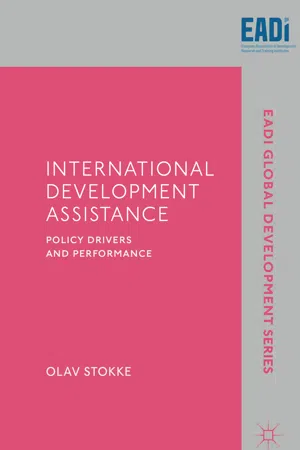
This book provides a comprehensive search for the basic political drivers of international development cooperation, based on the policy and performance of the OECD countries from the early 1960s to the present. The author focuses on the stated and implemented policies of the four so-called frontrunners and the Western hegemon, scrutinizing the changing trends in the justifications, objectives and guidelines set for the policy and their evolving performance vis-à-vis the international ODA target. Through extensive research, the work examines predominant world-views, societal value systems and foreign policy traditions, in order to find the policy drivers that vary nation to nation and how development assistance has evolved globally.
- English
- ePUB (mobile friendly)
- Available on iOS & Android
eBook - ePub
About this book
Information
Part ISearching for the Policy Drivers of ODA
© The Author(s) 2019
O. StokkeInternational Development AssistanceEADI Global Development Serieshttps://doi.org/10.1007/978-3-030-06219-4_11. Introduction
Olav Stokke1
(1)
Norwegian Institute of International Affairs, Oslo, Norway
The idea of assisting the countries of “the South”1 in their development efforts goes a long way back. Although colonial powers, as well as humanitarian and Christian missionary organizations and societies, were—for varying reasons—the forerunners, development assistance in the evolving form we know it as today remains associated with the early years after the Second World War (WWII) and with the efforts of the United Nations (UN). In the UN, governments—including an increasing number of governments of the South—were the primary actors. During the early post-WWII years, the decolonization process came high up on the UN agenda. Working in tandem with governments, the UN secretariats were inhabited by people whose loyalty to the UN—and the ideal norms reflected in its Charter—transcended the loyalty they felt towards their governments. Central actors in the tiny UN secretariat that formed the UN development policy in the late 1940s and the 1950s were moulded in a Keynesian tradition that emphasized the crucial role of the state in economic development.2
Basic international norms to guide international development assistance were formed within the UN system in the late 1940s and early 1950s. In the process, the first UN development “agency” was established—the Expanded Programme of Technical Assistance (EPTA), operative in 1950. Internationally, this process evolved further, particularly with the declaration of the first UN development decade (DD1) (the 1960s) and the three development decades that followed, each with formalized development strategies and targets set for the volume of aid and what should be achieved.3
In 1960, an important development took place at a regional level. The Western countries—organized within the Organization for Economic Cooperation and Development (OECD)—established a Development Assistance Committee (DAC ) that operationalized the UN volume target. It established a framework for what should be included in the concept and counted as development assistance, as well as a system for regular reporting on and evaluating of the actual follow-up by its member countries on commitments and norms. It even pushed its member governments to provide higher volumes on better conditions for the recipients of the assistance.4
The processes in the late 1990s and the first years of the new century that produced and formalized the Millennium Development Goals (MDGs) once more brought the international target for official development assistance (ODA) to the fore. Along with improved market access and debt sustainability, meeting the target was identified as a decisive precondition for developing a global partnership for development. To meet the challenges set out in Transforming our World: The 2030 Agenda for Sustainable Development, “the target of 0.7% of ODA/GNI to developing countries and 0.15 to 0.2% of ODA/GNI to least developed countries” was again put forward, this time as an instrument to meet the 17 sustainable development goals (SDGs) and the 169 targets set for more specified sub-goals.
1 What the Study is About—The Main Questions Posed
A target for better-off countries’ assistance to development in economically poorer countries was first formulated in the strategy for the first United Nations development decade, the 1960s. This was set at 1% of their net national income (NNI) in private and public transfers. The more specific target for ODA, 0.7% of the gross national product (GNP), with a date set for its attainment, was included in the strategies for the following three UN development decades.
A few member countries of the OECD have set specific targets for their ODA at a more ambitious level—1% of GNP/gross national income (GNI ). In the mid-1970s, these were the Netherlands and the Scandinavian countries. Towards the end of the century, Luxembourg joined this “group”. A few other OECD countries have come close to the international 0.7% target and have at times even attained it. Among these were France—but its ODA included aid to its overseas dependencies and territories (départements et territories d’outre mer—the DOM-TOMs)—and, in the new century, the UK and Germany. Some OECD member countries have referred to the target as a future aim, which they were presently unable to fully meet. Certain other member countries have explicitly refused to commit themselves to the target or to the date set for meeting it—or both. Outside the OECD, the performance of a few oil-rich Arab countries—especially Kuwait, Qatar, Saudi Arabia and the United Arab Emirates—went far beyond the international 0.7% target in the 1970s and 1980s.
This study will focus on the performance of the OECD members of the DAC—how they have responded to the international 0.7% target and why their responses have differed so much.
An overall picture emerges from the answers to a simple first question: (1) over the decades, to what extent have the DAC and its individual members sought to meet the international 0.7% target—repeatedly confirmed by the UN system, although with various reservations on the part of some DAC members? The overview will be based on OECD statistics.
The follow-up questions, however, are more demanding. The follow-up on the UN commitments on aid is voluntary, not obligatory. In the absence of an international regime to govern and enforce decisions within this policy area, the basic all-over question looms in the background: (2) under what conditions may an international 0.7% target have a chance of succeeding?
However, the focus here is narrowed down to the performance of the OECD countries: (3) what can explain the differences among DAC member nations in their commitments to and follow-up on the international 0.7% target?
This comparative study starts with the success stories—those countries that have succeeded in meeting the targets, namely the Netherlands and the Scandinavian countries. How have they succeeded in meeting the 0.7% target in a sustainable way? The complex answer to this question is of fundamental interest, as it identifies opportunities for others. However, the explanations that may be drawn from the success stories need to be compared with those emerging from the other end of the performance spectrum. The US is selected for comparison. Again, what may explain the fact that the US came to be among the countries with the weakest ODA performance in relative terms? The answers to this question are of equally fundamental importance, identifying constraints.
The selection of these five countries for scrutiny may also be interesting because of their unequal starting positions. In the 1950s and early 1960s, the US was a leading provider of development assistance both in absolute and in relative terms, prompting the other DAC countries to increase their aid contributions. The countries that later became frontrunners were, in contrast, slow starters. In particular, Denmark and Norway were initially right at the back, both in absolute and in relative terms. What explains the subsequent reversal of positions?
In answering these questions, the net will be cast wide. The attention of this comparative study will be directed towards the international alignments of the countries concerned—beyond their UN membership. It will also focus on their relative economic ability to respond to the commitment as measured by their GNP per capita and their balance-of-payments situation over the years. The predominant worldviews, societal values, norms and traditions within the individual DAC countries may also be relevant, as may the political basis of the governments in the countries concerned, along a right-left axis. This study will look into predominant characteristics of this kind in the countries selected.
The policies and performance of the countries within the Nordic region—Denmark, Finland, Norway and Sweden—call for special attention. During the formative years of their aid policies, these countries had established a formal and informal regional cooperation in general, including on aid policy. However, their security alignments differed: Denmark and Norway (along with the Netherlands) were members of the North Atlantic Treaty Organization (NATO), while Sweden took a neutral/non-aligned stand and Finland was linked to a “friendship treaty” with the USSR. Their relations to the evolving European economic and political integration varied as well. Denmark joined the European Economic Community (EEC) in 1972 (the Netherlands was a founding member), while the three other Nordic countries remained—for different reasons—outside the EEC during the formative years of their aid policies. In the 1990s, however, Finland and Sweden joined the European Union (EU), while Norway remained outside this inner circle.
This “special attention” calls for studies of selected aspects of the aid policies of the four frontrunners that have committed themselves to meeting the international target set for ODA and from time to time have met even higher volume targets set by themselves. Following up on (3) above: (4) what can we learn from the experiences and performances of the Netherlands and the Scandinavians? They are all “small powers”. For this reason, too, their policies need to be contrasted with the aid policy of a major power. The US offers itself for this purpose. (5) What are the main differences in the stated and implemented aid policies of the so-called frontrunners and the Western hegemon—and what can we learn from these differences? As noted, the Nordic setting is likewise an appropriate choice for a comparative study.
Although the formation of the four frontrunners’ aid policies is the main focus, the robustness—sustainability—of these is also of crucial importance. (6) To what extent were the targets, once met, maintained by these countries? The follow-up on the targets during subsequent years will be traced. Beyond the empirical answers, again (7): what may explain the sustainability and eventual variations in this regard? The attention will once more be on the political and economic indicators referred to above—and on the main drivers of, and constraints on, the development cooperation policies of the countries concerned.
This brings us to the most crucial questions—implicit in the above questions. (8) What have been the major drivers of the policies? And (9): what have been the major constraints?
Attention will be directed towards the reasons given for the provision of development assistance by the governments of the frontrunners during the formative years and for maintaining or increasing it—those explicitly stated as well as the implicit ones, emerging from the objectives and norms set for development cooperation. Naturally, the actual implementation of the objectives and norms embedded in the stated policy will inform our analysis as well.
Attention will...
Table of contents
- Cover
- Front Matter
- Part I. Searching for the Policy Drivers of ODA
- Part II. International ODA Targets, Their Follow-Up and Real Value to Recipients
- Part III. ODA Targets and Policy Determinants: the Frontrunners and the Western Hegemon
- Part IV. Analysis and Conclusions
- Back Matter
Trusted by 375,005 students
Access to over 1.5 million titles for a fair monthly price.
Study more efficiently using our study tools.
Frequently asked questions
Yes, you can cancel anytime from the Subscription tab in your account settings on the Perlego website. Your subscription will stay active until the end of your current billing period. Learn how to cancel your subscription
No, books cannot be downloaded as external files, such as PDFs, for use outside of Perlego. However, you can download books within the Perlego app for offline reading on mobile or tablet. Learn how to download books offline
Perlego offers two plans: Essential and Complete
- Essential is ideal for learners and professionals who enjoy exploring a wide range of subjects. Access the Essential Library with 800,000+ trusted titles and best-sellers across business, personal growth, and the humanities. Includes unlimited reading time and Standard Read Aloud voice.
- Complete: Perfect for advanced learners and researchers needing full, unrestricted access. Unlock 1.5M+ books across hundreds of subjects, including academic and specialized titles. The Complete Plan also includes advanced features like Premium Read Aloud and Research Assistant.
We are an online textbook subscription service, where you can get access to an entire online library for less than the price of a single book per month. With over 1.5 million books across 990+ topics, we’ve got you covered! Learn about our mission
Look out for the read-aloud symbol on your next book to see if you can listen to it. The read-aloud tool reads text aloud for you, highlighting the text as it is being read. You can pause it, speed it up and slow it down. Learn more about Read Aloud
Yes! You can use the Perlego app on both iOS and Android devices to read anytime, anywhere — even offline. Perfect for commutes or when you’re on the go.
Please note we cannot support devices running on iOS 13 and Android 7 or earlier. Learn more about using the app
Please note we cannot support devices running on iOS 13 and Android 7 or earlier. Learn more about using the app
Yes, you can access International Development Assistance by Olav Stokke in PDF and/or ePUB format, as well as other popular books in Politics & International Relations & International Relations. We have over 1.5 million books available in our catalogue for you to explore.