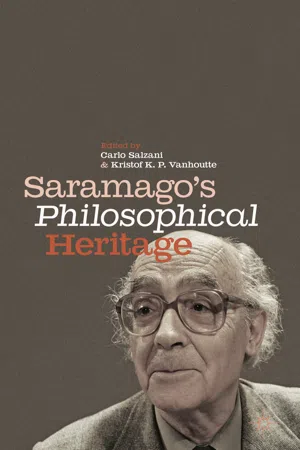
The past decades have seen a growing "philosophical" interest in a number of authors, but strangely enough Saramago's oeuvre has been left somewhat aside. This volume aims at filling this gap by providing a diverse range of philosophical perspectives and expositions on Saramago's work. The chapters explore some possible issues arising from his works: from his use of Plato's allegory of the cave to his re-readings of Biblical stories; from his critique and "reinvention" of philosophy of history to his allegorical exploration of alternative histories; from his humorous approach to our being-towards-death to the revolutionary political charge of his fiction. The essays here confront Saramago's fiction with concepts, theories, and suggestions belonging to various philosophical traditions and philosophers including Plato, Pascal, Kierkegaard, Freud, Benjamin, Heidegger, Lacan, Foucault, Pato?ka, Derrida, Agamben, and Žižek.
eBook - ePub
Saramago’s Philosophical Heritage
- English
- ePUB (mobile friendly)
- Available on iOS & Android
eBook - ePub
Saramago’s Philosophical Heritage
About this book
Information
Topic
PhilosophySubtopic
Historiography© The Author(s) 2018
Carlo Salzani and Kristof K. P. Vanhoutte (eds.)Saramago’s Philosophical Heritagehttps://doi.org/10.1007/978-3-319-91923-2_11. Introduction: Proteus the Philosopher, or Reading Saramago as a Lover of Wisdom
Carlo Salzani1 and Kristof K. P. Vanhoutte2, 3
(1)
Independent Scholar, Munster, Germany
(2)
University of the Free State, Bloemfontein, South Africa
(3)
Pontifical University Antonianum, Rome, Italy
Carlo Salzani (Corresponding author)
Kristof K. P. Vanhoutte
Keywords
José SaramagoPhilosophyAllegorical turnEssayistic novel1
Γνῶθι σεαυτόν (gnṓthi seautón): with these two words Socrates demonstrated, through the usage of philosophical irony, his great philosophical wisdom. And this ironical denial has since Socrates made history. Without desiring to list all those who have taken recourse to the “Socratic irony,” we find it very much present in the author that stands at the center of this volume: the Portuguese Nobel Prize laureate José Saramago.
In an entry on May 17, 1993, of his Lanzarote Notebooks ( Cadernos de Lanzarote ), Saramago—the future author of, ironically, a novel entitled The Cave , which opens with an epigraph from Plato’s Republic—confesses: “I understand nothing of philosophy” (CL 1:42). He will repeat this so-called ignorance on several occasions, stating either that “I have nothing of the philosopher” (CL 2:197) or “I know very little of philosophy” (Gómez Aguilera 2010, p. 165). These “confessions” must not be taken at face value but, obviously, rather ironically. In fact, at the same time he proclaims to know nothing of philosophy, he repeats, in several talks and interviews, that “our present society needs philosophy” (ibid., p. 165) and calls for a “return to philosophy,” in the sense of a return to “what we hope to find in philosophy, that is, reflection, analysis, a sensibility that be critical and free” (Saramago 2005). This “return to philosophy” is intended, therefore, as a “return to thinking,” to a dimension fundamental to and “inseparable from [,] human nature” (Saramago 2005) which contemporary society seems to have lost or at least belittled. Philosophy means here, broadly, “a space, a place, a method of reflection,” “simply a way of feeling life, of living life, which culminates, when it happens …, in peace of mind [serenidade]” (Gómez Aguilera 2010, pp. 165, 96–97). In this sense, Saramago even argues that “philosophy should be included in human rights, and everybody should be entitled to it” (ibid., p. 471).
This commonsense view of philosophy does not exclude, however, a more concrete interest in actual philosophy, in the “philosophy of philosophers.” Notwithstanding his ironical confessions of his philosophical ignorance, in Saramago’s diaries, talks and interviews, there appear sparse but regular references to philosophers and philosophies. For example—and leaving aside the already mentioned reinterpretation of Plato’s allegory of the cave—and once more through an ironical confession of his ignorance in philosophy, in a diary entry on September 17, 1994, he avows never to have taken interest in the philosophy of Karl Popper (who had just died) and wonders whether he has thereby missed some important tools to understand the world. The answer is negative, though the real target of Saramago’s ironical disinterest is Popper’s political —(neo)liberal—views (CL 2:197–98). In the same vein, on the occasion of the publication of one of Gianni Vattimo’s books in Spanish (Philosophy, Politics, Religion: Beyond “Weak Thought,” 1996), he confesses never to have understood Vattimo’s “weak thought” and especially his many “reconsiderations” about it—whereby, again, Saramago’s targets are the political impacts of these views (CL 4:229–30).
Not all of Saramago’s direct confrontations with the philosophy of the philosophers are, however, relegated to the ambit of ironical confessions of ignorance. At times he also goes for a much more direct “showdown” with the professional lovers of wisdom. For example, he recurrently attacks Francis Fukuyama for his thesis of the “End of History” that triumphally sanctifies neoliberal democracy as the final stage of human evolution (Saramago 1999; Céu e Silva 2009, p. 384). Furthermore, he also criticizes Jacques Derrida for reducing the world to a text or Roland Barthes for his thesis of the “The Death of the Author” (Céu e Silva 2009, p. 101).
Saramago’s philosophical lineage goes back, rather, to those masters of refined and compassionate rationalism like Montaigne or Voltaire (Gómez Aguilera 2010, pp. 139, 219; Céu e Silva 2009, p. 254n85; Baptista-Bastos 1996, p. 33), to an anti- (or pre-)academic philosophy that explored the depths, lights and shadows of the human condition in forms that confound and blend literary genres and academic compartmentalization. It is precisely in this sense that his oeuvre is profoundly “philosophical” (Grossegesse 1999, p. 10; Amorim 2010, pp. 27, 274): like the old masters, his works exercise systematic doubt, iconoclasm and pessimism, recurring to an implacable reason and embracing universal compassion. And this feature of his work has not been overlooked by interpreters and even by some perceptive philosopher: the Slovenian philosopher Slavoj Žižek, for example, has on multiple occasions taken recourse to Saramago’s novel Seeing (Žižek 2009a, b)—albeit mistakenly1 (Vanhoutte 2013)2—and even before Žižek , Peter Hallward, the author of one of the more interesting reflections on the philosophy of Alain Badiou, wrote as a side-thought (but we all know that short remarks and quick “by the way” comments in philosophy contain the most interesting thoughts) that “Saramago’s story The Unknown Island (1997) might even be read, up to a point, as an allegory of Badiou’s philosophy in general” (Hallward 2003, p. 385n11).3
2
The reference to Montaigne and Voltaire is not accidental and helps moreover illuminate a peculiar trait of Saramago’s work, of which he was well aware. On many occasions he repeated that “probably I’m not a novelist; probably I’m an essayist who needs to write novels because he cannot write essays” (Reis 1998, p. 48); “in all my novels,” he stated again, “there is an essayistic temptation,” and so his books can be considered as “essays with fictional characters” (Gómez Aguilera 2010, pp. 223, 264). Saramago saw his novels as “the place of a reflection about certain aspects of life I care about. I invent stories in order to express my concerns, my questions…”; in fact, he emphasizes, “I don’t write books to tell stories” (Gómez Aguilera 2010, p. 264). Importantly, this “essayistic temptation” dissolves the divisions and separations between literary genres and transforms the novel into what Saramago himself calls a “literary space” (espaço literário), which, as such, admits everything into his realm: essay, science, historiography, poetry—and also philosophy (CL 4:212; Gómez Aguilera 2010, p. 199). Saramago’s novel is “a total expression,” a sort of summa, a “reunification of all genres, a place of wisdom. It accommodates epic, theatre, philosophical or philosophizing reflection” (ibid., p. 263). And perhaps philosophical reflection even takes a leading, unifying role:
This can be sensed already from the titles of his many books. In fact, as he himself notes (Saramago 2013, pp. 36–37), the titles of his novels are not “appropriate” to traditional novels and confound genre divisions. His first “mature” novel is titled Manual of Painting and Calligraphy (1977), and the book that made him internationally famous is titled Memorial do Convento (literally, The Monastery Memoir, English translation Baltasar and Blimunda, 1982). Other titles include The History of the Siege of Lisbon (1989), The Gospel According to Jesus Christ (1991), Ensaio sobre a Cegueira and Ensaio sobre a Lucidez (literally Essay on Blindness and Essay on Lucidity, English translations Blindness and Seeing , 1995 and 2004). “Manual,” “memoir,” “history,” “essay” and even a “gospel”: Saramago’s “literary space” combines and merges all genres in a critical analysis of the moral, social and political predicaments of our times, just like Montaigne’s essays and Voltaire’s stories and novellas. In the philosophical attempt to explore...I think that here there are reasons to approach what I’ve done not merely from the point of view of literary studies, but also from another point of view, which I wouldn’t know how to name, but that has to do with other kinds of inquiries. Is it worth here to name philosophy, or another research of this kind? (Reis 1998, p. 49)
Table of contents
- Cover
- Front Matter
- 1. Introduction: Proteus the Philosopher, or Reading Saramago as a Lover of Wisdom
- 2. Correcting History: Apocalypticism, Messianism and Saramago’s Philosophy of History
- 3. The “Dark Side” of History: Saramago, Foucault, and Synchronic History
- 4. José Saramago’s “Magical” Historical Materialism
- 5. Some Remarks on a Phenomenological Interpretation of Saramago’s Cave
- 6. Death by Representation: In Law, in Literature, and in That Space Between
- 7. A Contemporary Midrash: Saramago’s Re-telling of the “Sacrifice of Isaac”
- 8. Female Representations in José Saramago: A Space for Oppositional Discourses from the Canonical Gospels to The Gospel According to Jesus Christ
- 9. Saramago’s Axiology of Gender Difference
- 10. Saramago’s Dogs: For an Inclusive Humanism
- 11. Traumatic Counterfactuals
- 12. Bye Bye Bartleby and Hello Seeing, or On the Silence and the Actualization to Do … Not
- Back Matter
Trusted by 375,005 students
Access to over 1.5 million titles for a fair monthly price.
Study more efficiently using our study tools.
Frequently asked questions
Yes, you can cancel anytime from the Subscription tab in your account settings on the Perlego website. Your subscription will stay active until the end of your current billing period. Learn how to cancel your subscription
No, books cannot be downloaded as external files, such as PDFs, for use outside of Perlego. However, you can download books within the Perlego app for offline reading on mobile or tablet. Learn how to download books offline
Perlego offers two plans: Essential and Complete
- Essential is ideal for learners and professionals who enjoy exploring a wide range of subjects. Access the Essential Library with 800,000+ trusted titles and best-sellers across business, personal growth, and the humanities. Includes unlimited reading time and Standard Read Aloud voice.
- Complete: Perfect for advanced learners and researchers needing full, unrestricted access. Unlock 1.5M+ books across hundreds of subjects, including academic and specialized titles. The Complete Plan also includes advanced features like Premium Read Aloud and Research Assistant.
We are an online textbook subscription service, where you can get access to an entire online library for less than the price of a single book per month. With over 1.5 million books across 990+ topics, we’ve got you covered! Learn about our mission
Look out for the read-aloud symbol on your next book to see if you can listen to it. The read-aloud tool reads text aloud for you, highlighting the text as it is being read. You can pause it, speed it up and slow it down. Learn more about Read Aloud
Yes! You can use the Perlego app on both iOS and Android devices to read anytime, anywhere — even offline. Perfect for commutes or when you’re on the go.
Please note we cannot support devices running on iOS 13 and Android 7 or earlier. Learn more about using the app
Please note we cannot support devices running on iOS 13 and Android 7 or earlier. Learn more about using the app
Yes, you can access Saramago’s Philosophical Heritage by Carlo Salzani, Kristof K. P. Vanhoutte, Carlo Salzani,Kristof K. P. Vanhoutte in PDF and/or ePUB format, as well as other popular books in Philosophy & Historiography. We have over 1.5 million books available in our catalogue for you to explore.