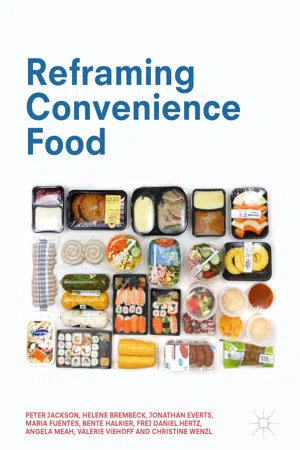
Convenience food is a complex and contested category, whether understood as a marketing term used by retail professionals or in everyday conversation by non-specialists. It encompasses a wide variety of processed and semi-processed foods including frozen pizza and ready meals, sausages, sandwiches and pies, tinned fruit and canned vegetables, bagged salads, confectionary and crisps—all of which might broadly be described as ‘ready to cook, ready to heat or ready to eat’ (see Pfau and Saba 2009).
Despite these definitional issues (pursued in more detail in Chap. 3), convenience food is frequently criticised as unhealthy and environmentally unsustainable, responsible for eroding the distinctiveness of local food-ways as part of a wider process of cultural homogenization, sometimes referred to as McDonaldization (Ritzer 1993). For example, a study published in the British Medical Journal reported that none of the 100 ready meals it tested conformed to minimum WHO dietary standards (Howard et al. 2012),1 while a report from the UK Department for Environment, Food and Rural Affairs criticised convenience food for the inclusion of resource-intensive ingredients with high greenhouse gas emissions and heavy transport costs, consuming large volumes of energy, land and water (Defra 2012). In these circumstances, the use of convenience food is often ‘tinged with moral disapprobation’ (Warde 1999, p. 518), particularly in comparison with ‘home-made’ food, cooked from scratch using fresh ingredients.
This book and the research project on which it is based questions this pejorative view, seeking to understand how various types of convenience food have become embedded in consumers’ lives, combined with other kinds of food to become part of their everyday diet. Seeking to understand the place of convenience food in people’s daily lives, we ask what lessons can be learned from the commercial success of convenience food that might be applied by those who seek to promote healthier and more sustainable diets? The project draws on original findings from comparative research in Denmark, Germany, Sweden and the UK, funded through the ERA-Net SUSFOOD programme. The book argues that reframing convenience food within an understanding of everyday consumer practice provides new academic insights and helps avoid the all-too-frequent moralization of convenience food in policy and media circles.2
This introductory chapter outlines the complexity and contested nature of convenience food (cf. Jackson and Viehoff 2016). It introduces the research project on which the book is based including the rationale for our four case studies (commercial baby food, supermarket ready meals, workplace canteen food and meal-box schemes). It describes our theoretical and methodological approach, concluding with an outline of the book’s core argument.
Convenience Food as a Contested Category
Convenience food is a sprawling category that defies easy definition (Scholliers 2015). Given the lack of an agreed definition (explored further in Chap. 3), we could take various approaches to the topic. One would be to adopt the definitions used by our research participants, following the term wherever it takes us, as suggested by Gluck and Tsing’s (2009) approach to tracing ‘words-in-motion’. Alternatively, we might try to delimit the field and focus on specific types of convenience food (such as ready meals or frozen pizza). Our approach is somewhat different from either of these perspectives. Rather than seeking to arbitrate whether some kinds of food should be included in the term while others should not, we have sought to trace how specific foods in particular circumstances come to be regarded as convenient (a process we describe using the neologism ‘conveniencization’). How, for example, does powdered baby milk (infant formula) come to be regarded as more convenient than breast milk? Where and when does this happen? Whose interests does it serve and whose does it marginalize or exclude? What commercial forces enable it to happen and what socio-technical innovations are involved in its development? Rather than taking ‘convenience food’ as a separate category of food whose meaning is settled and unchanging, we examine the processes and practices through which certain foods take on characteristics that are regarded (by some people in some places and at specific times) as ‘convenient’.
Our focus on ‘conveniencization’ (explained in more detail in Chap. 3) also enables us to explore how new forms of convenience food become normalized parts of people’s diets, regarded as staples within the practices of their everyday lives (cf. Lavelle et al. 2016). It also encourages us to explore how many households are able to combine ‘fresh’ and ‘convenience’ foods without making a strong distinction between the two categories (cf. Carrigan and Szmigin 2006; Short 2006). The process of ‘conveniencization’—and the distinction it implies between ‘convenient’ and ‘convenience’ food—is crucial for understanding what we mean by ‘reframing’ convenience food—and what is at stake in approaching the subject in this way.
The FOCAS Project
The research on which this book is based was funded by the ERA-Net SUSFOOD programme whose aim was to enhance collaboration and coordination between European research programmes on sustainable food production and consumption. The programme involved 25 partners from 16 European member states. The Call to which we responded addressed three thematic areas (with our project being associated with the third strand): increased resource efficiency in food production; innovation in food processing technologies; and understanding consumer behaviour to encourage more sustainable food choice.
Our project addressed the relationship between Food, Convenience and Sustainability (or FOCAS, for short). Its specific aims were to examine:
How ‘convenience food’ is understood by consumers and how its use relates to understandings of ‘healthy eating’ and environmental sustainability
With what specific practices (shopping, cooking, eating, disposing) ‘convenience food’ is associated
How such foods are incorporated within different household contexts and domestic routines, and
To what extent current practices are subject to change (towards more sustainable and healthier practices)?
We addressed these aims through four carefully-chosen case studies, each addressing different aspects of convenience food. The first case explored the consumption of commercial baby food among families with children aged under 18 months. Following debates on food safety, sustainability and health (Bentley 2014), the understanding of processed baby food as a modern, healthy and scientifically-based product has been questioned. This was particularly true in China, where the contamination of infant formula with the poisonous chemical melamine led to widespread parental anxieties about baby milk and led the dairy industry to adapt their marketing strategies (cf. Gong and Jackson 2012, 2013). Today, processed baby foods are marketed as a convenient and flexible solution for time-pressed mothers, meeting their needs while conforming to official health advice. However, elaborate packaging and long-distance transport, complex supply chains and changing dietary guidelines make the choice of baby food a vexing issue. Our research (led by Helene Brembeck and Maria Fuentes) was based in Sweden with some comparative work elsewhere in Europe including brands such as Semper in Sweden, Hipp in Germany, Ella’s Kitchen in the UK and Lovemade in Denmark. It included desk-based research on the marketing of various brands of baby food and field-based research among Swedish and Somali women in the small Swedish town of Falköping, exploring the role of processed food in baby-weaning practices as mothers sought to introduce their children to solid food. This case study allowed us to test Alan Warde’s (1999) claim that baby food is rarely marketed in terms of its convenience for babies or mothers.
The second case study, based in the UK but including comparative fieldwork in Germany (led by Peter Jackson, Angela Meah and Valerie Viehoff), looked at an iconic example of convenience food: supermarket ready meals, sold in frozen or chilled form, at numerous price points and with separate branded and own-label options. The research used interviews, kitchen ‘go-alongs’ and ethnographic observation with a diverse range of households in the UK and Germany to examine how consumers incorporate a range of convenience foods within their diets; the meanings attached to their consumption; and the scope for introducing healthier and more sustainable alternatives. We...