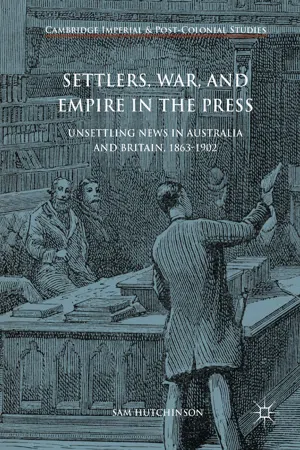
This book explores how public commentary framed Australian involvement in the Waikato War (1863-64), the Sudan crisis (1885), and the South African War (1899-1902), a succession of conflicts that reverberated around the British Empire and which the newspaper press reported at length. It reconstructs the ways these conflicts were understood and reflected in the colonial and British press, and how commentators responded to the shifting circumstances that shaped the mood of their coverage. Studying each conflict in turn, the book explores the expressions of feeling that arose within and between the Australian colonies and Britain. It argues that settler and imperial narratives required constant defending and maintaining. This process led to tensions between Britain and the colonies, and also to vivid displays of mutual affection. The book examines how war narratives merged with ideas of territorial ownership and productivity, racial anxieties, self-governance, and foundational violence. In doing so it draws out the rationales and emotions that both fortified and unsettled settler societies.
eBook - ePub
Settlers, War, and Empire in the Press
Unsettling News in Australia and Britain, 1863-1902
- English
- ePUB (mobile friendly)
- Available on iOS & Android
eBook - ePub
Settlers, War, and Empire in the Press
Unsettling News in Australia and Britain, 1863-1902
About this book
Information
© The Author(s) 2018
Sam HutchinsonSettlers, War, and Empire in the PressCambridge Imperial and Post-Colonial Studies Serieshttps://doi.org/10.1007/978-3-319-63775-4_11. Introduction
Sam Hutchinson1
(1)
Independent Scholar, Mt Victoria, Wellington, New Zealand
What happens when we look at wars of empire , not to learn about the wars themselves, but for what they tell us about the broader narratives that sustained British settler and metropolitan societies? What connections can we draw between discussions of conflict abroad, and British colonial and imperial feeling ? What did settlers talk about when they talked about war?
In September 1863, a leading New South Wales newspaper, the Sydney Morning Herald (SMH) , republished an article entitled ‘Natal’ from the Yeoman. The article praised the ability of British colonists to ‘reproduce the representative Briton’. Its writer assured those readers unable to physically travel to the colonies that they too could witness this development. Their knowledge, though, would come through ‘a somewhat easier process’. Namely, by ‘travers[ing] the seas of newspapers which reflect our brethren and cousins in all their ways and phases, their businesses and pleasures, their joys and sorrows, their downlyings and uprisings, their goings in and comings out’.
The article noted that colonists faced hardships of a particular kind in settling their lands. These difficulties notwithstanding, the ‘British colonist remains intact; and he who has taken up the leading journal of one colony and read through its pages may apply the larger portion of it, with scarcely a variety, to any other of them’. In this light, ‘it is evident that the effervescent fooleries and sparrings of mimic wars are but the spray tossed up on the crest of the advancing billow’. It told its readers that ‘Slower or faster, but everywhere deep and strong, the wave of colonial life presses on. As the white man advances the savages receded, and a mimic London is born amid the stumps of the aboriginal wilderness.’1
Here, in pages designed for those whose livelihoods rested upon their ability to wrench economic value from the soil, was a thumbnail sketch of an epic global drama. The movement of British settlers to new lands was a revolution in world affairs, one that not only transformed the earth’s terrain, but that also, as the author of this article was aware, clashed with other cultural, political, and economic systems.2
This spectacle was there for all to see through the materiality of a vast communications network, and in the relationship between the elements of the so-called British world that existed in its newspapers. As individuals around the British Empire read their daily papers, they could partake in a dynamic that drew spatial connections between vastly dispersed territories and the events occurring within them. The actions of settlers in one part of the globe were compared with similar actions elsewhere. Colonial identifications were formed and challenged across the empire and between colonies.
Yet the confidence radiating from such passages could be brittle. Beneath the surety of the prose were lingering doubts about the project that settlers around the world had embarked on. This too was encouraged by the press. The same colonists who could read accounts of themselves as producers for their empire might turn the page to read of other consequences caused by that same mode of production , and the political and legal systems that underwrote it, in a neighbouring colony. Across the Tasman, like-minded British settlers in New Zealand were engaged in a bitter struggle with local Māori . Readers could then draw further connections. If the process of settler ‘advancement into the wilderness’ was alike in each location, how did this violence reflect on Australian colonists? Who was in the right, and why?
The Yeoman article presented a prevailing view of what would soon be known as the ‘expansion of England ’, one that gestured towards the violence of colonial expansion .3 But there were other views. ‘It is in the very nature of things that settlers and natives should quarrel’, wrote the Times in 1862.
That there is room enough for both does not affect the case in the least. The savage will hang perniciously on to the frontier of civilization, and he will provoke the settler by thefts and forays. The settler is necessarily clamorous for land, of which, in its primitive state, he requires large tracts for his purposes, and in dealing with the native – the putative owners of the soil – for the purchase of land he is likely enough to hold strong opinions.
The Times concluded, ‘So the end is a war, in which the natives fight for their monopoly of territory, and the colonists for the necessary extension of their settlements, the conflict being aggravated by an infinity of small encounters at every spot where a black man’s haunt touches a white man’s farm.’4
Where the Yeoman celebrated the advance of barely distinguishable British settlers around the globe, the Times offered little more to the reader than solemn resignation, the euphemisms all the more arresting for their subject matter. As we will later see, the Times had cause for restraint. While the differences in tone between these two passages are easily registered, each shared a basic message. These quarrels belonged to the order of nature. Any number of oppositions are set up to stress the point and are familiar enough: savage and settler, primitive and civilised, haunt and farm, fragility and permanence. The Times painted a picture of unyielding extremes. The process it described was universal, providing infinite encounters, at every spot. Above all, it was ‘necessary’, the word twice chosen to add certitude to what was natural. If land is what settlers need, and invasion is how they got it, war would ensue.
The many conflicts fought in the name of the British Empire in the nineteenth century had in common an eager following in the British and colonial press. More often than not, this coverage doubled as a key plank in the architecture supporting colonial or British martial involvement. This book examines the kinds of narratives that attended this involvement. It looks at the interplay between material relationships underpinning settler and imperial expansion, and the kinds of feelings , impulses, and language that they stimulated. These narratives were increasingly in demand as the century wore on, as newspaper readers demanded more triumphant tales of empire , and as colonists took up arms overseas as fellow British settlers, budding nationals, and imperial partners. In other words, the newspaper press acted to console readers that though one portion of the British community might occasionally be challenged, ‘the wave of colonial life presses on’.
The following chapters consider public commentary on the participation of Australian colonists in a succession of conflicts in New Zealand (1863–1864), the Sudan (1885), and South Africa (1899–1902).These were conflicts that reverberated around the British Empire and which the newspaper press reported at length. Martial enthusiasm had long stirred the imaginations of Britons at ‘home’ and in the colonies. Participation in war was seen as crucial to forming, and reassessing, community identities .5 This book views Australian colonial involvement in these conflicts not as isolated military histories, but as windows into patterns of rhetoric at crucial junctures in British colonial and imperial history. It traces the shifting circumstances that shaped the coverage of each episode—an approach that reveals a great deal about the broader moods animating imperial and colonial societies.
The Waikato, Sudan, and South African conflicts were inseparable from broader global processes linking the disparate parts of the British Empire . Each conflict had its particularities. The Waikato War , fought in the heart of New Zealand’s North Island, saw Māori hapū (sub-tribes) and iwi (tribes) engage with British soldiers, colonists, and other Māori in a classic settler struggle for land and sovereignty . The Sudan crisis, by contrast, was an early phase of the ‘scramble for Africa’ , and was embroiled in late Victorian imperial strategy. The South African War was a curious mix of the two. Undertaken with the geostrategic and economic impetus of African partition in mind, the South African War also saw the singular circumstance of British imperial and colonial troops fighting other non-British white settlers in a land with a largely African population. In each instance Australian colonists participated for a range of reasons. As much as each instance was unique, however, it is the recurrences in their representation that stand out.
Nineteenth-century British and Australian newspapers responded to these military crises with vigorous debates over the nature of the settler colonial project, using each occasion to rally the rationales underpinning colonial and British societies. At one level, this book explores the capricious and ambivalent process of community identification , whereby peoples come to classify themselves as belonging to certain groups in relation to, and against, others. It demonstrates the unstable ways that identities are incessantly produced, reproduced, and struggled over in public speech. What emerges during these military engagements is a complex and fascinating modulation between, at the broadest level, imperial British and settler self-consciousness.
The following chapters also offer an account of the stories settlers told themselves to circumvent the hard questions of their own histories. Their silences and omissions spoke to historical anxieties . These anxieties were grounded in the colonial predicament, caught as they were between professed pride in social, political, and economic achievements, and a reluctance to see that these achievements derived from violent territorial appropriation. This book aims to bring a focus on settler colonial processes and sensibilities together with war narratives, and to hold them in a single conversation.
Imperial wars occasioned the forceful assertion of settler ownership of what they saw as their portion of the British Empire. Through their actions, colonists sought to repay the maternal gift of their territory and governance , and to fashion a narrative that resisted challenges to it. Reconstructing public debates in, across, and between the colonies and Britain allows us to track how public rhetoric was accepted, modified, and challenged. In doing so I hope to offer an alternative vantage point from which to respond to old questions, and to generate new ones.
I have focused on iterations of speech found in documents explicitly prepared for public consumption, and to be shared among diverse—if often select—audiences. The sorts of public texts I look at call for a particular kind of attention to language. They aimed to convey not just information, but to capture and express outward feelings, and to give those feelings form and direction, often in an attempt to arouse those same feelings in others. They aimed to persuade, and often, to manipulate.
The conflicts I examine were and remain eclipsed in the antipodean imagination by the Great War that would set the world aflame. It is not my intention to suggest any Whiggish march from the mid-nineteenth century to 25 April 1915; from gold to Gallipoli as it were. I prefer to view the elements that would subsequently constitute the so-called Anzac legend as being largely in place in these earlier occasions, awaiting only a fitting moment for their expression. I see each instance as encircling recurring historical problems rather than as stepping stones to the Dardanelles.
War and Print
Why focus on the press? It is hard to exaggerate the central place the newspaper held in nineteenth-century British society, or the depth of its impact on the worldview of its readers. It was for most Britons their only window into other societies, and one that shed light on the preoccupations of their own. Reading the press was, as scholars have pointed out, how the average Victorian Briton made sense of their world.6 In colonial Australian society too, newspapers were a ‘necessity of life’, though they have received less attention from historians.7 In 1903 , British-born novelist Ada Cambridge , reflecting on three decades of colonial life, noted that ‘his daily newspaper is as necessary as his meals to the average citizen’.8 Australia, remarked journalist Richard Twopenny two years prior to the 1885 Sudan crisis, was the ‘land of newspapers’.9 British travellers in the colonies routinely noted the advancements of the Australian press and the culture of reading there.10 In the mid-1890s, a prominent French co...
Table of contents
- Cover
- Frontmatter
- 1. Introduction
- 2. Symptoms of Empire
- 3. The Waikato War: Settler Rights and Production
- 4. The Waikato War: Philanthropy and the Settler Fantasy
- 5. The Sudan Crisis: Displays of Unity
- 6. The Sudan Crisis: Creating Historical Memories
- 7. The South African War: Trying Again
- 8. The South African War: Points of Fracture
- 9. Conclusion
- Backmatter
Trusted by 375,005 students
Access to over 1.5 million titles for a fair monthly price.
Study more efficiently using our study tools.
Frequently asked questions
Yes, you can cancel anytime from the Subscription tab in your account settings on the Perlego website. Your subscription will stay active until the end of your current billing period. Learn how to cancel your subscription
No, books cannot be downloaded as external files, such as PDFs, for use outside of Perlego. However, you can download books within the Perlego app for offline reading on mobile or tablet. Learn how to download books offline
Perlego offers two plans: Essential and Complete
- Essential is ideal for learners and professionals who enjoy exploring a wide range of subjects. Access the Essential Library with 800,000+ trusted titles and best-sellers across business, personal growth, and the humanities. Includes unlimited reading time and Standard Read Aloud voice.
- Complete: Perfect for advanced learners and researchers needing full, unrestricted access. Unlock 1.5M+ books across hundreds of subjects, including academic and specialized titles. The Complete Plan also includes advanced features like Premium Read Aloud and Research Assistant.
We are an online textbook subscription service, where you can get access to an entire online library for less than the price of a single book per month. With over 1.5 million books across 990+ topics, we’ve got you covered! Learn about our mission
Look out for the read-aloud symbol on your next book to see if you can listen to it. The read-aloud tool reads text aloud for you, highlighting the text as it is being read. You can pause it, speed it up and slow it down. Learn more about Read Aloud
Yes! You can use the Perlego app on both iOS and Android devices to read anytime, anywhere — even offline. Perfect for commutes or when you’re on the go.
Please note we cannot support devices running on iOS 13 and Android 7 or earlier. Learn more about using the app
Please note we cannot support devices running on iOS 13 and Android 7 or earlier. Learn more about using the app
Yes, you can access Settlers, War, and Empire in the Press by Sam Hutchinson in PDF and/or ePUB format, as well as other popular books in History & British History. We have over 1.5 million books available in our catalogue for you to explore.