eBook - ePub
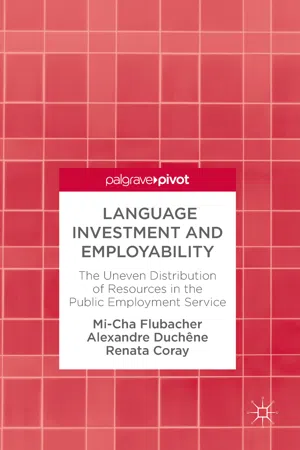
Language Investment and Employability
The Uneven Distribution of Resources in the Public Employment Service
- English
- ePUB (mobile friendly)
- Available on iOS & Android
eBook - ePub
Language Investment and Employability
The Uneven Distribution of Resources in the Public Employment Service
About this book
This book provides a unique insight into negotiations around language investment for employability in the context of public employment services. Drawing on extensive ethnographical research carried out in Regional Employment Offices in Switzerland, the authors follow the stories of various job seekers. In doing so, they challenge the currently dominant assumption that investment in language competences leads to better employability. Arguing for a political economic perspective on these issues, this book will be of interest to anyone concerned with the connections between language and social inequality, as well as students and scholars of sociolinguistics and applied linguistics.
Information
© The Author(s) 2018
Mi-Cha Flubacher, Alexandre Duchêne and Renata CorayLanguage Investment and Employabilityhttps://doi.org/10.1007/978-3-319-60873-0_11. Language Investment and Employability: An Introduction
Mi-Cha Flubacher1, 2 , Alexandre Duchêne2 and Renata Coray2
(1)
University of Vienna, Vienna, Austria
(2)
University of Fribourg, Fribourg, Switzerland
Abstract
The introduction outlines the theoretical and empirical background of a critical sociolinguistic ethnography on the role of language competences in the process of the public employment service. The two key concepts ‘language investment’ and ‘employability’ are discussed and their implied correlation is challenged by pointing to the complex social, political, and economic processes through which languages become valued, recognised, or ignored when looking for a job. The introduction further entails the description of the methodological and analytical framework of this ethnographic research project on the site of the Regional Employment Offices in the Swiss Canton of Fribourg. Finally, it presents the publication’s aim to unpack the discursive construction of language competences as an element of employability and relating it to the uneven distribution of resources.
Keywords
EmployabilityLanguage investmentCritical sociolinguisticsEthnographyUnemployment Learning a new language in order to increase one’s chances on the labour market has become a commonplace strategy, as it appears when glancing through journal articles on this topic and with such headlines emerging as the following: ‘Want to Boost Your Salary? Try Learning German’, 1 ‘Money, dream jobs, a better brain: why everyone should learn a second language’, 2 or ‘Learn a Language, Get a Raise’. 3 The message seems clear: What one has to do in order to find the perfect job and/or earn (more) money is to learn another language. In other words, learning a language is seen as a potentially rewarding return on investment . This opinion is widespread. European citizens, for example, seem to be convinced that knowing foreign languages has a positive impact on their chances of finding a better job, both in their own country and abroad (European Commission 2012, as referred to in Araújo et al. 2015, p. 12). This conviction concurs with the ‘Barcelona Objective 2002’ (European Council 2002), according to which pupils should learn at least two foreign languages at school. While this objective propelled multilingual policies into the limelight of education, it was motivated particularly by the idea that a multilingual population would be of economic benefit for the European Union, most importantly in the form of a productive workforce on a global market (see also Studer et al. 2007). Language learning and language competences are thus reconfigured in terms of ‘investment ’, that is, individual, institutional, or societal investments in terms of financial resources, time, and energy for the development of language competences that (ideally) can be turned into economic profit (Duchêne 2016).
Against the backdrop of this discourse, we argue that the conversion of investment into profit is far from coming about automatically for everyone or for every language. We wonder, for example, what happens to migrants and their multilingual competences , especially when evaluated against competences in the locally dominant language? As it happens, any linguistic competence is valued every so often against competences in the local language , marking speakers as competent or deficient, irrespective of their overall linguistic repertoire. Moreover, while it is difficult to assess concisely the importance of language competences for individual professional success stories, it seems informative to contextualise the question of conversion potential of language competences in the framework of unemployment—especially in comparison with other factors such as personal networks , professional qualifications , and soft skills . After all, unemployment is one of these exemplary moments where the potential conversion is highly contested and put to proof. The proposed correlation of language investment , employability , and professional success thus warrants a critical and empirical investigation in relation to the complex social, political, and economic process through which languages become valued, recognised, or ignored. It is our aim to provide such an investigation in this book. For this, we will raise the following empirical question: Under which conditions, in which contexts, and for whom does language investment actually constitute a key element for employability? Starting from this question, we will investigate the possibility, limits, and effects of what is considered ‘language investment ’, especially with regard to employability. For this aim, we turn to the specific context of the public employment service in the bilingual canton of Fribourg in Switzerland. The institutional framework of the public employment service provides a specific lens onto the complex of language investment and employability . In drawing on this specific case, we propose to rethink language investment and employability in political economic terms, that is, in a perspective that understands individuals as embedded in specific socio-political, economic, and institutional structures, which have to be integrated in research (see also Duchêne 2016).
1.1 Language Investment and Employability: A Critical Sociolinguistic Perspective
Seeing language investment and employability as the two core concepts for this study, we deem it appropriate to introduce the two concepts before turning to discuss how they relate to each other in the current public discourse. Both ‘investment’ and ‘employability’ have gained traction over the last few years in public and political discourse, hence becoming keywords in their own right, that is, as significant in two senses: as ‘binding words in certain activities and their interpretation’ and as ‘indicative words in certain forms of thought’ (Williams 1983, p. 15). When we approach such terms (as investment or employability) as keywords, ‘definitions’ as proposed in dictionaries or textbooks are understood once again as indexical of and contexualised in the current political economy, its power structures, and ‘particular formations of meaning’ (Williams 1983, p. 15). In the following, we will unpack these two terms separately in trying to understand what general meaning they entail, embedding our approach in the research tradition of critical sociolinguistics , but also drawing on work in interactional sociolinguistics , linguistic anthropology , the sociology of work , and other relevant disciplines.
1.1.1 Language Investment
The economic underpinnings of the concept ‘investment’ become evident when considering its general and most basic meaning to invest time, money, or some other resource with the expectation of benefits, that is, of a certain return on investment (see Coen and Eisner 1987 for a detailed description of the term from an economic perspective). The decision to invest is always made with the idea that it will pay off in the future and refigures the object of investment as something—or someone—with a certain potential. This is also central to human capital theory , according to which cost and benefit of investment is a fixed component in education policies (for example, Becker 1993 for how investment is conceptualised in human capital theory). From this perspective, language competences become human capital per se, that is, ‘individual knowledge components’, or skills (for example, Urciuoli 2008, for a critique). Actually, it appears as though language can be considered as two different forms of skills: as belonging to ‘soft skills ’, when communicative competences are at stake (in this case, often labelled as ‘communicative skills’)—or as belonging to ‘hard skills’, when a certain level of language competence is demanded for a certain position.
Yet, in directly (and critically) addressing the work of Becker (for example, 1993), Bourdieu argues (1986, pp. 243–244) that human capital theory (and ‘commonsense view’) sees ‘success or failure as an effect of natural aptitudes’. While also correlating such success (or failure) with monetary investments, ‘they [human capital theorists] are unaware that ability or talent is itself the product of an investment of time and cultural capital ’ (Bourdieu 1986, p. 244). In that, such a human capital perspective remains in a sphere of economic calculation and speculation without taking into account the different forms of capital an individual might have to their disposition. While Bourdieu is focusing on the context of school and academic success and failure, we propose to adopt his understanding of capital when discussing the processes of language investment in the context of the public employment service . According to Bourdieu (for example, 1986, p. 243), we need to differentiate between economic capital (that is, ‘immediately and directly convertible into money’) and c...
Table of contents
- Cover
- Frontmatter
- 1. Language Investment and Employability: An Introduction
- 2. The Politics of Investment and Employability in the Public Employment Service
- 3. The Logic of Return on Language Investment in the Allocation of Resources for Employability
- 4. The Uneven Recognition of Language Investment for Employability
- 5. Concluding Considerations About Language Investment and Employability from a Political Economic Perspective
- Backmatter
Trusted by 375,005 students
Access to over 1.5 million titles for a fair monthly price.
Study more efficiently using our study tools.
Frequently asked questions
Yes, you can cancel anytime from the Subscription tab in your account settings on the Perlego website. Your subscription will stay active until the end of your current billing period. Learn how to cancel your subscription
No, books cannot be downloaded as external files, such as PDFs, for use outside of Perlego. However, you can download books within the Perlego app for offline reading on mobile or tablet. Learn how to download books offline
Perlego offers two plans: Essential and Complete
- Essential is ideal for learners and professionals who enjoy exploring a wide range of subjects. Access the Essential Library with 800,000+ trusted titles and best-sellers across business, personal growth, and the humanities. Includes unlimited reading time and Standard Read Aloud voice.
- Complete: Perfect for advanced learners and researchers needing full, unrestricted access. Unlock 1.5M+ books across hundreds of subjects, including academic and specialized titles. The Complete Plan also includes advanced features like Premium Read Aloud and Research Assistant.
We are an online textbook subscription service, where you can get access to an entire online library for less than the price of a single book per month. With over 1.5 million books across 990+ topics, we’ve got you covered! Learn about our mission
Look out for the read-aloud symbol on your next book to see if you can listen to it. The read-aloud tool reads text aloud for you, highlighting the text as it is being read. You can pause it, speed it up and slow it down. Learn more about Read Aloud
Yes! You can use the Perlego app on both iOS and Android devices to read anytime, anywhere — even offline. Perfect for commutes or when you’re on the go.
Please note we cannot support devices running on iOS 13 and Android 7 or earlier. Learn more about using the app
Please note we cannot support devices running on iOS 13 and Android 7 or earlier. Learn more about using the app
Yes, you can access Language Investment and Employability by Mi-Cha Flubacher,Alexandre Duchêne,Renata Coray in PDF and/or ePUB format, as well as other popular books in Languages & Linguistics & Labour Economics. We have over 1.5 million books available in our catalogue for you to explore.