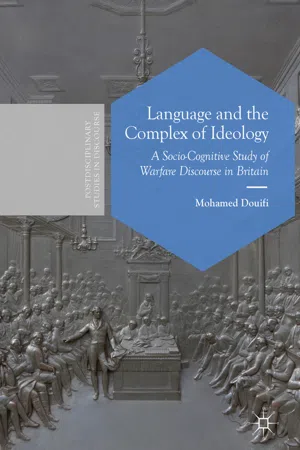
This book undertakes a systematic analysis of the workings of ideology in discourse, using an interdisciplinary approach that links language, cognition and society. Through examination of two corpora - a collection of British newspaper articles and a set of political speeches - the author examines Britain's involvement in the Iraq War (2003), and critically assesses the language practices which constructed a pro-war ideology under Tony Blair's premiership. Drawing on a constellation of concepts from van Dijk's socio-cognitive model, this book carries out both qualitative and quantitative analyses and conceptualises discourse as a nonlinear, highly discursive and socio-cognitive phenomenon. This innovative work will appeal to students and scholars of Cognitive Linguistics, Quantitative Linguistics, Social Constructivism, Critical Discourse Analysis, Political Sciences and Communication Studies.
eBook - ePub
Language and the Complex of Ideology
A Socio-Cognitive Study of Warfare Discourse in Britain
- English
- ePUB (mobile friendly)
- Available on iOS & Android
eBook - ePub
Language and the Complex of Ideology
A Socio-Cognitive Study of Warfare Discourse in Britain
About this book
Information
© The Author(s) 2018
Mohamed DouifiLanguage and the Complex of IdeologyPostdisciplinary Studies in Discoursehttps://doi.org/10.1007/978-3-319-76547-1_11. Introduction
Mohamed Douifi1
(1)
English Department, University of Algiers-2, Algiers, Algeria
Mohamed Douifi
This study addresses the discursive legitimization strategies in the controversial discourse of Blair on the Iraq War (2003) and demonstrates how this was reproduced in the British “quality” press. The ramifications of the war are still unfolding in the Middle East and raising serious questions about the jurisdiction and role of the United Nations (UN). As the qualitative and empirical findings indicate, there was much emphasis on moralism in Blair’s discourse to justify his interventionist policy in Iraq and elsewhere. The ethical claim was subsequently embraced by the press as a legitimate cause for war when the military machine crossed the borders of Iraq. Recurrent references were also made to the threat of Saddam’s “nuclear weapons” and his support of international terrorism. The empirical illustration provided in this book not only consolidates the qualitative interpretations I advanced on how ideology permeates the threads of discourse, but also solves some issues that relate particularly to the cognitive analysis of language.
At an abstract theoretical level, I argue that behind the surface language structure lies another highly complex socio-cognitive web of structures that define and assign particular meaning to events and social objects. In this sense, language itself cannot adequately express such intricacy, and hence, much of what people want to convey through language remains partly incomplete or fragmented. Understanding such metalevel of discourse would necessitate a multifaceted method of analysis that meticulously scrutinizes many aspects of language use. This is why I opted to conduct this study within the Critical Discourse Studies (CDS) framework, which is less reductionist and rich, both in terms of theory and in terms of methodology. As it stands, this book contributes to the field of discourse analysis and adds original insights to the contemporary CDS approaches that are more cognitively oriented. It is also relevant for other disciplines that consider the function of language in society such as social constructivism, quantitative linguistics, political science, media and communication studies.
It is worthwhile noting at the very outset that the methodological rationale of this research work is grounded within the field of CDS , which is also alternatively, but perhaps not quite appropriately, dubbed Critical Discourse Analysis (CDA). Because the latter label sounds somewhat reductionist in regard to the spacious domain of “language analysis”, it is now far less used. Following Teun A. van Dijk, (Critical) Discourse Studies is an umbrella epithet that is more apt than the traditional and misleading label “Critical Discourse Analysis”, which has been universally embraced since the early 1990s. This tradition of discourse critique is especially associated with the works of Teun A. van Dijk himself, Norman Fairclough, Ruth Wodak, Paul Chilton, Theo van Leeuwen, James Paul Gee and other research groups and schools.1
This would reduce CDA to a mere branch of inquiry or “school” under the broad realm of CDS , which includes a wide range of methods and approaches—some of which are predominantly descriptive. Indeed, such a view has recently been shared by many other leading scholars as well. Van Dijk clarifies that “this more general term suggests that such a critical approach not only involves critical analysis, but also critical theory, as well as critical applications. The designation CDS may also avoid the widespread misconception that a critical approach is a method of discourse analysis” (2009a, p. 62). He further comments that “discourse studies is often defined as the contemporary discipline of what used to be called rhetoric since antiquity, that is, the practice and study of ‘good’ public speaking and writing, for instance in parliament, in court or in literature” (2007, p. xxix). Amongst the very essential preoccupations of this trans-discipline is to mediate on the form–function dichotomy in language use, bringing together a broad range of disciplines from across the social sciences and humanities in one melting pot (see Angermuller, Maingueneau, & Wodak, 2014; Hart & Cap, 2014). Christopher Hart adds that “CDS is principally concerned with the communication and discursive construction of social, including political, knowledge, as well as with linguistic persuasion and manipulation. These processes, however, must ultimately be grounded in the cognitive systems of interacting social agents” (2011, p. 1).
Ostensibly, following the boom in the philosophy of language that was inaugurated by the linguistic shift of the 1960s or thereabouts, several scholars endeavoured to refine our understanding of language and its function in the social world. Shortly thereafter, their collective efforts were crystallized in a bunch of innovative conceptual frames of reference, models and theories which sought to advance a systematic and more objective critique of the various types of discourse. Thenceforth, a cluster of heterogeneous strategies were suggested which winded their way through a variety of disciplines, primarily linguistics, sociology, psychology and philosophy, to name but a few. It was inevitable, however, due to this highly intricate, and sometimes asymmetric, convergence between linguistics and social theory that discourse analysis would become a thriving subject of research in its own right. This was indeed a major leap in the general theory of language, yet there remain some unresolved theoretical issues and lacunae vis-à-vis the nature of discourse, and particularly the parameters involved in discourse processing and analysis.
In order to avoid the ambiguity that might arise from the vast literature in the realm of discourse analysis, one might need to highlight once again the fact that CDA has been defined in a myriad of ways, which were sometimes at odds with each other. The reason for such flexibility in the theory of CDA is not hard to discover. Put simply, the various schools that emerged especially from the 1970s onwards embraced different conceptualizations of discourse, and implemented strategies of critique that were congruent with their own perceptions and research objectives. Furthermore, those fundamental idiosyncratic discrepancies, both in terms of theory and praxis, were informed by the heterogeneous domain assumptions adopted by these schools that may originate from different disciplinary backgrounds. Nonetheless, they do sometimes intersect and reinforce each other.
Based on this thriving theoretical framework, I attempt to scrutinize the relationship between language use and ideology, taking the military involvement of Britain in the 2003 Iraq War as a case study.2 At a narrow level, the goal is twofold.
First, to examine the strategies of legitimization in Blair’s discourse through the analysis of the lexico-semantic structure of his language so as to link such structure with power relations, cognitive processes and structures in society. In other words, I seek in the first place to unscramble the ideological load of language which is mostly, but not necessarily, embedded in the grammar, vocabulary and style that characterized Blair’s political discourse. Close attention, however, is paid to his controversial pro-war stance in relation to Iraq. The other contextual elements, the historical, socio-cognitive and political in particular, are equally discussed because they are important to make sense of the meaning of language in the situation where it is used. The term “ideology”, then, designates one of the most essential concepts in this book, whose overall purpose is to comment on both the conscious and unconscious workings of ideology in society and language.
Second, the above-mentioned components are examined once more in an extended corpus of news articles (CNA) taken from some well-circulated British “quality” papers: The Daily Telegraph , The Guardian and The Independent . In this respect, one has to bear in mind that in a democracy such as Britain, the discourse of the press is supposed to be independent from the shackles of the official ideology and its overt political biases. This is especially so when it comes to cover a controversial issue such as a military offensive against another sovereign state, as will be exemplified in the case of Iraq.
Obviously, the study of ideology and discourse is not a totally nascent subject area of research, but genuinely rooted in the traditional disciplines of the social sciences and humanities, most plainly, perhaps, in rhetoric studies and literary criticism. What is continuously changing is the lens through which we look at the widely diverse societies, their cultural patterns, ways of seeing and ideologies , where language is still a key instrument to decipher the complexity of these social worlds.
One of the preoccupations of contemporary social theorists and linguists, amongst many other scholars, is to come up with a comprehensive and thorough account on the multiple articulations of ideology in discourse. Indeed, this is the very same concern of this research work, which is based on a cross-disciplinary methodology, giving prominence to the social and cognitive dimensions of language use. That is to say, it aims to decode ideology in discourse through a critical reading of the surface structure of language, as well as its deep structure. Such a flexible mod...
Table of contents
- Cover
- Front Matter
- 1. Introduction
- 2. Basic Theoretical Insights on Ideology and Discourse Analysis
- 3. Contemporary Orientations in Discourse Studies
- 4. The Anglo-Iraqi Relationships: A Historical Overview
- 5. Blair’s Foreign Policy Discourse on Iraq
- 6. The Discursive Construction of the Iraq War in the British “Quality” Press
- 7. Conclusion
- Back Matter
Trusted by 375,005 students
Access to over 1.5 million titles for a fair monthly price.
Study more efficiently using our study tools.
Frequently asked questions
Yes, you can cancel anytime from the Subscription tab in your account settings on the Perlego website. Your subscription will stay active until the end of your current billing period. Learn how to cancel your subscription
No, books cannot be downloaded as external files, such as PDFs, for use outside of Perlego. However, you can download books within the Perlego app for offline reading on mobile or tablet. Learn how to download books offline
Perlego offers two plans: Essential and Complete
- Essential is ideal for learners and professionals who enjoy exploring a wide range of subjects. Access the Essential Library with 800,000+ trusted titles and best-sellers across business, personal growth, and the humanities. Includes unlimited reading time and Standard Read Aloud voice.
- Complete: Perfect for advanced learners and researchers needing full, unrestricted access. Unlock 1.5M+ books across hundreds of subjects, including academic and specialized titles. The Complete Plan also includes advanced features like Premium Read Aloud and Research Assistant.
We are an online textbook subscription service, where you can get access to an entire online library for less than the price of a single book per month. With over 1.5 million books across 990+ topics, we’ve got you covered! Learn about our mission
Look out for the read-aloud symbol on your next book to see if you can listen to it. The read-aloud tool reads text aloud for you, highlighting the text as it is being read. You can pause it, speed it up and slow it down. Learn more about Read Aloud
Yes! You can use the Perlego app on both iOS and Android devices to read anytime, anywhere — even offline. Perfect for commutes or when you’re on the go.
Please note we cannot support devices running on iOS 13 and Android 7 or earlier. Learn more about using the app
Please note we cannot support devices running on iOS 13 and Android 7 or earlier. Learn more about using the app
Yes, you can access Language and the Complex of Ideology by Mohamed Douifi in PDF and/or ePUB format, as well as other popular books in Languages & Linguistics & Computer Science General. We have over 1.5 million books available in our catalogue for you to explore.