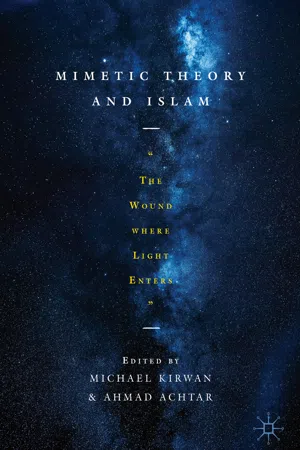
This volume explores the 'Mimetic Theory' of the cultural theorist René Girard and its applicability to Islamic thought and tradition. Authors critically examine Girard's assertion about the connection between group formation, religion, and 'scapegoating' violence. These insights, Girard maintained, have their source in biblical revelation. Are there parallels in other faith traditions, especially Islam? To this end, Muslim scholars and scholars of Mimetic Theory have examined the hypothesis of an 'Abrahamic Revolution.' This is the claim that Judaism, Christianity, and Islam each share in a spiritual and ethical historical 'breakthrough:' a move away from scapegoating violence, and towards a sense of justice for the innocent victim.
eBook - ePub
Mimetic Theory and Islam
"The Wound Where Light Enters"
- English
- ePUB (mobile friendly)
- Available on iOS & Android
eBook - ePub
Mimetic Theory and Islam
"The Wound Where Light Enters"
About this book
Information
Topic
Theology & ReligionSubtopic
Islamic Theology© The Author(s) 2019
Michael Kirwan and Ahmad Achtar (eds.)Mimetic Theory and Islamhttps://doi.org/10.1007/978-3-030-05695-7_11. The Wound Where Light Enters: Mimetic Theory and Islam
Michael Kirwan1 and Ahmad Achtar2
(1)
Loyola Institute, Trinity College Dublin, Dublin, Ireland
(2)
School of Advanced Study, University of London, London, UK
Introduction: A New Optic
This volume is an investigation into the possible convergence of a prominent Christian theorist of religion, René Noel Girard (1923–2015), and the scriptures, traditions, and beliefs of Islam. It is the fruit of several conferences and much scholarship, involving specialists in Girard’s ‘Mimetic Theory’ and academics from both faith traditions and Jewish scholars. It records a bracing intellectual and spiritual adventure, but a challenging one, not least, because there are two time frames in operation. On the one hand, authentic and respectful inter-religious dialogue requires time and a painstaking readiness to listen to the other and to learn from them. This cannot be a short-term project. Considered from another angle, however, time is what we do not have. The challenges we face as a species—political and ecological—urgently require a conversion to new patterns of behaviour. The great religious traditions provide us with a vocabulary to describe our context: ‘apocalyptic’. Can they also provide us with the wisdom we need to survive? The answer, we hope, is ‘yes’; but there is no time to lose.
The late Robert Hamerton-Kelly has urged the importance of Girard’s ‘Mimetic Theory’ because of its relevance to our time. Above all, because it explores the persistent connection between religion and violence which has become a cliché in both intellectual and popular circles. He reminds us that ‘the power of a theory is its ability to guide our attention to the important phenomena in the field’:
I believe that the overriding fact of our time is violence; therefore a theory that attempts to make sense out of violence is more likely to orient us to the points in the field that are salient for our time … there is a congruence between our times, our texts, and our tradition that makes for a powerful interpretive constellation. (Hamerton-Kelly 1992, p. 5)
‘Our time, our texts, and our tradition’. Hamerton-Kelly was a Christian theologian, with particular expertise in the New Testament; so the ‘texts and tradition’ he refers to here are primarily those of Christianity. The question that concerns us here is whether this ‘interpretive constellation’ can, or should, include the texts and tradition of another world faith, namely, Islam.
Violence is our starting point, simply because it is the ‘overriding fact of our time’. But it cannot be our finishing point. The present volume is not, or not just, another contribution to the massive literature on ‘religion and violence’. Girardian theory differs from other treatments of this dismal subject because of its peculiar status, as ‘not-quite theory of religion’ and ‘not-quite theology’. Girard makes huge claims, citing anthropological, social, historical, psychological data; but the argument in which this data is deployed points towards the ‘insider’s’ experience of religion. The theory speaks of personal and group conversion and the rejection of idolatry; it takes seriously religious practices of asceticism and right worship.
Girard’s work can be described as a ‘theologically inflected anthropology’. More dramatically, the philosopher Jean-Marie Domenach (1988) speaks of a ‘voyage to the end of the sciences of man’. According to Domenach, Girard’s thinking sails perilously close to the abyss of nihilism, before performing an amazing volte-face which brings the human sciences ‘gloriously back to the Kingdom of God’. Sometimes, as Girard himself has noted, a thinker will push so far into scepticism or unbelief, only to find himself coming out the other side.
In Girard’s own case, a new awareness of the importance of Christianity struck him as he was preparing a book on great western literature in the late 1950s. At the same time, a health scare shook him into returning to the practice of Catholicism after several decades’ absence. But such a change of optic is rare (especially among French intellectuals). We have spoken of an ‘interpretive constellation’; let us consider another cosmological image. A character in Jumpers, a play by Tom Stoppard, asserts to his philosopher colleague that it was perfectly understandable that people should believe the sun went around the earth because, prior to the astronomical discoveries of Copernicus, ‘that’s what it looked like’. His colleague retorts: ‘In that case, what would it have looked like if the earth went round the sun?’
The answer, of course, is ‘exactly the same’. Thanks to the advancement of science, people were eventually able to adjudicate between these two optics; but to anyone without access to astronomical investigation, there is nothing to choose between them. We cannot say that people in the Middle Ages were ‘deceived by appearances’ or that ‘their eyes deceived them’. Nevertheless, those people found one explanation—the geocentric one—to be more intuitively convincing and persuasive than its (correct) alternative, the heliocentric.
Why should this be so? Is it sheer force of habit and intellectual inertia that makes us ‘see’ things one way, rather than the other: basically, a lack of creativity and imagination?
Or are there more sedimented resistances within us, to those changes of perspective that dislocate us, not just physically but spiritually and existentially? The trial of Galileo is the notorious example of ‘knowledge’ clashing with ‘human interest’. Galileo’s observations (or so we are told) were suppressed, on account of their perceived challenge to political and religious authority. In this way, the Galileo affair becomes the paradigm example of a perennial stand-off between ‘faith’ and ‘science/reason’.
In Stoppard’s play, the lunar landing of 1969 is a traumatic symbol of relativized humanity, seen, for the first time, whole and vulnerable. The ‘Copernican Revolution’, and its decentring of mankind, is a symbol for the dethroning of God. Modernity has exiled God to the extremities of distant causality, before declaring the idea of deity to be obsolete and dispensable altogether.
From this modern secular perspective, religious believers have been and continue to be in thrall to a ‘groupthink’ which imprisons them in one optic and prevents them from trying out another lens.
René Girard advocates a ‘Copernican Revolution’—one which, surprisingly, goes against the grain of modernity, by drawing us back to religious belief rather than away from it: a ‘voyage to the end of the sciences of man’. His work is an engagement with, but also a riposte to, the ‘master thinkers’ of sceptical modernity: Freud, Nietzsche, and to a lesser extent, Marx, each of whom has sought to overcome religious belief by offering sets of alternative optics. What just looks like evidence for divine existence is, in fact, something otherwise: the projections of a powerful ‘groupthink’ (engendered by arrested psychological development or by resentment at unequal power relations or by the anguish of alienating social and economic conditions).
Girard turns the hourglass on its head: what would human existence just look like, if its turbulence and fearful discontents were the product, not of social or personal alienations but of our encounter with, and resistance towards, the advent of the Living God?
René Girard is ‘Copernican’ in two ways: firstly, as a thinker who brings us back, surprised, to the possibility of faith, after the ravages of critical assault (consider the famous words of the philosopher Paul Ricoeur: ‘beyond the desert of criticism, we wish to be called again’).1 Secondly, and more specifically, Girard’s contribution to the rather tired debate of whether religion is a ‘cause’ of violence sees him invert the hourglass once more. His ‘Mimetic Theory’ asserts a kind of relationship of complicity—but asks whether the causal flow is the other way: ‘violence causes religion’.
Part One: Mimetic Theory; A Brief Overview
René Girard’s first book Deceit, Desire and the Novel was published in 1961 (Girard 1965 [1961]). In this work, he describes how five great European writers, Cervantes, Flaubert, Stendhal, Proust, and Dostoevsky, portray in their novels a sort of transcendence or conversion process, not necessarily in the Christian sense, which involves the collapse of ‘the autonomous self’, or the romantic idea that we are totally independent individuals whose wants and desires originate within ourselves. Each of these writers was aware that desire is ‘mimetic’, or imitative, and that we learn to desire through the eyes of another or others.
To express this geometrically: desire is a triangle of subject, model, and object. What begins as acquisitive desire, involving an object or something of a tangible nature, can take on a metaphysical nature, such as the desiring of another’s reputation, fame, state of well-being—or even personal fulfilment or holiness; not so much what the model has, but what they are.
All desire is mimetic, but not necessarily in a negative, conflictual sense. Jean-Michel Oughourlian recounts:
This ‘disorder’ does not simply refer to the disordered psyche; it has important repercussions in social existence. Girard maintains that in archaic societies, acquisitive mimesis (the covetousness directed at the possessions of another person) was an ever-present source of rivalrous violence. As violence, by its mimetic nature, is highly contagious, this posed a constant threat to the community’s very survival. Entire communities would be wiped out in conflicts over scarce goods, as no mechanism existed to arbitrate these conflicts. With no police force, judicial system, or social contract to control it, violence was dispelled by sacrificial rites, which evolved as an outlet of diffusion and containment. Consequently, the build-up of violence in a community would be contained by projecting the violence onto someone or something. The victim was usually vulnerable: a prisoner of war, a tribal outcast, or a person without connections in the community. This eliminated the possibility of retaliation that would prolong or reignite the violence. I...My years of research and clinical observation have convinced me that it is indeed desire that humanises us, that impels us to unite with each other, to associate with each other, to assemble in groups, and also, as we will see, to resemble each other. It forms us in proportion as it animates us and arouses our thoughts and feelings. Desire leads us to seek out the company of others, their approval, their friendship, their support, and their recognition. But this can also be accompanied by rivalry and hatred; it can arouse both love and violence. (Oughourlian 2010, p. 11)
Table of contents
- Cover
- Front Matter
- Part I. The Argument
- Part II. Texts
- Part III. Traditions
- Part IV. Christianity and Islam in Resentful Modernity
- Back Matter
Trusted by 375,005 students
Access to over 1.5 million titles for a fair monthly price.
Study more efficiently using our study tools.
Frequently asked questions
Yes, you can cancel anytime from the Subscription tab in your account settings on the Perlego website. Your subscription will stay active until the end of your current billing period. Learn how to cancel your subscription
No, books cannot be downloaded as external files, such as PDFs, for use outside of Perlego. However, you can download books within the Perlego app for offline reading on mobile or tablet. Learn how to download books offline
Perlego offers two plans: Essential and Complete
- Essential is ideal for learners and professionals who enjoy exploring a wide range of subjects. Access the Essential Library with 800,000+ trusted titles and best-sellers across business, personal growth, and the humanities. Includes unlimited reading time and Standard Read Aloud voice.
- Complete: Perfect for advanced learners and researchers needing full, unrestricted access. Unlock 1.5M+ books across hundreds of subjects, including academic and specialized titles. The Complete Plan also includes advanced features like Premium Read Aloud and Research Assistant.
We are an online textbook subscription service, where you can get access to an entire online library for less than the price of a single book per month. With over 1.5 million books across 990+ topics, we’ve got you covered! Learn about our mission
Look out for the read-aloud symbol on your next book to see if you can listen to it. The read-aloud tool reads text aloud for you, highlighting the text as it is being read. You can pause it, speed it up and slow it down. Learn more about Read Aloud
Yes! You can use the Perlego app on both iOS and Android devices to read anytime, anywhere — even offline. Perfect for commutes or when you’re on the go.
Please note we cannot support devices running on iOS 13 and Android 7 or earlier. Learn more about using the app
Please note we cannot support devices running on iOS 13 and Android 7 or earlier. Learn more about using the app
Yes, you can access Mimetic Theory and Islam by Michael Kirwan, Ahmad Achtar, Michael Kirwan,Ahmad Achtar in PDF and/or ePUB format, as well as other popular books in Theology & Religion & Islamic Theology. We have over 1.5 million books available in our catalogue for you to explore.