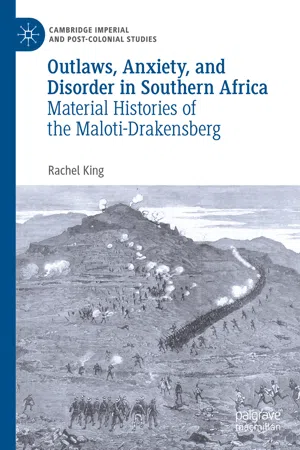
This book explores how objects, landscapes, and architecture were at the heart of how people imagined outlaws and disorder in colonial southern Africa. Drawing on evidence from several disciplines, it chronicles how cattle raiders were created, pursued, and controlled, and how modern scholarship strives to reconstruct pasts of disruption and deviance. Through a series of vignettes, Rachel King uses excavated material, rock art, archival texts, and object collections to explore different facets of how disorderly figures were shaped through impressions of places and material culture as much as actual transgression. Addressing themes from mobility to wilderness, historiography to violence, resistance to development, King details the world that raiders made over the last two centuries in southern Africa while also critiquing scholars' tools for describing this world. Offering inter-disciplinary perspectives on the past in Africa's southernmost mountains, this book grapples with conceptsrelevant to those interested in rule-breakers and rule-makers, both in Africa and the wider world.
Rachel KingOutlaws, Anxiety, and Disorder in Southern AfricaCambridge Imperial and Post-Colonial Studies Serieshttps://doi.org/10.1007/978-3-030-18412-4_1
Begin Abstract
1. Introduction: The Slow Regard of Unruly Things
Rachel King1
(1)
Institute of Archaeology, University College London, London, UK
In July 1879, southern Africa’s Cape Parliament convened an inquest into a conflict in Basutoland (present-day Lesotho), a territory that the Cape Colony had annexed only eight years previously but had already erupted into rebellion (Fig. 1.1).1 The enquiry focused on the events leading to the rebellion, the actions of the administrators involved, and what may have been done to prevent the insurgency of Moorosi, leader of a group of people called BaPhuthi. This last question, however, ultimately became one of history and culture. Testimony from officials and ethnologists dissected the traditions and socio-politics of Moorosi’sBaPhuthi, attempting to parse their pre-rebellion activities and ways of life: Was there something in BaPhuthi culture to make this polity inherently unruly? If so, could this have spread to other Africans with whom they came into contact? What gestures or patterns of behaviour should have warned Basutoland’s administrators that rebellion was coming? And was Moorosi best understood as the malcontent chief of a minority tribe or as the politically astute ‘head of a banditti’ of cattle thieves (Theal 2002, IV, 176–177)?
Fig. 1.1
Map of southern Africa in the nineteenth century, with places mentioned in the text of this chapter. (Image created by author)
The 1879 inquest took place amidst wider fears of potential uprisings by southern African chiefdoms, particularly in places where British governments were seeking to consolidate their authority over land, labour, and natural resources. Only six months earlier British forces had been defeated by Cetshwayo’s Zulu at the Battle of Isandlwana and the outcome of the Anglo-Zulu war over Natal Colony was uncertain. The late 1870s saw the Pedi leader Sekhukhune in violent conflict with Afrikaans-speaking Boer and British troops in the Transvaal Republic, especially following British annexation of this territory in 1877.
These clashes occurred against the backdrop of a subcontinent that had, over the course of the eighteenth and nineteenth centuries, witnessed large-scale demographic changes, internal political transformations, and fitful fluctuations of colonial frontiers (Parsons 1995; Etherington 2001; Landau 2010). The 1806 founding of the British Cape Colony heralded more than a century of colonial boundaries expanding and contracting eastward and northward from Cape Town and, ultimately, a proliferation of new colonies, protectorates, and annexures. This expansion manifested itself in different colonialisms, including mission stations (King and McGranaghan 2018), the eastward movement of Afrikaans-speaking trekboere dissatisfied with British rule (Giliomee 2003), speculators and surveyors driving competition for land (Keegan 1988; Braun 2014), and enhanced demands for labour (Crais 1992; Keegan 1996; Lester 2005).
These colonial projects intersected with and fuelled transformations within African political cultures that had been fulminating since the late eighteenth century. Largely agropastoralist, Bantu-speaking chiefdoms competed for cattle, followers, and land on the high plains (Highveld), the eastern coast, and its adjoining midlands (Etherington 2001). Ambitious leaders like the Basotho chief Moshoeshoe (paramount and progenitor of the area that became Basutoland) developed novel political cultures and strategies, creating new social orders and transforming the African political landscape during the first half of the nineteenth century (Landau 2010). Colonialist intrusions impacted these events, and resulted in European constituencies who saw these political movements as obstacles to progress and order (Etherington 2004, 2011). This period of mobility and political change in the early nineteenth century has been referred to as thelifaqane (Sotho, ‘time of troubles’), and featured in contemporary settler narratives as a time of disorder caused by the intemperance of African chiefs (Parsons 1995; Etherington 2001, 333). Later revisionist scholarship has critiqued the alarmism of these accounts, instead describing decades characterised by chiefly ambitions, hunger, and violence as well as political creativity and cultural change. Meanwhile, spaces that were too difficult for expanding governments to access like the Maloti-Drakensberg Mountains (whose southern reaches formed part of Moorosi’s territory) remained at the edges of these events, although very much influenced by them, as the mountains saw influxes of people dubbed outlaws, deserters, and raiders whose activities placed them outside of recognised legalboundaries (Wright 1971; King and Challis 2017).
The questions raised during the inquest into what became known as Moorosi’s War thus implicated larger concerns for a southern African colony that was still very much an arrangement of frontiers: Is disorder contagious? Can one predict disorderly behaviour by studying African culture? If so, what were the ramifications for the emergent fields of anthropology and African history?
1.1 The Disorder of Things
These concerns about disorder, how it was interpreted and checked, and how these perceptions coloured the racism of institutional controls and history-writing alike are familiar territory in the study of the recent past in Africa (e.g. Fleisher 2004; Wright 2007). Indeed, historians and anthropologists of southern Africa have provided nuanced, incisive vocabularies and analytical lenses for dissecting the notions of disorder that manifested themselves during the inquest into Moorosi’s War.
Paul Landau’s (2010) Popular Politics in South Africa directs us to consider how mis-translations of African politics by missionaries and colonial administrators might have led European observers to interpret the rebellion (and, indeed, Moorosi’s entire polity) as more monolithic than it was in reality. Moorosi’s War may have been less a unified rebellion than a protest heightened through colonial mis-understanding. Carolyn Hamilton’s (1998) Terrific Majesty would have us look to the limits of colonial imagination, and how authorities’ interpretations of Moorosi’s conduct were inflected by their impressions of other African leaders and the tropes of despotism, savagery, and destruction that accompanied them. Elizabeth Eldredge’s (2007) Power and Discourse in Colonial Africa suggests reading documentary sources for ‘hidden transcripts’ of African authority in the face of (often precarious) colonial power. Her reading of the prelude to Moorosi’s War emphasises how the rebellion’s eruption was due in no small part to the ability (or more often the inability) of Basutoland’s magistrates to understand the logic behind Moorosi’s many provocations of the new administration, and modulate their behaviour accordingly. The magistrates themselves represented a disorderly force that fuelled the conflict. Peter Sanders’ (2011) ‘Throwing Down White Man’ would similarly have us look to the ‘mis-rule’ of Basutoland’s young administration, and especially to how British intervention in Basutoland and the slow erosion of Moorosi’s chiefly powers compounded the BaPhuthi leader’s long-simmering frustrations with the limits to his authority imposed by the ruling Basotho lineage. In this, Sandersjoins Sandra Burman (1981) in suggesting that reactions to Moorosi’s disorder represented the collision of internal African political tensions with new European legislation.
From an anthropological perspective, Jeanand John Comaroff (2006) suggest that the drive to discipline disorder should be seen as more about performing than enacting the force of law—a long-term melodrama attempting to cover up where the state’s power was slipping. This was perhaps especially necessary in 1879, as southern Africa was seeing a series of armed conflicts between Africans and Europeans in areas that were far from politically stable. Moorosi’s War was feared to be a spark that would ignite a wider series of uprisings (see Chap. 6).
For me as an archaeologist, the inquest into Moorosi’s War, and particularly the suggestion of its roots in something long ago and culturally innate, evokes questions concerning time-depth, space, and material culture that underlie debates about the antiquity or endurance of unruliness. Rather than follow the Parliamentarians’ queries of ‘how disorderly were these rebels?’, we could ask ‘how were Moorosi and his BaPhuthi construed as disorderly?’. Pushing further, I wonder how perceptions of unruliness, dissent, and deviance were rooted in perceptions of the material world, of inscrutable bodies, and of places that inspired frustration and fear. How did material experiences—archaeological traces of the distant past, and the movements, behaviours, accoutrements, and dwellings of people in the more recent past—help to conjure impressions of disorder through memory, rumour, and mystery? Were people imagined as disorderly—not just Moorosi but others deemed a security threat—aware of this? Did they incorporate this awareness into their lives? What patterns, experiences, and knowledge networks led people to view crisis as they did, react to it as they did, and ask the questions that they did?
This sort of archaeological perspective is not just about trying to describe the material aspects of African history, although it certainly enables this. Ultimately, it is about identifying and exploring habits of reasoning, of making sense, and of making history that have taken place in the last two centuries and that implicated the physical world in different, unexpected ways. Lying beneath the inquest into Moorosi’s War are deeper colonial impressions about how African chiefdoms should behave—had always behaved—and what misbehaviour looked and felt like in the nineteenth century, ideas that underpinned history-writing, gaol-building, law-making, war-making, and other projects that left material traces of their own.
This is a book about these practices of...
Table of contents
Cover
Front Matter
1. Introduction: The Slow Regard of Unruly Things
2. ‘Waste-howling wilderness’: The Maloti-Drakensberg as Unruly Landscape
3. ‘Were they half civilized?’ Knowledge and Reminiscence in the Maloti-Drakensberg
4. Un-Settled Encounters; or, if Walls Could Speak
5. ‘Appetite comes with eating’: Of Raiding and Wrong-Doing
6. Persist, Resist: Rebellion in Slow Motion
7. Things of the Nation: Disorderly Heritage
8. Conclusion
Back Matter
Trusted by 375,005 students
Access to over 1.5 million titles for a fair monthly price.
Study more efficiently using our study tools.
Frequently asked questions
Yes, you can cancel anytime from the Subscription tab in your account settings on the Perlego website. Your subscription will stay active until the end of your current billing period. Learn how to cancel your subscription
No, books cannot be downloaded as external files, such as PDFs, for use outside of Perlego. However, you can download books within the Perlego app for offline reading on mobile or tablet. Learn how to download books offline
Perlego offers two plans: Essential and Complete
Essential is ideal for learners and professionals who enjoy exploring a wide range of subjects. Access the Essential Library with 800,000+ trusted titles and best-sellers across business, personal growth, and the humanities. Includes unlimited reading time and Standard Read Aloud voice.
Complete: Perfect for advanced learners and researchers needing full, unrestricted access. Unlock 1.5M+ books across hundreds of subjects, including academic and specialized titles. The Complete Plan also includes advanced features like Premium Read Aloud and Research Assistant.
Both plans are available with monthly, semester, or annual billing cycles.
We are an online textbook subscription service, where you can get access to an entire online library for less than the price of a single book per month. With over 1.5 million books across 990+ topics, we’ve got you covered! Learn about our mission
Look out for the read-aloud symbol on your next book to see if you can listen to it. The read-aloud tool reads text aloud for you, highlighting the text as it is being read. You can pause it, speed it up and slow it down. Learn more about Read Aloud
Yes! You can use the Perlego app on both iOS and Android devices to read anytime, anywhere — even offline. Perfect for commutes or when you’re on the go. Please note we cannot support devices running on iOS 13 and Android 7 or earlier. Learn more about using the app
Yes, you can access Outlaws, Anxiety, and Disorder in Southern Africa by Rachel King in PDF and/or ePUB format, as well as other popular books in History & African History. We have over 1.5 million books available in our catalogue for you to explore.