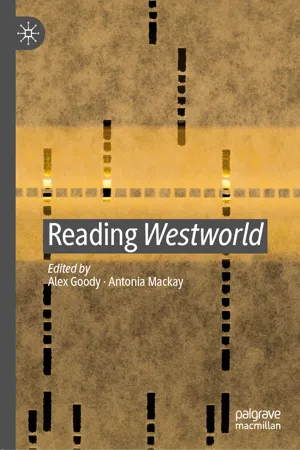
Reading Westworld is the first volume to explore the cultural, textual and theoretical significance of the hugely successful HBO TV series Westworld. The essays engage in a series of original enquiries into the central themes of the series including conceptions of the human and posthuman, American history, gaming, memory, surveillance, AI, feminism, imperialism, free will and contemporary capitalism. In its varied critical engagements with the genre, narratives and contexts of Westworld, this volume explores the show's wider and deeper meanings and the questions it poses, as well considering how Westworld reflects on the ethical implications of artificial life and technological innovation for our own futurity. With critical essays that draw on the interdisciplinary strengths and productive intersections of media, cultural and literary studies, Reading Westworld seeks to respond to the show's fundamental question; "Have you ever questioned the nature of your reality?" It will be of interest to students, academics and general readers seeking to engage with Westworld and the far-reaching questions it poses about our current engagements with technology.
- English
- ePUB (mobile friendly)
- Available on iOS & Android
eBook - ePub
Reading Westworld
About this book
Information
Subtopic
Film & Video© The Author(s) 2019
Alex Goody and Antonia Mackay (eds.)Reading Westworldhttps://doi.org/10.1007/978-3-030-14515-6_11. Introduction
Alex Goody1 and Antonia Mackay1
(1)
Oxford Brookes University, Oxford, UK
In 2016, we were both researching the role of technology within very different academic contexts. Alex was working on gendered forms of technology specific to modernism such as those in radio, cinema and advertising, whilst Antonia was working on a new surveillance studies series, researching biodata and the role of the lens. How we both came to be interested in HBO’s Westworld is perhaps less surprising than these disparate research areas may first suggest. Despite our various academic specialisms, we have often found that our interests in culture frequently collide. We both possessed a fascination with all things X Files, an affection for Supernatural and a weakness for Stranger Things. Gradually, our mutual obsession with Westworld began to surface at informal gatherings—at birthdays, drinks, celebrations—and then more formally, at meetings, in staff offices and over coffee. Whilst we both work within the discipline of English Literature, we share a (not-so-secret) fascination with the interaction between literature and its broader culture. What began as a weekly conversation about the show’s references to American culture and history, literary intertextuality and posthumanism, quickly turned into a passion project, culminating in this collection’s creation. To use the words of the Man in Black (played by Ed Harris) “there’s a deeper level to this game” (“The Original”, Season 1, Episode 1), and it is our intention that the chapters collected in this volume disclose these buried levels.
Robots, Androids and Cyborgs
We write this introduction at a point in human history when the robotic and the human are frequently entangled and even intimate. Recent television documentaries such as Sex Robots and Us (BBC Three, 2018), My Sex Robot (Netflix, 2010) and The Sex Robots Are Coming (Channel 4, 2017) speak of our increasing gadgetisation and normalisation of the robotic. Yet, there is nothing new in our reliance upon the robotic, as the Turing Test (1950), Manfred Clynes’ cyborg (or cybernetic organism) (1956) and Ted Nelson’s coining of the terms hypertext and hypermedia in 1963 (Nelson 1965), indicate. The robotic, certainly from a western context, extends much further back than our recent technological advances would suggest, as far, perhaps, as the mythical automata of Ancient Greece and Rome, or the Golem of Jewish folklore. The Tin Woodman of L. Frank Baum’s The Wonderful Wizard of Oz (1900), and Nikola Tesla’s radio controlled electric boat (dubbed the “telautomaton”) further suggest the presence of the robotic in the early part of the twentieth century, whilst the term “robot” was first used in a play by Karel Čapek in 1920. Robots, it would appear, are part of our much wider conception of culture, and are not only present in our history, but actively appear to have shaped it. Certainly today’s incarnation of the “sex robot” bears little resemblance to the robotic arms and industrial robots of the mid-century, and yet, there has always been, as Kate Devlin argues, a gendered element in our creation and use of the robotic. Devlin’s Turned On: Science, Sex and Robots (2018) charts the “rise of the machine” and focuses on the role that technology (specifically, robotic technology) plays in our contemporary moment. For our purposes here, it is useful to adopt her definition of “robot” and “automata” where “robot has its roots in an eastern European term for servitude. It comes from the Czech robotnik meaning ‘forced worker’ and from robata, which describes drudgery” (51). A distinction between “robot” and the more general terms of technology is an important one to make before reading the following chapters, for much of what Westworld does is question our comprehension of the distinction between the robotic and the human. When considered under Devlin’s terms, there appears to be little separating the human worker from the robotic. Further, Devlin’s definition of automata is worth bearing in mind, where “automata are machines that give the appearance of being self-powered and self-driven working independently… in fact, they are mechanistic, performing repetitive pre-set actions that might seem self-selected but are merely automated” (46). What becomes clear here is the manner in which Westworld’s robotics are distinct from automata—they are embodied and capable of performing in ways which exceed pre-set actions.
It is also worth considering the difference between “robot” and “android”, where the OED definition of android is “a robot with human appearance”. Given the human-like appearance of many of the key figures discussed here (such as Dolores Abernathy played by Evan Rachel Wood and Maeve Millay, played by Thandie Newton), this collection standardises the use of “android” rather than “robot” when referring to the Hosts of the park. It is also worth considering a final term that is used in this collection—the cyborg. According to Donna Haraway’s “A Cyborg Manifesto: Science, Technology, and Socialist-Feminism in the Late Twentieth Century” (1991) the cyborg is distinct from android and robot in as much as it rejects the boundaries between human/animal and human/machine; rather “the cyborg does not dream of community on the model of the organic family… the cyborg would not recognise the Garden of Eden; it is not made of mud and cannot dream of returning to dust” (1991, 151). For Haraway then, the cyborg cannot easily be defined as either organic or mechanical, but rather represents a “hybrid of machine and organism” (1991, 149)—part robotic and part organic. Whilst many of the chapters contained in this collection speak of the Hosts as android, some make reference to possible cyborgisation of human visitors at the hands of technology, and hence, to Haraway’s definition and its explicitly political inflection. For Haraway, crucially, the cyborg deconstructs not only the distinction between human and machine but also those related dualisms that are central to the construction of the white, male humanist subject as the norm. Thus, a figuration such as the cyborg undoes those dualisms “systematic to the logics of and practices of domination of women, people of colour, nature, workers, animals – in short, domination of all constituted as others” (177). In showing a way out of “the maze of dualisms in which we have explained our bodies and our tools to ourselves” (181) Haraway’s cyborg chimes with the android narratives of Westworld that evince a consistent interest in challenging, not only the stereotypes of gender in its women Hosts, but with its ethnically diverse Hosts—Maeve, Hector Escaton (played by Rodrigo Santoro), Akecheta (played by Zahn McClarnon), Miyamoto Musashi (played by Hiroyuki Sanada), Akane (played by Rinko Kiuchi), and so on—confronting the reductive racialisation of othered bodies.
Returning to Devlin’s sex robots (or “robosexology” as she terms it), she refers to the normalisation of the robotic in our contemporary moment as producing robots who are “situated” (45) where “they are part of the everyday environment that rapidly changes around them, and they can respond to, and detect and act on those changes. Their presence in that physical environment means they have a body, through which they experience new information” (45). Such integration of the robotic, has, according to her, resulted in an embodiment which unsurprisingly leads to the production of sex robots. Ridley Scott’s film version of Philip K. Dick’s Do Androids Dream of Electric Sheep? (1968), Blade Runner (1982) features imagined embodiments of the female robotic form for pleasure. Pris (played by Darryl Hannah) is a Nexus 6 replicant whose operational function is that of a “basic pleasure model,” whilst the other renegade female Nexus-6 Zhora (played by Joanna Cassidy) works as an exotic dancer. As replicants or organic androids, they are embodied in an attractive female form whose role is to entertain and play the part of object/slave for paying customers. Alicia Vikander’s...
Table of contents
- Cover
- Front Matter
- 1. Introduction
- 2. These Violent Delights: Navigating Westworld as “Quality” Television
- 3. ‘That Which Is Real Is Irreplaceable’: Lies, Damned Lies, and (Dis-)simulations in Westworld
- 4. Factitive Maps: Manipulating Spaces and Characters in Vast Narratives
- 5. Westworld and the Pursuit of Meaningful Play
- 6. Music as a Source of Narrative Information in HBO’s Westworld
- 7. The Frontier Myth of Memory, Dreams, and Trauma in Westworld
- 8. Long Live the New Flesh: Race and the Posthuman in Westworld
- 9. Flies in the Face: Entomology and the Mechanics of Becoming-Living in Westworld
- 10. Westworld’s Archideology and the Impossibility of Freedom
- 11. A Mere Instrument of Production: Representing Domestic Labour in Westworld
- 12. Escaping the Robot’s Loop? Power and Purpose, Myth and History in Westworld’s Manufactured Frontier
- 13. I-n-I Re-member Now: A Rastafari Reading of HBO’s Westworld
- 14. The Theme Park of Forking Paths: Text, Intertext and Hypertext in Westworld
- 15. Yul Brynner’s Hat and Time Travel in the Hyperreal
- 16. Epilogue
- Back Matter
Trusted by 375,005 students
Access to over 1.5 million titles for a fair monthly price.
Study more efficiently using our study tools.
Frequently asked questions
Yes, you can cancel anytime from the Subscription tab in your account settings on the Perlego website. Your subscription will stay active until the end of your current billing period. Learn how to cancel your subscription
No, books cannot be downloaded as external files, such as PDFs, for use outside of Perlego. However, you can download books within the Perlego app for offline reading on mobile or tablet. Learn how to download books offline
Perlego offers two plans: Essential and Complete
- Essential is ideal for learners and professionals who enjoy exploring a wide range of subjects. Access the Essential Library with 800,000+ trusted titles and best-sellers across business, personal growth, and the humanities. Includes unlimited reading time and Standard Read Aloud voice.
- Complete: Perfect for advanced learners and researchers needing full, unrestricted access. Unlock 1.5M+ books across hundreds of subjects, including academic and specialized titles. The Complete Plan also includes advanced features like Premium Read Aloud and Research Assistant.
We are an online textbook subscription service, where you can get access to an entire online library for less than the price of a single book per month. With over 1.5 million books across 990+ topics, we’ve got you covered! Learn about our mission
Look out for the read-aloud symbol on your next book to see if you can listen to it. The read-aloud tool reads text aloud for you, highlighting the text as it is being read. You can pause it, speed it up and slow it down. Learn more about Read Aloud
Yes! You can use the Perlego app on both iOS and Android devices to read anytime, anywhere — even offline. Perfect for commutes or when you’re on the go.
Please note we cannot support devices running on iOS 13 and Android 7 or earlier. Learn more about using the app
Please note we cannot support devices running on iOS 13 and Android 7 or earlier. Learn more about using the app
Yes, you can access Reading Westworld by Alex Goody, Antonia Mackay, Alex Goody,Antonia Mackay in PDF and/or ePUB format, as well as other popular books in Media & Performing Arts & Film & Video. We have over 1.5 million books available in our catalogue for you to explore.