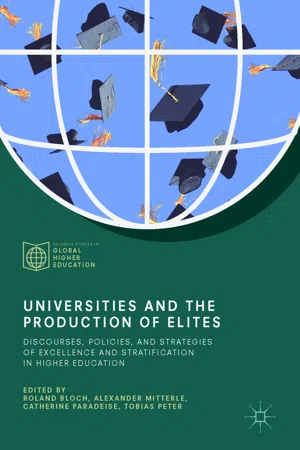
This book explores how universities as organizations influence and construct the production of academic elites and elitist institutions. It analyzes the role played by the reorganization of higher education (HE) institutions, stimulated by new performance-based narratives aimed at building attractiveness towards stakeholders such as governments, prospective employers, academics, and students. Based on American, European, and Asian case studies of HE systems and institutions considered at various scales, the volume analyzes the consequences of increasing competition between HE institutions which are facing challenges such as the internationalization of higher education supply, the shortage of public resources and the structural changes of labor market demands. It argues that policy discourses and tools, as well as assessment devices such as rankings and accreditation, incentivize HE institutions to develop positioning strategies that contribute to stratification and the production ofelites. It will be of great interest to students and researchers in the fields of higher education, sociology, and education policy.
eBook - ePub
Universities and the Production of Elites
Discourses, Policies, and Strategies of Excellence and Stratification in Higher Education
- English
- ePUB (mobile friendly)
- Available on iOS & Android
eBook - ePub
Universities and the Production of Elites
Discourses, Policies, and Strategies of Excellence and Stratification in Higher Education
About this book
Information
Topic
DidatticaSubtopic
Amministrazione nella didattica© The Author(s) 2018
Roland Bloch, Alexander Mitterle, Catherine Paradeise and Tobias Peter (eds.)Universities and the Production of ElitesPalgrave Studies in Global Higher Educationhttps://doi.org/10.1007/978-3-319-53970-6_11. Introduction: Universities and the Production of Elites
Roland Bloch1 , Alexander Mitterle1 , Catherine Paradeise2 and Tobias Peter3
(1)
Institute of Sociology, Martin Luther University Halle-Wittenberg, Halle, Germany
(2)
University Paris Est, Champs-sur-Marne, France
(3)
Institute of Sociology, Albert Ludwigs University Freiburg, Freiburg im Breisgau, Germany
Keywords
Higher educationStratificationCareer pathwaysStatusSociology of organizationsRoland Bloch
is a research associate at the Institute of Sociology and the Center for School and Educational Research at Martin Luther University Halle-Wittenberg and member of the Research Unit “Mechanisms of Elite Formation in the German Educational System,” funded by the German Research Foundation (DFG). He received his PhD at University of Leipzig with a dissertation on the study reforms in the course of the Bologna process and has worked on the structure of academic work at German universities. His latest research concerns stratifications in higher education, especially doctoral education.
Alexander Mitterle
is a research associate at the Institute for Sociology and the Center for School and Educational Research at the Martin Luther University, and member of the DFG-Research Unit “Mechanisms of Elite Formation in the German Educational System.” His recent research focuses on the development of stratification in German higher education. He has worked and published on various aspects of higher education including internationalization, private higher education, teaching structure and time as well as real-socialist higher education.
Catherine Paradeise
is a sociologist, Professor Emeritus at University Paris-Est and member of the LISIS (Interdisciplinary Research Group on Science, Innovation and Society). In the field of research studies, she co-edited in 2009 with G. Mallard and A. Peerbaye, Global Science and National Sovereignty. Studies in Historical Sociology of Science (New York, Routledge, paperback 2011). In the field of higher education and research, with Jean-Claude Thoenig, she recently published In Search of Academic Quality (London, Palgrave-Macmillan, 2015), she co-edited in 2009, with E. Ferlie, I. Bleiklie and E. Reale, University Governance: Western European Comparative Perspectives (Dordrecht, Springer). In 2016, she co-edited with E. Popp Berman University under Pressure (RSO series, Emerald).
Tobias Peter
is a research associate at the Institute of Sociology at Albert Ludwigs University Freiburg. His research interests are sociology of education, higher education and science, governmentality studies and system theory. Current publications: (2016, with Ulrich Bröckling): “Equality and Excellence. Hegemonic Discourses of Economisation within the German Educational System,” in: International Studies in Sociology of Education (Taylor & Francis, London); “Exclusive Globality, Inclusive Diversity. Internationality as a Strategy of Inclusion and Exclusion,” in: Maxwell, C., Deppe, U., Helsper, W., Krüger, H.H. (eds.), Elite Education and Internationalisation. From the Early Years to Higher Education (Palgrave Macmillan).
Universities have become central crossing points in modern society. They coproduce the narratives of our time, ranging from politics over neurogenetics to climate change. Universities educate students for diverse roles in society: nurses, musicians, lawyers, physicists, managers, neuroscientists, and philosophers have all been credentialized by higher education systems. In recent decades, there has been a consistent increase in the number of participants in higher education. The move from elite to mass education, as described by Martin Trow (1970), has led to the emergence of an expansive, self-enforcing dynamic, which cannot be contained by governments and educational administrations (Lutz 1983, p. 238f; Meyer et al. 2007; Palfreyman and Tapper 2009). In fact, only authoritarian regimes so far have been able to temporarily reverse this trend (Baker et al. 2007).
Mass education implies that higher education has become crucial to securing access to labor markets, especially to positions with higher social status (Meyer 1977; Collins 1979; Bourdieu 1998). Over the decades, scholars have confirmed that educational credentials are often door openers, which legitimate exclusive access to high-status professions and lead to occupational attainment (cf. Collins 1987; Abbott 1981, 2005). With the expansion of higher education, a growing differentiation, professionalization, and stratification within higher education systems can be perceived (Teichler 2008; Vaira 2009; Neave 2006). Surprisingly, there has been less attention paid to how exactly the organization and (vertical) structure of higher education impacts on social structures and occupational attainment.1 Beyond acknowledging the role of higher education in constructing elites, there has been a serious lack of research on the link between higher education and high-status positions. Zald and Lounsbury (2010, p. 964) see this as a result of the separation of research streams that were connected in the past:
[S]tudents of occupations and professions, organizations, and social stratification barely talk to each other today, whereas in earlier periods the linkages were more visible and apparent to many scholars.
Organizational approaches that address stratification concentrate on the system or field2 of higher education. They either study differences along the lines of research stratification (e.g. “world-class universities,” see next section) or specific aspects of teaching, without considering the effects on social stratification. Numerous pieces of research have outlined institutional hierarchies – or resistance to such hierarchies – established through national regulation (Trow 1984; Neave 2006). Such research has, for instance, contrasted the decentralized and stratified American system with the non-stratified systems that prevailed in continental Europe until at least the 2000s. It has explored differentiation in the tertiary sector between universities and institutions with a more professional or technical orientation, and observed the differential impacts of neo-managerialism and the commodification of higher education on such institutions (Paradeise et al. 2009). Organizational patterns spread among universities not only through competition but also through various forms of isomorphism (DiMaggio and Powell 1983). Here, stratification evolves between organizations that imitate others and those that are imitated (Meyer 1994). In such approaches, social stratification and class theory – if only for analytical reasons – are superseded by a perspective on society as functionally differentiated; higher education is analyzed as an entity of its own. The relationship between organizational ordering in the field and its effects on the labor market are seldom explored (Zald and Lounsbury 2010).
The study of elites, on the other hand, predominantly takes a reproductionist view, which sidelines ordering processes immanent to higher education in order to expose higher education as a central distributor of inequality (Bourdieu and Passeron 1990; Bourdieu 1998). Such processes can be seen as directed toward the legitimation of power structures; they imply a homology between organizations or specific higher education sectors and social stratification. From this perspective, top universities maintain societal inequality by overwhelmingly enrolling high-income and elite social groups (Brown et al. 2010). Their credentials legitimate the reproduction of social stratification (Kieserling 2008). Changes in the positions of certain educational organizations and/or organizational arrangements result from conflicts among elite groups (Bourdieu 1998; Brown 2001; Karabel 2005).
In a third group of theories, stratification in higher education is understood as a functional response to the societal need for skills and talent (Davis 1942; Davis and Moore 1945). The most prominent approach is human capital theory, which assumes that education is an individual investment of time (and money) that increases productivity and signals competence (Arrow 1973). A position with higher status and income is a legitimate return on such an investment (Becker 1983). From this perspective, stratification is determined through the objective demands of society and individual esteem. Similar to the reproductionist perspective, but for different reasons, national and organizational specificities and differences in higher education can ultimately only be explained by reasons outside their (sub)field or system (cf. Hölscher 2016, p. 19).
To bring together these various perspectives, we have to loosen up some of their fundamental premises (separated and autonomous systems or fields, power homology, functional inequality, and methodological individualism) and to anticipate and follow the empirical work that has so far been done on organizational pathways from education to work and academia.
The differences among (higher) education systems and how they impact on occupational attainment have been investigated in comparative studies of factories in the UK, France, and Germany during the 1970s. In similar studies by Lutz (1976) and Maurice et al. (1980), employment positions and career options were shown to relate to their respective educational systems. Hierarchical structures within companies thus vary in relation to the hierarchical structures in education (Lutz 1983). DiPrete et al. (2016) expand this view by testing the strength of the linkage between education and occupations in France, Germany, and the United States. Their study shows that the strength of linkage not only varies between countries but also between disciplines. They also confirm results from the sociology of professions that a high linkage strength supports higher wage income; however, they also argue for a more granular perspective that addresses linkages individually. In fact, the linkage logic within professions differs considerably from pathways to bureaucratic and free market positions (Brown 2001; Strathdee 2009). Klein (2016) argues for the German case that educational expansion has been accompanied by an increase in free market jobs, which has led to a wider heterogeneity of pathways from education to the labor market. A specific organizational and educational setting that builds linkages and career pathways thus demands more scrutiny (cf. Schwinn 1998, p. 14f). This fits with a strand of new institutionalist approaches, which emphasize the cultural and cognitive role of education but which have, to a large degree, been less interested in social stratification (Stevens 2008; Meyer 1969, 1977; Meyer et al. 2007; Baker 2009, 2011).3 In addition to sharing the reproductionist perspective on the increasing role of credentials, these approaches also ascribe a transformative power on society to higher education, an aspect that is absent from most elite-centered approaches. Both as an education provider and a research institution, the university “forms basic ideologies and creates academic degrees and expertise around these ideologies” (Baker 2014, p. 84). As a “sieve”, “incubator” or “hub” of society (Stevens et al. 2008), it both co-constructs and legitimizes “new classes of personnel with new types of authoritative knowledge” (Meyer 1977, p. 56; cf. Armstrong and Masse 2014, p. 808).
Although the educational and occupational worlds each follow their own logics, with the increasing role of credentials, they become structurally coupled in a wid...
Table of contents
- Cover
- Frontmatter
- 1. Introduction: Universities and the Production of Elites
- 1. Setting Up Narratives and Rationales
- 2. Disruptive Policies since the 1990s
- 3. Organizing Competition through Incentives: New Policy Devices
- 4. University Strategies for Redesigning Higher Education as Stratified Systems
- 5. The Production of New Elites?
- Backmatter
Trusted by 375,005 students
Access to over 1.5 million titles for a fair monthly price.
Study more efficiently using our study tools.
Frequently asked questions
Yes, you can cancel anytime from the Subscription tab in your account settings on the Perlego website. Your subscription will stay active until the end of your current billing period. Learn how to cancel your subscription
No, books cannot be downloaded as external files, such as PDFs, for use outside of Perlego. However, you can download books within the Perlego app for offline reading on mobile or tablet. Learn how to download books offline
Perlego offers two plans: Essential and Complete
- Essential is ideal for learners and professionals who enjoy exploring a wide range of subjects. Access the Essential Library with 800,000+ trusted titles and best-sellers across business, personal growth, and the humanities. Includes unlimited reading time and Standard Read Aloud voice.
- Complete: Perfect for advanced learners and researchers needing full, unrestricted access. Unlock 1.5M+ books across hundreds of subjects, including academic and specialized titles. The Complete Plan also includes advanced features like Premium Read Aloud and Research Assistant.
We are an online textbook subscription service, where you can get access to an entire online library for less than the price of a single book per month. With over 1.5 million books across 990+ topics, we’ve got you covered! Learn about our mission
Look out for the read-aloud symbol on your next book to see if you can listen to it. The read-aloud tool reads text aloud for you, highlighting the text as it is being read. You can pause it, speed it up and slow it down. Learn more about Read Aloud
Yes! You can use the Perlego app on both iOS and Android devices to read anytime, anywhere — even offline. Perfect for commutes or when you’re on the go.
Please note we cannot support devices running on iOS 13 and Android 7 or earlier. Learn more about using the app
Please note we cannot support devices running on iOS 13 and Android 7 or earlier. Learn more about using the app
Yes, you can access Universities and the Production of Elites by Roland Bloch, Alexander Mitterle, Catherine Paradeise, Tobias Peter, Roland Bloch,Alexander Mitterle,Catherine Paradeise,Tobias Peter in PDF and/or ePUB format, as well as other popular books in Didattica & Amministrazione nella didattica. We have over 1.5 million books available in our catalogue for you to explore.