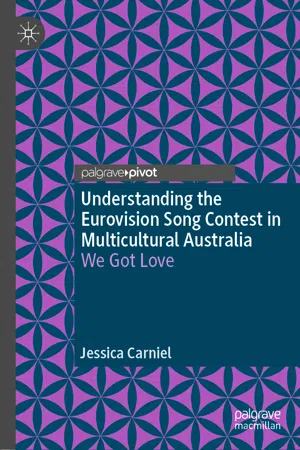
This book presents the first in-depth study of the Eurovision Song Contest from an Australian perspective. Using a cultural studies approach, the study draws together fan interviews and surveys with media and textual analysis of the contest itself. In doing so, it begins to answer the question of why the European song contest appeals to viewers in Australia. It explores and challenges the dominant narrative that links Eurovision fandom to post-WWII European migration, arguing that this Eurocentric narrative presents a limited view of how contemporary Australian multicultural society operates in the context of globalized culture. It concludes with a consideration of the future of the Eurovision Song Contest as Australia enters into the 'Asian century'.
eBook - ePub
Understanding the Eurovision Song Contest in Multicultural Australia
We Got Love
- English
- ePUB (mobile friendly)
- Available on iOS & Android
eBook - ePub
About this book
Information
Subtopic
Music© The Author(s) 2018
Jessica CarnielUnderstanding the Eurovision Song Contest in Multicultural Australiahttps://doi.org/10.1007/978-3-030-02315-7_11. Introduction
Jessica Carniel1
(1)
School of Arts and Communication, University of Southern Queensland, Toowoomba, QLD, Australia
Abstract
The Eurovision Song Contest has screened in Australia since 1983, attracting more viewers each year, particularly since Australia was invited to become a participating nation in the contest in 2015. This chapter contextualises the song contest’s popularity in Australia within global fan studies, including a reflection upon the author’s own “aca-fan” status. Eurovision fans in Australia and around the world value the contest for its cosmopolitanism, and its ethos of diversity and inclusion. The chapter introduces the book’s argument that although Australian Eurovision fandom is indeed a result of Australian multiculturalism, the dominant narrative focused on Australia’s connection to Europe via migration is overstated and overlooks the complex diversity of Australian society in a globalised world.
Keywords
CosmopolitanismFan studiesDiversityInclusionMulticulturalismAustraliaMy alarm goes off at 4.50 a.m. Groggily, I rise and dress myself warmly against the late autumn chill. As the kettle boils, I turn on both the television and my laptop. “Good morning, Australia!” I tweet , punctuating my greeting with emojis of a steaming cup and a croissant, and the hashtags #Eurovision and #SBSEurovision . I receive a handful of likes that let me know others around Australia and the rest of the world are online. As I settle under my nest of blankets on the couch, tea in hand, the cat jostling with computer for space on my lap, the strains of “Te Deum” float from my television.
For the past four years, this has become the annual ritual of the Australian fan of the Eurovision Song Contest (ESC). Prior to 2015 , when Australia transitioned from mere audience to competing participant in the contest, the Australian telecast of the events, from the semi-finals to the grand final, were broadcast on delay so that viewers watched during a more convenient evening time slot. Now, as viewers of a participant country, Australians are eligible to vote in their semi-final round and the grand final. As the time difference between Australia and most (western and central) European zones is between seven and nine hours, the live telecast of Eurovision occurs at 5 a.m. Australian Eastern Standard Time; viewers on the west coast of Australia must rise at 3 a.m.
Over half a million Australian viewers made this early start in 2017 alone, with twice as many viewing the delayed broadcast in the evening—although it must be acknowledged that many of these evening viewers will be watching it for the second time that day (Knox 2017). Viewer numbers have decreased after a peak of 4.2 million total for all three finals shows in 2015 , when Australians were dazzled—and perhaps bemused—by the novelty of being invited to participate in Eurovision for the first—and, we believed then, the only—time in the contest’s history. In 2018 , the total viewership for all three finals, including both morning and evening broadcasts, was just over one million. The decrease in numbers should not be read as a decline in the contest’s popularity in Australia. Rather, the difference is the shedding of the casual viewers to reveal the stalwart, dedicated audience and, at the core of this, the true fans who are dedicated to all things Eurovision more than that one week in May.
This is the story of those fans and the broader audience of the Eurovision Song Contest in Australia, the very people who have to contend with the question I have sought to answer in this book: why do Australians love the Eurovision Song Contest? After all, many do not hesitate to point out, it is a European song contest and Australia, despite its colonial history and its mass European migrations, particularly after the Second World War, is not part of Europe . Isn’t it in the Asia-Pacific? Protestations became more vehement when Australia officially joined the competition. As Graham Norton , the BBC ’s commentator for Eurovision, famously opined, “I know some countries aren’t technically in Europe but, come on—Australia is on the other side of world…I’ve got nothing against Australia. I just think it is kind of stupid” (quoted in Wooton 2016).
Other criticisms Australian fans must contend with are less geopolitical, and more cultural. While Eurovision’s reputation for kitsch and camp spectacle is a draw card for many, for others it is a source of derision. Furthermore, European pop music in general is often seen as inferior to the offerings from the dominant pop music industry in the United States , despite the prominence of Swedish songwriters and producers in many major pop hits over the past twenty years and other notable musical incursions from Europe . Eurovision songs in particular (with some convenient exceptions) are viewed by sceptics to be not the best Europe has to offer but, rather, the worst: misguided novelty acts that ape outdated trends in American pop music . After all, if the music was so good, would it not break into the global market organically? Australia’s own pop music scene is vibrant but its global hits are relatively rare, perhaps diluted by the sheer mass of product available in the global music market (Ferreira and Waldfogel 2013). There are, of course, historical exceptions, such as the so-called “princess of pop” Kylie Minogue , who has been Madonna-like in her ability to reinvent herself and carve out a long career (Minogue first entered the scene in the 1980s and released her most recent album in 2018) and pop-rock crossover sensation INXS. More recent successes include artists like Gotye , Troye Sivan, and Iggy Azalea , although the latter’s career in the US has been criticised for its use of cultural appropriation (Eberhardt and Freeman 2015). Overwhelmingly the local music scene has been dominated historically by variations of rock music and “indie” or “alternative” stylings, with local hip hop and dance music rising in popularity since the 2000s . Here, pop is defined as music that is accessible, “produced commercially, for profit, as a matter of enterprise not art” (Frith 2011, 94). Pop music as a genre is, in this context, often viewed as something “foreign” that Australians consume as an import rather than something that Australia manufactures itself. Furthermore, in a manifestation of the Australian cultural cringe (Phillips 1950), local pop offerings can be perceived as inferior, lacking the polished production values of the American industry , unless they also find success outside of the Australian market. Much European pop , particularly from non-English speaking countries, is also seen in this light, which can in turn affect how Australians approach the Eurovision Song Contest.
This anxiety about being on the margins of global pop music culture mirrors other forms of marginalisation associated with the contest. Eurovision’s great popularity with fans from LGBTIQA communities around the world, including Australia, is both a boon and a bane. On the one hand, it offers a strong market ready for new pop music , and in return has become a de facto international pride festival, about which fan and industry perspectives can be ambivalent. On the other hand, this association has been the source of political tensions between conservative and liberal participating states, which has important economic, political, cultural, and social ramifications. Turkey , for example, has not participated in Eurovision since 2014. In addition to concerns about participation costs, the voting system, the inequity of the “Big 5 ” system, and other significant regional politics (Vuletic 2018; Times of Israel 2018), officials from Turkish broadcaster TRT have criticised representations of queerness at the contest as inappropriate for family programming (Reuters 2018). While the EBU have stated that TRT and Turkey would be welcome in the contest again, its statement equally emphasised diversity and inclusivity as core values of the contest. These principles were put into practice in 2018 when the EBU terminated its partnership with Chinese broadcaster MangoTV after it censored, amongst other things, the Irish performance for its depiction of same-sex relationships and any rainbow flags visible in the crowd (EBU 2018).1
By participating in Eurovision, Australia is now participating in an international conversation around various economic, political, cultural, and social issues that are articulated in various ways through the administration and production of the Eurovision Song Contest. Its audience is also part of a transnational corpus made up of a range of local and international communities, bound by a shared interest and connected via the multitudinous nodes of social media networks. When I tweet “Good morning, Australia”, my use of the #SBSEurovision and #Eurovision hashtags signals my desire to connect to both local and global fans and viewers (acknowledging that the two subject positions may not necessarily align in the personal identification of some individuals). The text of my tweet highlights both my spatial and temporal distance from Europe and proximity to fellow Australians (who, given the sheer magnitude of the Australian continent, may also be quite distant but nevertheless bound in t...
Table of contents
- Cover
- Front Matter
- 1. Introduction
- 2. A Tale of Two Broadcasters: The EBU and SBS
- 3. Aussie-Fying Eurovision: Local Commentary as Media Interpolation
- 4. Part of the Party: Celebrating Eurovision Together
- 5. “We’re a Nation of Proud Multicultural Dags”: Multiculturalism and Viewer Identities
- 6. From Mr Eurovision to Australian Idols: Australian Performances (and Performing Australia)
- 7. “Every Region of the World Should Have a -Vision”: Eurovision in the Asian Century
- 8. Epilogue
- Back Matter
Trusted by 375,005 students
Access to over 1.5 million titles for a fair monthly price.
Study more efficiently using our study tools.
Frequently asked questions
Yes, you can cancel anytime from the Subscription tab in your account settings on the Perlego website. Your subscription will stay active until the end of your current billing period. Learn how to cancel your subscription
No, books cannot be downloaded as external files, such as PDFs, for use outside of Perlego. However, you can download books within the Perlego app for offline reading on mobile or tablet. Learn how to download books offline
Perlego offers two plans: Essential and Complete
- Essential is ideal for learners and professionals who enjoy exploring a wide range of subjects. Access the Essential Library with 800,000+ trusted titles and best-sellers across business, personal growth, and the humanities. Includes unlimited reading time and Standard Read Aloud voice.
- Complete: Perfect for advanced learners and researchers needing full, unrestricted access. Unlock 1.5M+ books across hundreds of subjects, including academic and specialized titles. The Complete Plan also includes advanced features like Premium Read Aloud and Research Assistant.
We are an online textbook subscription service, where you can get access to an entire online library for less than the price of a single book per month. With over 1.5 million books across 990+ topics, we’ve got you covered! Learn about our mission
Look out for the read-aloud symbol on your next book to see if you can listen to it. The read-aloud tool reads text aloud for you, highlighting the text as it is being read. You can pause it, speed it up and slow it down. Learn more about Read Aloud
Yes! You can use the Perlego app on both iOS and Android devices to read anytime, anywhere — even offline. Perfect for commutes or when you’re on the go.
Please note we cannot support devices running on iOS 13 and Android 7 or earlier. Learn more about using the app
Please note we cannot support devices running on iOS 13 and Android 7 or earlier. Learn more about using the app
Yes, you can access Understanding the Eurovision Song Contest in Multicultural Australia by Jessica Carniel in PDF and/or ePUB format, as well as other popular books in Media & Performing Arts & Music. We have over 1.5 million books available in our catalogue for you to explore.