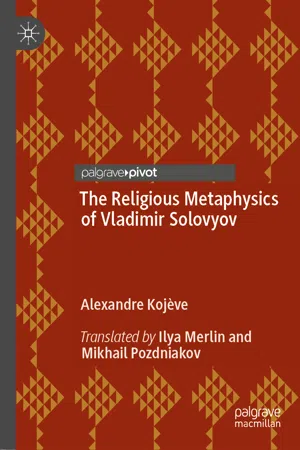
The original text of this work was published in the French journal Revue d'Histoire et de Philosophie Religieuses. This English translation presents Kojève's attempt to unify the religious philosophy of Vladimir Solovyov into a metaphysical system that Solovyov strived for but was never able to fully articulate in his lifetime.
eBook - ePub
The Religious Metaphysics of Vladimir Solovyov
- English
- ePUB (mobile friendly)
- Available on iOS & Android
eBook - ePub
The Religious Metaphysics of Vladimir Solovyov
About this book
Information
Topic
Theology & ReligionSubtopic
World History© The Author(s) 2018
Alexandre KojèveThe Religious Metaphysics of Vladimir Solovyov https://doi.org/10.1007/978-3-030-02339-3_11. Translators’ Introduction
Alexandre Kojève1
(1)
L’École des Hautes Études, Paris, France
Keywords
KojèveSolovyovHegalIntroductionThe first word on the essay at hand concerns its style, its method of proceeding. This was the element that most influenced the outcome of our work, involving in its way far more philosophy than one would think.
Kojève comes to us from a great linguistic distance. The works of the Russian philosopher Vladimir Solovyov were the source material for the German-language dissertation he completed in Heidelberg under the supervision of Karl Jaspers in 1926. 1 This dissertation he adapted into French and published in 1934 and 1935 as the two-part essay La métaphysique religieuse de Vladimir Soloviev while conducting his famous seminars on Hegel . The present English-language translation is this series’ fourth term and shares its place with Aleksey Kozyrev’s contemporary Russian translation, published in the collection Атеизм и другие работы in 2007. 2 Both do no more than simply continue the work that Kojève had already performed twice over. And if one bears in mind the linguistic form of the philosophical presentation in the main text ahead, the effect of this repeated labor is unmistakable: the translator, the writer-scribe, is drawn closer the philosopher, the mover of concepts, the arranger and inventor of order.
Kojève’s essay is at some points supremely awkward. His phrasing is not so much halting or stumbling as abrupt. He guides unevenly. As would be expected of a scholar, he introduces a certain development, arranges its premises, and moves on with the analysis as necessary. However, his advancements seem to deplete rather than expand his range of reference. His premises, for example, though many and various, are distinctly mobile and rarely unique to their first instance: they reappear time and again, modified for whatever end is currently at play. The total impression is of an analytic reduction, an ascetic decrease describing a movement inwards. His method is therefore not unlike that of mysticism, and bears all the austere rigor of one who has prepared for an interminable progress through the labyrinth.
Yet, more than once, his passage is interrupted by breaks and sudden expansions, filled with what may only be called images. That such images are composed with the classical language of analysis—a language which, despite everything we expect from it, is revelatory, concrete, and unfurtive—is only partly surprising. It should be remembered that the details of this world, those captured so easily in observations made and dropped in passing, form the basic elements of this singularly abstract language, which few have recognized for its sensitivity, its intimacy of precision, or its emotional life. Without such features, the distinct expressiveness of this language would be lost, and yet…
“More of a thinker than a writer”—this phrase sums Kojève, though it is unlikely he is considered a writer at all, at least not in the sense of a literary man of letters, someone for whom the pen came as promptly as the book. This changes what we can expect of his relationship to writing. Words and phrases, even conventional words and phrases, are chosen by him for their constructive powers. They are treated as thing-like, tangible, manipulable. And if such words, as signs, for him point elsewhere, then it is always to other words. Constantly inserted phrases such as “that is to say” [c’est à dire] or “in other words” [autrement dit] signal wherever they appear the identity of the preceding with adjacent statements and terminology. Other grammatical features of this work assume this rather direct relationship as well—a relationship so consistent that Kojève’s least philosophical moments in this essay are actually noteworthy for its lapse, his rhetoric in such passages being declarative and opaque, his tone conventional and his bearing disconnected. For us, this means that he did not, as other writers, employ this or that style to secure his end, but achieved it, though never to the point of mastery.
At times, the essay stutters, the distance between one sentence and the next too large to cross with ease. Kojève expects his reader to be familiar with the leap. He is unlike writers whose work tends toward a balanced and straightforward prose, with expositions of a consistent length and rhythm. In such works, the milestones are set regularly and with assurance: one can time the movement of themes, reasonably predicting the arrival of an important claim, its evidence, presentation, degree of emphasis, and end. Kojève’s essay in this respect is wild. There are page-long paragraphs, dense and highly technical, adjoined by others whose entirety spans a single sentence. Such is his manner throughout. This, again, is a work less written than pieced together under strain, and we are at least in part allowed to witness how. Cantilevered and suspended, varied in position and height, its passages are the weights and intermediate fixtures setting the lean and aspect of the whole. Indeed, the repetitive and circular coincidence of certain terms and turns of phrase shows that another structure persists throughout the essay as a whole, one parallel to the prescriptive hierarchy he uses to order its major sections. In this sense, his compositional style is highly justified, since it results from his attempts to track multiple parallel evolutions of his argument.
His method is closely related to the highly repetitive, transformational style of mathematicians and logicians. While there is some evidence of stylistic inability, as is shown in the occasional perfunctory aside or comment, the reasons for his use of language in general are, again, due to the necessities posed by his argument. Chief among these is the need to manage the appearance and distribution of distinctions as they arise. Because Kojève’s aim is the systematic organization of concepts, he writes with a number of constraints in mind: he cannot only introduce and refine the relevant concepts through insight or clarification; he cannot limit the scope of his proofs to accurate definition, scholarly reference, or quotation; and the context of his arguments cannot simply be established initially or after the fact with a statement of general principles. Indeed, all of the above are meaningless without their explicit interconnection. This is why Kojève contorts the syntax of every individual sentence such that it contains not only its immediate subject , but also its most important systemic counterparts. Ideally, each sentence would contain all the references necessary for its comprehension. Kojève’s specific labor was to force this interconnection into his statements even if it meant straining their coherence to the breaking point. Hence the parenthetical insertions and extended parataxis so characteristic of his writing, here and elsewhere. 3 This explicit use of parallelisms shows him to range deep into the linguistic effects produced by philosophy and places him firmly among others in the dialectical tradition, particularly Kierkegaard and Hegel , whose works, with Solovyov’s, likely served as models.
But Kojève’s use of parallelisms is not solely limited to their additive, constructive capabilities: it also acts as a schematic for parsing. A particularly powerful example is found in the essay’s opening paragraph, where Kojève introduces metaphysics as “the center of gravity and basis” for all of Solovyov’s work, and then refers to this claim with a substantive “this,” modified and appearing in the next few lines as “with this,” “in this,” “through this.” 4 Each variation is tied to a different insight and a distinct area of conceptual significance. Though this “this” is soon dropped and the passage ends, later in the essay two of its modifiers are combined to form the synthetic “in and through,” 5 which becomes one of his standard phrases.
Other examples are more general. Whenever Kojève uses the term “real,” for example, he is not being facetious—he is indicating empirically concrete rather than alethic, or metaphysical, existence . And since the term existence is appropriate to both, qualified versions such as “real existence” and “ideal existence ” become necessary for clarity. The same applies to terms such as perfect, whole, pure, free, and so on, and for terms split into capitalized and uncapitalized instances (Man/man, God/god, etc.), the uncapitalized, the lowercase, referring in each case to something unrealized and unable to partake, at least in its present state, in the divine. But here, the essay runs into certain orthographic difficulties: the capital letter, useful as it is for demarcating existential differences, loses its distinctiveness when regarding secondary or synthetic objects. Adam , for example, is the first representative of humanity, the first man; but he also represents Man in the sense of his divine origin, Man in the fullness of his relationship with God. Adam’s name, both profane and divine, is ambiguous, revealing if anything too much. In response to this difficulty, Kojève introduced a technique of apposition which follows at its heart a term that Solovyov found in Christian tradition, likely in the philosophy of Origen: Бoгoчeлoвeк—the Divine Man , the God-Man . 6 From it spring: Man-Jesus as opposed to Christ -Jesus, ideal atoms as opposed to physical atoms, the “becoming” Sophia as opposed to the eternal Sophia in her selfsame aspect, and the single unresolved instances of “Man-Adam ” and “Man-Idea”, with no specific pairings to serve as their opposites.
What elsewhere, in other works, would only be proof of the author’s precision regarding language is in the Religious Metaphysics evidence of something subterranean and intra-systemic. This is because Kojève’s formulaic repetitions open and extend the sense of individual items beyond their specific use here and there, in this or that section or sentence. See a small example in the string of infinitives which folds several motives into a single action: Solovyov “appeared to have desired to provide… so as to prove or deduce a priori the Christian dogmas.” 7 See another in this string of possessives: “the slowness of the evolution of the world corresponds in this way to the degree of imperfection of the free act of Sophia.” 8 See a third in this short, compressive summation found at the end of the essay, wherein Kojève combines the insights of many preceding arguments into the following sequence: “We know that the ‘content’ to which God freely imparts freedom is an ideal cosmos , a universe of ideas. Inasmuch as it is free, this ‘content’ is a totality of ideas, themselves free and independent beings endowed with free will. The unity of this totality, or this totality as unity, is Sophia, ideal Humanity or—we can say, in anticipation of Solovyov—the Soul of the World.” 9 Note the transformation of terms, their uptake of new forms, and their continuous philosophical equivocation: they are, in fact, established as a series of synonyms. Kojève’s characteristic repetitiveness is therefore a gesture of simplicity. What is established laboriously, through dense passages and many arguments, is eventually shortened and given place. The initial sense of remoteness, of separate and unrelated lines of thought, is entirely due to the dynamic quality of his reasoning and language. This partway-disclosed system of relationships, codified in grammar and laboriously maintained by Kojève, is the key to the Religious Metaphysics .
Ideally, if one were strong enough, a single unbroken text could be written that progressed continuously from point to point without once interrupting itself or backtracking. Or—even more difficult and perfect—the same, but in a single sentence. There are places in this essay where Kojève decided to attempt just this and take it as far as it would go, as with the passage on the qualities of Sophia: “an individual, concrete, living, almost tangible and in any case visible being, a human-divine being, human in female form, an intimate and condescending being, accessible to intellectual communion, direct and personal, understanding and a...
Table of contents
- Cover
- Front Matter
- 1. Translators’ Introduction
- 2. The Religious Metaphysics of Vladimir Solovyov
- 3. The Doctrine of World
- Back Matter
Trusted by 375,005 students
Access to over 1.5 million titles for a fair monthly price.
Study more efficiently using our study tools.
Frequently asked questions
Yes, you can cancel anytime from the Subscription tab in your account settings on the Perlego website. Your subscription will stay active until the end of your current billing period. Learn how to cancel your subscription
No, books cannot be downloaded as external files, such as PDFs, for use outside of Perlego. However, you can download books within the Perlego app for offline reading on mobile or tablet. Learn how to download books offline
Perlego offers two plans: Essential and Complete
- Essential is ideal for learners and professionals who enjoy exploring a wide range of subjects. Access the Essential Library with 800,000+ trusted titles and best-sellers across business, personal growth, and the humanities. Includes unlimited reading time and Standard Read Aloud voice.
- Complete: Perfect for advanced learners and researchers needing full, unrestricted access. Unlock 1.5M+ books across hundreds of subjects, including academic and specialized titles. The Complete Plan also includes advanced features like Premium Read Aloud and Research Assistant.
We are an online textbook subscription service, where you can get access to an entire online library for less than the price of a single book per month. With over 1.5 million books across 990+ topics, we’ve got you covered! Learn about our mission
Look out for the read-aloud symbol on your next book to see if you can listen to it. The read-aloud tool reads text aloud for you, highlighting the text as it is being read. You can pause it, speed it up and slow it down. Learn more about Read Aloud
Yes! You can use the Perlego app on both iOS and Android devices to read anytime, anywhere — even offline. Perfect for commutes or when you’re on the go.
Please note we cannot support devices running on iOS 13 and Android 7 or earlier. Learn more about using the app
Please note we cannot support devices running on iOS 13 and Android 7 or earlier. Learn more about using the app
Yes, you can access The Religious Metaphysics of Vladimir Solovyov by Alexandre Kojève, Ilya Merlin, Mikhail Pozdniakov, Ilya Merlin,Mikhail Pozdniakov in PDF and/or ePUB format, as well as other popular books in Theology & Religion & World History. We have over 1.5 million books available in our catalogue for you to explore.