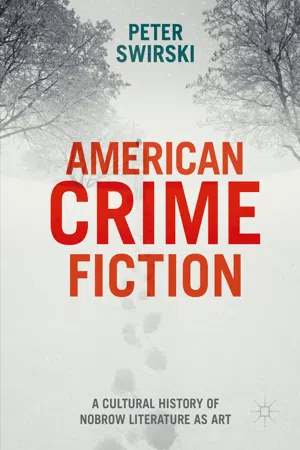
Peter Swirski looks at American crime fiction as an artform that expresses and reflects the social and aesthetic values of its authors and readers. As such he documents the manifold ways in which such authorship and readership are a matter of informed literary choice and not of cultural brainwashing or declining literary standards. Asking, in effect, a series of questions about the nature of genre fiction as art, successive chapters look at American crime writers whose careers throw light on the hazards and rewards of nobrow traffic between popular forms and highbrow aesthetics: Dashiell Hammett, John Grisham, William Faulkner, Ernest Hemingway, Raymond Chandler, Ed McBain, Nelson DeMille, and F. Scott Fitzgerald.
- English
- ePUB (mobile friendly)
- Available on iOS & Android
eBook - ePub
About this book
Information
© The Editor(s) (if applicable) and The Author(s) 2016
Peter SwirskiAmerican Crime Fiction10.1007/978-3-319-30108-2_11. Nobrow: Contents and Discontents
Peter Swirski1
(1)
Hong Kong, Hong Kong
The Most Ossified Popular Genre of All
Almost half of all the books ever printed and almost half of all the wordsmiths who have ever put pen to paper have come onto the scene after the death of Raymond Chandler.
Despite perennial announcements of the death of the book, in the second decade of the third millennium the volume of the printed word virtually defies understanding. The number of new books published each year around the world exceeds three million. In 2013 more than a million and a quarter titles, old and new, were published in the USA alone—about five times more than a little over a decade before. A cross-check of publishers’ lists suggests that between 400 and 500 genre paperbacks land every month on America’s bookstands.
By now Google has digitized approximately 15 million of the conservative estimates of 150 million books published in the world since the invention of the Gutenberg press. The actual number could be as high as 250 million: a quarter billion individual titles, plus millions more added year in, year out. In 2011 the British Library teamed up with Google to put another quarter million of uncopyrighted books, some forty million pages in total, online. With the Internet colossus footing the bill, other libraries are lining up to get in on the action.
Any way you count it, this explosion of the printed word adds up to the fact that almost half of all the books ever printed and almost half of all the wordsmiths who have ever put pen to paper have come onto the scene after the death of Raymond Chandler. Put differently, almost half of all the writers who have ever lived are living still. Factor in the population growth and the lengthening of the average lifespan and this fraction is bound to grow asymptotically until the day when nearly all writers in history will be creating in the eternal present.1
Like it or not, we live in the age of infoglut and infogluttony. The problem with that for the literary tastemakers and gatekeepers is that, although the proportion of what is culturally valuable to the total may not have changed over the ages (and how would you know?), multiplying both a millionfold has the effect of obscuring the former as effectively as if it was not there at all. It may take a long time, but you can be sure to find a proverbial good book in a thousand. But you will never find a million good books in a billion.
These days, with ever more titles in circulation and buyers spoiled for choice, it takes a lot more than a knack for telling a story to stand out as a storyteller. Even established names in the business, from John Grisham to the Bone-Farm forensic anthropologist Jefferson Bass, who previously relied on public relations departments of their publishing houses, now hire their own promo teams to help them and their brand stand out from the crowd. The only thing that has not changed is that big name endorsements still work as authordisiacs, just like they have done since the beginning of time.
When Barack Obama bought an armful of books on his holidays at Martha’s Vineyard in 2011, they included a selection of country noirs by Daniel Woodrell, which have been flying off the shelves since. Obama’s Democratic predecessor, that consummate populist and intellectual Bill Clinton, also enjoyed his mysteries, even as he curried presidential gravitas by joking about his cheap-thrills addiction. Still, two thumbs up from a fan in the Oval Office turned Walter Mosley and his Negro private investigator, Easy Rawlins, into instant celebrities.
Another symptom of the infoglut is that branding now trumps the actual contents of a book or a book review. For recognized authors the system still works, after a fashion. Plaudits in the New York Times Book Review or the Los Angeles Times Book Review still tend to pump up sales, whereas pans tend to bring them down. For everyone else it is pure Alice in Wonderland. Two thumbs up or two thumbs down? Both will give you legs. And while there is nothing new in the old saw that any publicity is good publicity, the extent to which the literary system fights a rearguard battle against the inundation of print is.2
Though it does not make the headlines, this state of affairs has dramatic repercussions for publishers, critics, and readers at large. Data I have collected on all continents save Africa and Antarctica suggest that even avid bookworms rarely average reading more than a book a week. Erring on the side of caution and assuming double that plus optimal conditions—no rest, no re-reads, no memory loss—you still end up with only about 100 books a year, or 7000 in a lifetime. This is the upper value on the literary database on which tastemakers can base their judgments. In reality, it is of course much smaller.
A few thousand against a quarter billion sounds pretty pathetic, even when you factor in that a sizeable portion of the total is nonfiction (not that nonfiction cannot be acclaimed as artsy—witness the Nobel Prizes for Literature in 1950, 1953, and 2015). And it is at this point that cultural conservatives traditionally execute a methodological sleight of hand to stave off the problem. Can’t read all that is out there? Don’t need to. All you need to do is convince yourself that it is formulaic and cheap, and 98 % of literature can be tossed out of the window.3
The argument is simple—almost aphoristic: once you have read one genre paperback, you have read them all. Naturally, this line of reasoning would be accurate if books were like electrons, every one identical and invariant to the examining eye. It is true, after all, that once you have seen one electron, you have seen them all. Poke it and probe it till Judgment Day and it will still show the same face as today. But books are not like that. What from the Ivory Tower looks like a homogeneous mass, from up close reveals distinctions as profound as those professed on behalf of the literary classics.
Although few intellectuals would state their case so forthrightly, especially nowadays when eclecticism and syncretism rule the day, sooner or later the latent bias comes to the fore. Philosopher and art critic Dennis Dutton typifies this scratch-a-progressivist-and-watch-a-purist-bleed attitude when, laying his aesthetic cards on the table in The Art Instinct (2009), he declares that “high art traditions demand individuality”.4 The suppressed premise? The unvariegated masses of pulp fiction do not and can, therefore, be dismissed en masse. Dutton holds these truths to be so self-evident that he does not even argue in their defense, content to advance them as a fiat instead.
Except that popular art prizes individuality no less than high art. No need to look further than arguably the most ossified popular genre of all: crime mystery. It does not take a connoisseur to individuate the urbane quirkiness of Donald Westlake, the gradient-defying villains of Elmore Leonard, the liposuctioned aesthetic of James Ellroy, the post-comradely flavor of Martin Cruz Smith, the jigsaw forensics of Kathy Reichs, the kosher-deli comedy of Kinky Friedman, the Möbius-twisted mind games of Jeffrey Deaver, the public conscience of Ruth Rendell, the Creole gumbo of James Lee Burke, the new Bostonians of Dennis Lehane—and so on, and so forth.
Conceding that crime fiction fosters individuality would make Dutton’s argument (tautologically) true at the cost of abandoning his distinction between genre fiction and high art. But his list of literary greats—Homer, Shakespeare, Cervantes, Austen, Dostoyevsky—shows that he is locked up there with Rapunzel in a high tower, lording over a forest of literary entertainment. People make art to please one another, he concedes a little later on. “There is a cool objectivity, however, about the greatest works of art: the worlds they create have little direct regard for our insistent wants and needs; still less do they show any intention on the part of their creators to ingratiate themselves with us” (241).
So this is how to differentiate art from schmart. If it disregards human wants and needs, it is a timeless masterpiece. If it ingratiatingly aims to please, it is not. Where does it leave Shakespeare whose Prospero hedges in the Epilogue to The Tempest that the players’ aim was merely to please, echoing the end of Twelfth Night where Feste sings of striving “to please you every day”?5 In fact, if art funnels something universal in terms of our biological wants and needs—and Dutton’s Darwinist theses leave no doubt that such is the case—then great art must do so as well, which in his terms would mean that it is mere entertainment.
Of the Standard of Taste
Literary critics can reliably say a number of things about a work of literature, except whether it is good.
The charge that popular fiction is unindividuated and formulaic is true only to the same extent that it is true of highbrow fiction. After all, what is unindividuated and at what level of comparison? All monasteries are alike by dint of being monasteries, yet if you look more closely, no two are identical and most are not even similar. Likewise, no two mysteries are identical, even if all are alike, once you look at them the right way. What is Macbeth, after all, if not Crime and Punishment meets “The Tell-Tale Heart”? What is The Great Gatsby if not The Godfather meets The Count of Monte Christo? What is Tough Guys Don’t Dance if not Kiss Me, Deadly meets Naked Lunch?
Crime writers create within an established aesthetic that attracts readers by advertising the type of game to be played for their pleasure. A clear analogy with sport stems from the fact that, although in football or basketball the rules of the games are also known ahead of time, fans flock to them all the same just because no one can tell in advance how a particular engagement will play out. Unlike sport, of course, writers can tweak the rules of the game in search of the optimal mix of convention and invention. In this, genre fiction is once again no different from high art, which also prizes formula and (self-)imitation, although under the guise of style.6
The annual Bad Hemingway and Faux Faulkner contests could never work—and could never be such riots—without readily identifiable formulas to spoof. Taking advantage of the fact that without formula there is no style, the rules are very simple. Entrants submit one-page samples of Papa’s or Pappy’s style and the most least masterful among them wins the honors. Crime ace Joseph Wambaugh was only one of the countless parodists who, over the years, had run amok with the Nobelists to the appreciative groans from the judges and kibitzers delighted to see styles reverse-engineered and reputations taken down a notch.
When it comes to genre art and to importing highbrow notions of taste where they do not belong, few missteps, however, can rival that of Ruth Bunzel’s in her classic ethnographic study of North American pottery of the Hopi nation. Hopi women—only women decorate pottery—are known for their sophisticated aesthetic, the central component of which is their veneration of originality. With ill-masked disdain, Bunzel reported, however, that their painted designs were essentially identical, often differing in elements so minute as to be almost negligible.
Decrying the sterility of the art and of the art-makers’ aesthetics, the critic failed to take into account the tradition—that is, the genre—in which the potters worked. Within that genre, the hallmark of originality is the use of variations on inherited elements. It is as if Bunzel decried Wyatt’s variations on the Petrarchan sonnet, or Drayton’s variations on Wyatt’s, or Surrey’s variations on Drayton’s, or Sidney’s variations on Surrey’s, or Shakespeare’s variations on Sidney’s as sterile. Or, for that matter, Leroux’s variations in Le Mystère De La Chambre Jaune on Poe’s “The Mystery of Marie Rogêt”, and the rich tradition of variations on the locked-room mystery in the century hence.
Indeed, if you believe Christopher Booker, the infinite variety of literary storylines hides just seven fundamental plots, albeit in a myriad variants, varieties, and variations. As if to highlight the arbitrariness of all such literary structuralism, after advancing the fundamental seven—rags to riches, voyage and return, tragic overreach, rebirth, comic chaos and happy ending, quest narrative, overcoming the monster—Booker added two more “fundamental” categories: mystery/crime and rebellion (never mind that both are quests to overcome the monster).
Another place where this typology bites the dust is the advent of high modernism or postmodernism with its turn toward autotelism and self-deconstruction, manifest in the focus on the act of telling at the expense of the tale. But once you get past the procrustean schematics, the wealth of literary examples, which range over aboriginal yarns, beast fables and fairy tales, epics from the antiquity, operatic librettos, epistolary novels, Wilkie Collins thrillers, Victorian multi-deckers, and Bollywood blockbusters, clearly exhibit similarities that cut across literary kinds, genres, and not least, brows. So much for high art as a paragon of individuality and for genre art as a paragon of sterility.
Story formulas—structures of incidents, as Aristotle called them—hook us afresh because of our interest in the fundamental patterns of human existence. Essentially unchanged since the beginning of history, these insistent wants and needs account for our unflagging pleasure in consuming storylines familiar from time immemorial. This is what the Russian morphologists and formalists intuited already at the beginning of the twentieth century, even though they could not explain it without the tools of modern evolutionary literary studies (evolist).7
Today we know that the answer lies is our universal propensity for thinking in stories—so universal, that it forms an inalienable part of our nature and, as such, an inalienable part of both our emotional and intellectual lives. Percipient as ever, back in 1757 David Hume himself a...
Table of contents
- Cover
- Frontmatter
- 1. Nobrow: Contents and Discontents
- 2. Briefcases for Hire: Dashiell Hammett and John Grisham
- 3. Boilerplate Potboilers: William Faulkner and Ernest Hemingway
- 4. The Not So Simple Art of Murder: Raymond Chandler
- 5. The Urban Procedural: Ed McBain
- 6. Take Two: Nelson DeMille and F. Scott Fitzgerald
- Backmatter
Trusted by 375,005 students
Access to over 1.5 million titles for a fair monthly price.
Study more efficiently using our study tools.
Frequently asked questions
Yes, you can cancel anytime from the Subscription tab in your account settings on the Perlego website. Your subscription will stay active until the end of your current billing period. Learn how to cancel your subscription
No, books cannot be downloaded as external files, such as PDFs, for use outside of Perlego. However, you can download books within the Perlego app for offline reading on mobile or tablet. Learn how to download books offline
Perlego offers two plans: Essential and Complete
- Essential is ideal for learners and professionals who enjoy exploring a wide range of subjects. Access the Essential Library with 800,000+ trusted titles and best-sellers across business, personal growth, and the humanities. Includes unlimited reading time and Standard Read Aloud voice.
- Complete: Perfect for advanced learners and researchers needing full, unrestricted access. Unlock 1.5M+ books across hundreds of subjects, including academic and specialized titles. The Complete Plan also includes advanced features like Premium Read Aloud and Research Assistant.
We are an online textbook subscription service, where you can get access to an entire online library for less than the price of a single book per month. With over 1.5 million books across 990+ topics, we’ve got you covered! Learn about our mission
Look out for the read-aloud symbol on your next book to see if you can listen to it. The read-aloud tool reads text aloud for you, highlighting the text as it is being read. You can pause it, speed it up and slow it down. Learn more about Read Aloud
Yes! You can use the Perlego app on both iOS and Android devices to read anytime, anywhere — even offline. Perfect for commutes or when you’re on the go.
Please note we cannot support devices running on iOS 13 and Android 7 or earlier. Learn more about using the app
Please note we cannot support devices running on iOS 13 and Android 7 or earlier. Learn more about using the app
Yes, you can access American Crime Fiction by Peter Swirski in PDF and/or ePUB format, as well as other popular books in Literature & Modern Literary Criticism. We have over 1.5 million books available in our catalogue for you to explore.