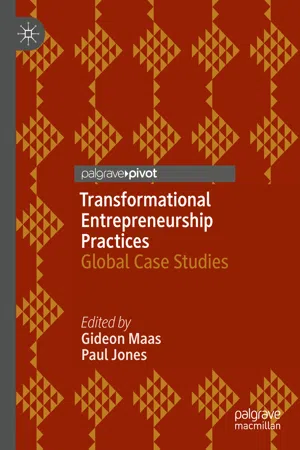
Presenting an updated overview of transformational entrepreneurship, this book explores how critical concepts can be contextualised for different regions and countries, underlining the fact that no one system fits all. In order for entrepreneurship to play a role in socio-economic development, a balance needs to be struck between focusing on individual entrepreneurial activities and regions, and society-wide changes. Building on the Editors' previous books, Systemic Entrepreneurship and Entrepreneurship Centres, this volume delves deeper into the importance of innovative eco-systems, providing examples of how transformational entrepreneurship can be implemented in different geographical locations. An invaluable read for policy-makers as well as scholars, the authors provide a series of detailed case studies from regions including the UK, Malaysia and Africa.
eBook - ePub
Transformational Entrepreneurship Practices
Global Case Studies
- English
- ePUB (mobile friendly)
- Available on iOS & Android
eBook - ePub
Transformational Entrepreneurship Practices
Global Case Studies
About this book
Information
© The Author(s) 2019
Gideon Maas and Paul Jones (eds.)Transformational Entrepreneurship Practiceshttps://doi.org/10.1007/978-3-030-11524-1_11. The Journey to Transformational Entrepreneurship
Gideon Maas1 , Paul Jones2 and Joan Lockyer1
(1)
Coventry University, Coventry, UK
(2)
Swansea University, Swansea, UK
Abstract
A need exists for renewed thinking to stimulate entrepreneurship to support socio-economic growth. Within this context, “transformational entrepreneurship” refers to a holistic and heuristic orientation in terms of entrepreneurship promotion and combines the individual and other sub-systems (such as society and institutions) interacting and collaborating to create a positive framework in which opportunities can be exploited beyond the local level.
Keywords
EnterpriseEntrepreneurshipTransformational entrepreneurshipEcosystem1.1 Introduction
The global environment is characterised by various phenomena which the National Intelligence Council (2017) has summarised as follows: the rich are aging, the poor are not; weak economic growth will persist in the near term; technology is accelerating progress but causing discontinuities; growing global connectivity amid weak growth will increase tensions within and between societies; governing is getting harder; risk of conflict will increase due to diverging interests among major powers, an expanding terror threat, continued instability in weak states and the spread of lethal, disruptive technologies; and climate change, environment and health issues will demand attention. Entrepreneurs and stakeholders supporting entrepreneurs find themselves in the midst of these phenomena, and it is expected that they collectively work together to stimulate sustainable socio-economic development. The role and importance of entrepreneurship creating sustainable socio-economic development are not questioned—rather, it is questioned whether the current landscape possesses the right capability, capacity, ecosystems and policies to transform or maintain progressive socio-economic landscapes.
A plethora of initiatives supporting entrepreneurship exists. However, Sautet (2013) and Maas and Jones (2015) concur that although entrepreneurship is socially productive, it struggles to address major challenges such as those identified by the National Intelligence Council (2017). Thus a new approach to the development of socio-economic development is required—a systemic process that is more heuristic and holistic in nature to accommodate both individualistic and societal needs. Without such a new approach, that is, transformational entrepreneurship, the potential for socio-economic development will remain limited and only benefit a minority of individuals, businesses and nations.
Within such a transformation there are more questions than answers. Do we base decision-making on historical data or do we dare to be more futuristic in our entrepreneurial solutions? Do we focus on the right type of innovation or are we merely “me-too” orientated where everyone is doing the same? Are we enlarging the existing “economic cake” or are we dividing it into smaller pieces, which makes sustainable socio-economic development difficult? Do we have the right capability, capacity, ecosystems and policies to manage the current and future environment successfully?
It is the premise of this book that all existing approaches stimulating entrepreneurship should be investigated—those practices that are relevant should be continued and those outdated should be replaced by current and futuristic solutions. Built on the basis of theoretical principles associated with transformational entrepreneurship and ecosystems, practical cases are provided to illustrate the concept of transformational entrepreneurship globally. Finally, transformational entrepreneurship is not focusing on subsistence entrepreneurs or people who are regarded as lifestyle entrepreneurs. In addition, it needs to be highlighted that there is nothing wrong being a subsistence or lifestyle business owner. However, transformational entrepreneurship is focusing on stimulating socio-economic development in a dynamic manner. Schoar (2010: 58) agrees with this distinction between subsistence and transformational entrepreneurs, indicating that transformational entrepreneurs “are those who aim to create large, vibrant businesses that grow much beyond the scope of an individual’s subsistence needs and provide jobs and income for others”.
1.2 Definitions
Various definitions exist for terminologies used in this chapter. However, it is not the intention of this chapter to debate different definitions or explore why a specific definition was selected over another. The definitions below are sufficient to support the core concepts that will be discussed in this chapter:
- Enterprise: The Quality Assurance Agency (QAA 2018: 7) defines enterprise as: “Enterprise is defined here as the generation and application of ideas, which are set within practical situations during a project or undertaking. This is a generic concept that can be applied across all areas of education and professional life.”
- Entrepreneurship: The QAA (2018: 7) defines entrepreneurship as: “Entrepreneurship is defined as the application of enterprise behaviours, attributes and competencies into the creation of cultural, social or economic value. This can, but does not exclusively, lead to venture creation.”
- Innovation involves the utilisation of ideas in problem solving by developing processes and improving the way things are done by creating new products, services, processes and organisations (Dawson and Andriopoulos 2014).
- The entrepreneurial ecosystem is a network of interconnected actors which formally and informally coalesce to connect, mediate and govern the performance within the local entrepreneurial environment (Mason and Brown 2013).
- Holistic approaches recognise the interconnectedness of people and the environment and look to support continuous adaptation, transformation and coordination through a process of change and evolution (Best 2011; Wapner and Demick 2003).
- A heuristic orientation refers to the process by which individuals make decisions in conditions of uncertainty. The value of a heuristic approach is that decisions are made. The downside is that decisions are limited and the options are circumscribed by the limits of time, knowledge and information. How decisions are made is a function of social, cultural and individual rationality (Gigerenzer 2010).
- Socio-economic growth is a process that seeks to identify both the social and the economic requirements within a community and looks to create strategies that address those needs in ways that are practical and in the optimum interests of the community over the long term (Jaffee 1998).
- Systemic entrepreneurship involves sub-systems interacting and collaborating to create a positive framework in which opportunities can be exploited; it should be socially productive and go beyond the local level (Sautet 2013).
Based on the above definitions and discussions following this paragraph, transformational entrepreneurship is defined by the authors of this chapter as follows: Transformational entrepreneurship is to promote enterprise and entrepreneurship through a systemic approach, bringing about transformation in socio-economic development.
There are four areas in this definition, namely:
- It represents a broad area of activity—the enterprising area, which should be applicable to all areas of work.
- It represents a focused area—entrepreneurship, which represents the “doing” part of the definition.
- A systemic approach referring to a holistic approach.
- Transformation in socio-economic development representing an optimal balance between economic and societal development.
1.3 Transformational Entrepreneurship
There is a general consensus that entrepreneurship can and should play an important role in socio-economic development (Ács et al. 2014; COM 2012; Cooney 2012). Moreover, it is pointed out that entrepreneurial activity which focuses predominantly on the individual entrepreneur or local region will probably not have the desired positive impact on national socio-economic development hoped for (Ács et al. 2014; COM 2012; Cooney 2012). A balance should be struck between a focus on individual entrepreneurial activities and society-wide changes, which may have a more positive impact on socio-economic growth. This shift in thinking from individual to country-wide conceptualisations of entrepreneurship is not without its difficulties; however, the step is an important one if policy-makers are to be persuaded of the economic contribution of entrepreneurship. Ács et al. (2014) argue that society- or even country-level entrepreneurial measurements have never previously received adequate attention. In order to address global phenomena such as poverty, unemployment, and low or no growth, transformation is required in the way entrepreneurship is supported as part of a total system, that is, a system consisting of individuals, the community, public sector, private sector and natural resources.
Two important concepts can be identified from the previous paragraph, namely, systemic and transformational entrepreneurship. According to Ács et al. (2014: 477) the term “...
Table of contents
- Cover
- Front Matter
- 1. The Journey to Transformational Entrepreneurship
- 2. Innovation and Entrepreneurial Ecosystems as Important Building Blocks
- 3. Case Study: Transformational Entrepreneurship in the UK—“From UK Bread Waste to Global Beer Brand”
- 4. Case Study: Gender and Enterprise Development in Africa
- 5. Case Study: Transformational Entrepreneurship in Australia
- 6. Case Study: Transformational Entrepreneurship in Malaysia—Dare to Dream, Dare to Talk, Dare to Act(ion)
- 7. Conclusions on Transformational Entrepreneurship
- Back Matter
Trusted by 375,005 students
Access to over 1.5 million titles for a fair monthly price.
Study more efficiently using our study tools.
Frequently asked questions
Yes, you can cancel anytime from the Subscription tab in your account settings on the Perlego website. Your subscription will stay active until the end of your current billing period. Learn how to cancel your subscription
No, books cannot be downloaded as external files, such as PDFs, for use outside of Perlego. However, you can download books within the Perlego app for offline reading on mobile or tablet. Learn how to download books offline
Perlego offers two plans: Essential and Complete
- Essential is ideal for learners and professionals who enjoy exploring a wide range of subjects. Access the Essential Library with 800,000+ trusted titles and best-sellers across business, personal growth, and the humanities. Includes unlimited reading time and Standard Read Aloud voice.
- Complete: Perfect for advanced learners and researchers needing full, unrestricted access. Unlock 1.5M+ books across hundreds of subjects, including academic and specialized titles. The Complete Plan also includes advanced features like Premium Read Aloud and Research Assistant.
We are an online textbook subscription service, where you can get access to an entire online library for less than the price of a single book per month. With over 1.5 million books across 990+ topics, we’ve got you covered! Learn about our mission
Look out for the read-aloud symbol on your next book to see if you can listen to it. The read-aloud tool reads text aloud for you, highlighting the text as it is being read. You can pause it, speed it up and slow it down. Learn more about Read Aloud
Yes! You can use the Perlego app on both iOS and Android devices to read anytime, anywhere — even offline. Perfect for commutes or when you’re on the go.
Please note we cannot support devices running on iOS 13 and Android 7 or earlier. Learn more about using the app
Please note we cannot support devices running on iOS 13 and Android 7 or earlier. Learn more about using the app
Yes, you can access Transformational Entrepreneurship Practices by Gideon Maas, Paul Jones, Gideon Maas,Paul Jones in PDF and/or ePUB format, as well as other popular books in Business & Business Strategy. We have over 1.5 million books available in our catalogue for you to explore.