eBook - ePub
Afghanistan and the Coloniality of Diplomacy
The British Legation in Kabul, 1922–1948
- English
- ePUB (mobile friendly)
- Available on iOS & Android
eBook - ePub
Afghanistan and the Coloniality of Diplomacy
The British Legation in Kabul, 1922–1948
About this book
This book offers an institutional history of the British Legation in Kabul, which was established in response to the independence of Afghanistan in 1919. It contextualises this diplomatic mission in the wider remit of Anglo-Afghan relations and diplomacy from the nineteenth to the twenty-first century, examining the networks of family and profession that established the institution's colonial foundations and its connections across South Asia and the Indian Ocean. The study presents the British Legation as a late imperial institution, which materialised colonialism's governmental practices in the age of independence. Ultimately, it demonstrates the continuation of asymmetries forged in the Anglo-Afghan encounter and shows how these were transformed into instances of diplomatic inequality in the realm of international relations. Approaching diplomacy through the themes of performance, the body and architecture, and in the context of knowledge transfers, this work offers new perspectiveson international relations through a cultural history of diplomacy.
Information
Topic
StoriaSubtopic
Storia mediorientale© The Author(s) 2019
M. DrephalAfghanistan and the Coloniality of DiplomacyCambridge Imperial and Post-Colonial Studies Serieshttps://doi.org/10.1007/978-3-030-23960-2_11. Introduction: Empire, Colony and Diplomacy
Maximilian Drephal1
(1)
Department of History, University of Sheffield, Sheffield, South Yorkshire, UK
The Rise of an Embassy
Established in response to Afghan independence in 1919, the establishment of the British Legation in Kabul appeared to express the recognition of Afghanistan as a sovereign state in the realm of international relations by its former imperial suzerain. On paper, it conformed to Amanullah Khan’s (r. 1919–1929) demands for direct relations between Afghanistan and the imperial metropole in London. In the nineteenth century, the colonial state had powerfully shaped the politics of Afghanistan, also directing its foreign affairs in return for cash payments to Abdur Rahman Khan (r. 1880–1901) and Habibullah Khan (r. 1901–1919), Amanullah Khan’s grandfather and father respectively, from 1880 to 1919. Between 1919 and 1922, the colonial state in India adjusted to the new reality of Afghan independence without breaking from the past. The payment of colonial funds for the direction of Afghanistan’s international relations to Afghan rulers ended with the peace treaty of Rawalpindi in 1919. However, funds now flowed into Afghanistan for other purposes, namely into the setup of a British-Indian diplomatic-colonial enclave, the Legation’s structures and personnel. In late 1921, George Nathaniel Curzon, the former Viceroy of India (1899–1905) and then Foreign Secretary, decreed that the Legation building “should be one of the finest Residences in Asia”. 1 From 1922 onwards, the Raj modelled the Legation according to its own ambitions, objectives and experiences. Colonial officers became diplomats, staffed the Legation and transferred colonialism’s manifold asymmetries to Kabul, in essence recreating the colonial project en miniature in Kabul. As a twentieth-century diplomatic presence in Kabul, the British Legation accumulated a pool of actionable instructions, sourcing knowledge from other colonial contexts in South Asia. It ensured the continuity between a corpus of nineteenth-century knowledge of Afghanistan and twentieth-century British diplomacy.
In early 1989, Soviet troops prepared to withdraw from Afghanistan, ending the fourth major war that had violently entangled the country and imperial powers since the First Anglo-Afghan War in 1839. In January 1989, the British government, together with the USA, France, Italy and Japan, decided to remove its diplomatic mission from the Afghan capital, citing deteriorating security conditions. 2 The British Chargé d’Affaires in Afghanistan, Ian Mackley, was paraphrased as saying “[t]he US, Britain, West Germany and France have all written [Mohammad Najibullah] off, and have concluded that the sooner Kabul falls to the Mojahedin the better”. 3 By departing, diplomatic missions effectively withdrew international recognition from the government of Mohammad Najibullah, which their presence in Kabul had until then rendered, and contributed to the erosion of Afghan politics in the following years. In the words of one commentator, the decision to leave was “wholly political, and contrary to the realistic and non-political traditions of British diplomacy”. 4 Others, including India and Pakistan, maintained their diplomatic representations until well into the 1990s. Between 1989 and 1992, the regime of Najibullah, a remnant of the Soviet occupation of Afghanistan, was increasingly embattled as Kabul became a fighting ground. In 1992, the government collapsed following the end of Russian aid. The mujahideen took control of Kabul.
The departure of the British Embassy in January 1989 brought back to memory Britain’s past encounters in Afghanistan since the early nineteenth century. In 1989, “a few elderly survivors of the British Raj” remembered events, which had played out almost exactly sixty years before. In February 1929, the advance of an army of ‘rebels’ had been halted by Amanullah Khan’s troops in the vicinity of the British Legation, trapping the Empire’s diplomatic mission in the crossfire of bullets and shrapnel. Sixty years on, Richard Gould, the son of the Legation’s Counsellor, spoke of a “hair-raising three-mile walk through enemy lines” from the British Legation to the airfield, where aeroplanes would eventually take the Legation’s women and children to safety in India. 5 The Legation returned to Kabul in 1930 after relations with the government of Nadir Shah (r. 1929–1933) had been re-established. For the second time in the twentieth century, a British mission left Afghanistan during a moment of profound political and international crisis.
For Peter Hopkirk, too, writing for The Times, the past held the key to explaining events in Afghanistan in 1989. Looking for clues in a two-page piece dating from May 1990, he went “back to square one” to the immediate aftermath of the First Anglo-Afghan War. 6 Hopkirk drew a large frame around the killing of two “British officers” in Bokhara in 1842, Charles Stoddart and Arthur Conolly:
Stoddart and Conolly were paying the price of engaging in a highly dangerous game – the Great Game , as it became known to those who risked their life in pursuit. The Great Game was played against Russia, then engaged in carving out a vast empire in the Caucasus and Central Asia. Today, as violent unrest threatens the survival of that empire, the events of those times have taken on a new significance; the seeds of the present turmoil were sown during the Great Game years. The current bitterness and resentment of the Central Asian peoples towards their Soviet rulers dates back to their forcible, and often brutal, subjugation by Tsarist generals. For their part, the British tried to pre-empt Russian moves. 7
In this reading, the Cold War was the Great Game. British characters in the nineteenth and twentieth centuries had died attempting to contain several expansionist Russian empires. Soviet soldiers became Tsarist generals. Later that year, Hopkirk published The Great Game: On Secret Service in High Asia, which became a widely referenced text. The past was precedent. The “secret heroes” of Britain’s imperial history came back to life. 8 The end of the Cold War made glorified imperial history popular.
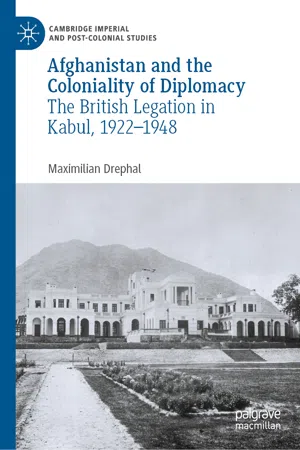
In 1989, British diplomats left behind “a 25-acre haven of Edwardian comfort and security”, “an oasis of tranquillity”. 9 In 1994, the British government handed over the abandoned Embassy buildings to its owner, and one of its postcolonial successor states in South Asia, the government of Pakistan. Work on the buildings had been completed in 1927. They had housed the British Legation since 1926, and from 1948 the British Embassy. Pakistan took possession of an imperial monument in Kabul’s Karte Parwan district. For both Pakistan and the UK, empire and its history in South Asia were living concepts in their relations with Afghanistan. Pakistan and the UK were joined by their common imperial history, and in particular the governance of the historical Indo-Afghan borderland through which ran the Durand Line, now referred to as AfPak. The occupation of the premises of the former British Legation visualised that common inheritance. As during the uprising against Amanullah Khan in the winter of 1928/1929, the Embassy structures became targets for anti-imperial sentiment. In 1995, the buildings were attacked by 5000 Afghans protesting the government of Pakistan’s “creeping invasion” of Afghanistan and, especially, its employment of the Taliban as a “military instrument”. 10 Now it was the Pakistani Embassy’s turn to be withdrawn from Kabul.
The British Embassy returned to Kabul seven years later in 2001, in the wake of the ‘Fourth Anglo-Afghan War’, the fifth for Afghanistan involving imperial powers of the day. As with previous occupations in 1839 and 1878 as well as in 1922, a British diplomatic mission, once again, found itself in search of ‘permanent’ accommodation. The British and Pakistani governments entered discussions about a sale of the Legation buildings, which eventually failed. For a moment, the “return to magnificence for British diplomats” had seemed possible. 11 “Remarkably, the ambassadorial china, silver teapots and crystal glasses survived years of Taliban rule, hidden away and kept safe by two Afghan caretakers”. 12 In 2010, the former Minister’s residence was refurbished. In 2012, it reopened as the Embassy of Pakistan. At the moment of writing, a picture of the former Legation buildings adorns the diplomatic representation in digital space. 13 At the same time, the British Embassy is located in Kabul’s Wazir Akbar Khan district, named after the son of Dost Mohammed Khan, who besieged the Indian occupation army in 1841 and eventually forced its withdrawal during the imperial catastrophe of the First Anglo-Afghan War. The very diplomatic institution that emerged in response to Afghan independence in 1919 has become geographically entangled with the icon of Afghanistan’s anti-imperial resistance to the first British military occupation. The idea of Afghan independence has been inscribed twice onto this diplomatic mission; by means of its own history as well as its location in Afghanistan’s capital.
The history of the British Legation in Kabul, the British Empire’s diplomatic mission from 1922 to 1948, is a funnel for these events. In 1919, Afghanistan was the first South Asian polity under imperial rule to be internationally recognised as an independent, sovereign state. In the following years, Afghanistan sent its representatives into capitals around the world and, at the same time, received the diplomatic agents from other states according to the principle of diplomatic reciprocity and equality . As diplomats, staff and families arrived in Kabul, the cityscape was populated with diplomatic buildings and enclaves. The history of one of these, the British Legation in Kabul, throws light on the processes ...
Table of contents
- Cover
- Front Matter
- 1. Introduction: Empire, Colony and Diplomacy
- 2. The Remaking of Anglo-Afghan Relations
- 3. Subaltern Biographies
- 4. Biography and Imperial Governance
- 5. Accreditation and Performance
- 6. Diplomatic Bodies
- 7. Architecture
- 8. From Colonial Legation to Postimperial Embassy
- 9. Conclusions: The Coloniality of Diplomacy
- Back Matter
Trusted by 375,005 students
Access to over 1.5 million titles for a fair monthly price.
Study more efficiently using our study tools.
Frequently asked questions
Yes, you can cancel anytime from the Subscription tab in your account settings on the Perlego website. Your subscription will stay active until the end of your current billing period. Learn how to cancel your subscription
No, books cannot be downloaded as external files, such as PDFs, for use outside of Perlego. However, you can download books within the Perlego app for offline reading on mobile or tablet. Learn how to download books offline
We are an online textbook subscription service, where you can get access to an entire online library for less than the price of a single book per month. With over 1.5 million books across 990+ topics, we’ve got you covered! Learn about our mission
Look out for the read-aloud symbol on your next book to see if you can listen to it. The read-aloud tool reads text aloud for you, highlighting the text as it is being read. You can pause it, speed it up and slow it down. Learn more about Read Aloud
Yes! You can use the Perlego app on both iOS and Android devices to read anytime, anywhere — even offline. Perfect for commutes or when you’re on the go.
Please note we cannot support devices running on iOS 13 and Android 7 or earlier. Learn more about using the app
Please note we cannot support devices running on iOS 13 and Android 7 or earlier. Learn more about using the app
Yes, you can access Afghanistan and the Coloniality of Diplomacy by Maximilian Drephal in PDF and/or ePUB format, as well as other popular books in Storia & Storia mediorientale. We have over 1.5 million books available in our catalogue for you to explore.