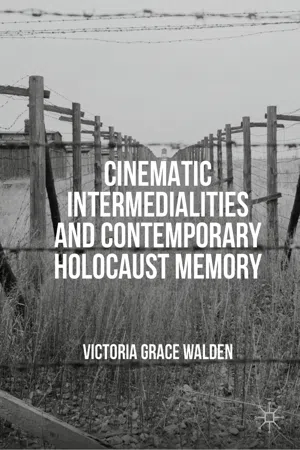
This book explores the growing trend of intermediality in cinematic representations of the Holocaust. It turns to the in-betweens that characterise the cinematic experience to discover how the different elements involved in film and its viewing collaborate to produce Holocaust memory. Cinematic Intermedialities is a work of film-philosophy that places a number of different forms of screen media, such as films that reassemble archive footage, animations, apps and museum installations, in dialogue with the writing of Deleuze and Guattari, art critic-cum-philosopher Georges Didi-Huberman and film phenomenologies. The result is a careful and unique examination of how Holocaust memory can emerge from the relationship between different media, objects and bodies during the film experience. This work challenges the existing concentration on representation in writing about Holocaust films, turning instead to the materials of screen works and the spectatorial experience to highlight the powerful contribution of the cinematic to Holocaust memory.
- English
- ePUB (mobile friendly)
- Available on iOS & Android
eBook - ePub
Cinematic Intermedialities and Contemporary Holocaust Memory
About this book
Information
Subtopic
Film & Video© The Author(s) 2019
Victoria Grace WaldenCinematic Intermedialities and Contemporary Holocaust Memoryhttps://doi.org/10.1007/978-3-030-10877-9_11. Introduction
Victoria Grace Walden1
(1)
University of Sussex, Brighton, UK
What does it mean to read a book about the space inbetween audio-visual moving images? This experience is already characterised by what is missing, from images not seen or those condensed into low resolution black-and-white snapshots, to the movement between images so fundamental to cinema and the experience of being before the screen. By asking you to read my words about film, I am already requesting your imaginative investment and for you to delve inbetween written language and the cinematic examples discussed in this book and thus to contemplate the impact intermediality can have for Holocaust memory. This is a book about the inter. In her Deleuzian, yet phenomenological, investigation of intercultural cinema, Laura U. Marks argues that to read or hear an image ‘is to look / listen not for what’s there but for the gaps’ (2000, p. 311). Like Marks, Cinematic Intermedialities and Contemporary Holocaust Memory asks you to attend to the spaces inbetween images, and inbetween media in order to read films, an installation and an app as more than their representational values.
This book began as a reaction to much of the existing literature about the representation of the Holocaust onscreen. It started with a simple question, ‘how do we experience Holocaust films?’ Whilst so much writing about the Holocaust and cinema seemed fixated on factual veracity, I was frustrated by this. As a film scholar, I do not see historical accuracy as cinema’s raison d’être. However, given the strong reactions to such films, I became interested in how this medium could provoke these responses. Phenomenology, it seemed, was the most useful approach to adopt. Yet, like all academic research, this project evolved. It developed into something far beyond my initial question and method. As I was searching for case studies that would illustrate the breadth of contemporary screen media representations of the Holocaust, I discovered that the works to which I was most drawn all shared a similar obsession with older media forms, from celluloid home movies to analogue family photographs , from survivor memories to paper testimonies written by those who knew the dead, which remain the only material evidence that these people once lived. Not only, like all cinema, are these works intermedial, but they explicitly engage with the relationships between their different media. Simultaneously , the more I immersed myself in phenomenology and tried to resist Deleuzian approaches to affect (a resistance based on no substantial rationale bar a stubborn wont to avoid the most ‘in vogue’ theory of the time), the more I found myself intellectually fascinated with the latter. I found myself, like my case studies, tackling an inbetween, which for me was characterised by intellectual circles that suggested they were antagonist to each other yet in dialogue opened up a fascinating space for rigorous interrogation of the film experience not simply as text, or material object, or thing-in-itself, or embodied experience but as a combination of all these and as things-in-relation to each other. Somewhere between Georges Didi-Huberman’s phenomenological re-reading of Jacques Lacan; Gilles Deleuze’s anti-psychoanalysis and anti-phenomenological post-structuralist approach to film alongside his work with Felix Guattari ; and film phenomenology, emerged a complex picture of cinema as all of the above.
This book interrogates the many gaps—or inbetweens—that characterise the cinematic experience. Those moments of contact which signify the meeting of different media and images, and the encounter between spectator and film. It is not satisfied with simply looking at the representational dimensions of the image inscribed into its visual surface and the soundtrack. Instead it delves deep into the inbetween spaces of cinema—between images, between different media , between the past and the present, and between bodies and things on and offscreen to consider how contemporary screen works that are intermedially reflexive encourage the production of Holocaust memory. But what does this term ‘intermedially reflexive’ mean? There is a growing amount of literature interested in intermedial cinema projects, yet as much of this writing recognises, cinema is and always has been intermedial—it always involves the juxtaposition of different media, for example on the most basic level, visual image and audio (see for example, Pethő 2011; Nagib and Jerslev 2014; Bruhn and Gjelsvik 2018). To distinguish a certain type of film that foregrounds its intermediality, and is also often critically engaged with its juxtaposition of different media, Pethő uses the term intermediality reflexive (2011, p. 65).
Whilst there is still much contestation about whether intermediality is a method or object of study, and what either of these might look like, several scholars interested in the intermedial define it in relation to a sense of ‘being in between’ (Müller 2010, p. 20) or ‘Zwischenraum’ (Pethő 2010). Müller argues that the meeting of different media is a moment of contact between different materials and the process of mixing them together draws attention not only to the specifics of each medium, but also to the space between them (2010, p. 20). The phenomenological resonance of this idea is particularly foregrounded in Eric Méchoulan’s (2015) exploration of intermediality’s etymological root in the Latin inter. He argues that the ‘fact of “being-between” (inter-esse) is to be in the middle of two instances; however, the verb does not simply mean the distance between two places, but also their difference’ (2015, p. 5). He considers this simultaneous attention to distance and difference to suggest that inter refers to ‘the fact of being present, not in itself, but just in a relationship’ (2015, p. 6). This idea resonates with Deleuze and Guattari’s (2004) understanding of the assemblage as an arrangement that draws attention to things-in-relation to each other. In this respect, then, intermediality emphasises the relationship between different materials and bodies. Following this logic, we may also see intermediality as foregrounding affect if we follow Melissa Gregg and Gegory J. Seigworth’s definition of the term: as that which arises from ‘in-between-ness’ and passes between bodies (human or otherwise) (2010, p. 1).
Thus, the intermedially reflexive case studies discussed in this book are my object of study, yet intermediality also describes my methodology. I discuss films, an installation and an app which bring together older media forms—archival footage and photographs, and paper and vocalised testimony—that present specific records of the Holocaust, and newer video and digital technologies and content, which seek to form a connection with the past to which the archival remnants refer. Unlike Bruhn and Gjelsvik, I am not suggesting a ‘hands-on’ method of cataloguing instances of intermediality, organising and then contextualising them to understand their meaning (2018). Unlike Pethő, I do not aim to provide a purely phenomenological interpretation of the inbetween either. Instead, interested in the gesture of turning to the inter—that space inbetween things—my philosophical approach flows between three established ways of thinking. It shifts, although not uncritically, between Didi-Huberman’s materialist approach to the image, Deleuze’s reading of cinematic examples of non-linear temporality, virtuality and repetition, and his work with Guattari on assemblages, and the understandings of spectatorial experience put forward by contemporary film phenomenologists. Jens Schröter (2010) argues that intermediality not only blurs the boundaries between different media, but also between lived and mediated worlds, awakening the spectator’s sensorium and encouraging them to pay attention because it challenges their expectations. Intermediality, then, can also be a particularly productive strategy for drawing attention to the spectator’s bodily engagement with a film and its many material elements. Yet, I would go a step further. My take on intermediality not only recognises the affect different media can have on the spectator’s mind and body, but considers them to be a medium too. This is of course counter to Marshall McLuhan’s (2005 [1964]) notion that media are the extensions of (hu)man, yet I feel that both his suggestion and the focus on technological forms in intermedial studies grossly underestimates the significance of the spectator as a communicator. We are not simply empty shells waiting to be communicated at, but rather engage in sensual, intellectual and imaginative exchanges with the media we encounter. Perhaps we are extensions of them as much as they are of us. Perhaps they have as much potential for agency as we do in any assemblage of matter.
As with any term, there are issues with ‘intermediality’. On the one hand, one of the most common criticisms from within intermedial scholarship is the idea that the word suggests that there once existed ‘pure medium’. However, even before the term intermediality became popular, McLuhan (2005 [1964]) argued that all media forms contain others. On the other hand, if all media are intermedial, then this potentially makes the term redundant (Is it not then just a characteristic of media?). I do not present the macro approach to media evolution of many studies of intermediality which explore the ways new media evolve through adopting characteristics of their predecessors, for example, to draw attention to the photographic qualities of cinema (Gaudreault and Marion 2002). Such a...
Table of contents
- Cover
- Front Matter
- 1. Introduction
- 2. Holocaust Film Beyond Representation
- 3. The Archive, Assemblage and Archaeology
- 4. Animation, Assemblage, the Affection-Form
- 5. Digital Augmentation, Assemblage, the Actual and the Virtual
- 6. Epilogue
- Back Matter
Trusted by 375,005 students
Access to over 1.5 million titles for a fair monthly price.
Study more efficiently using our study tools.
Frequently asked questions
Yes, you can cancel anytime from the Subscription tab in your account settings on the Perlego website. Your subscription will stay active until the end of your current billing period. Learn how to cancel your subscription
No, books cannot be downloaded as external files, such as PDFs, for use outside of Perlego. However, you can download books within the Perlego app for offline reading on mobile or tablet. Learn how to download books offline
Perlego offers two plans: Essential and Complete
- Essential is ideal for learners and professionals who enjoy exploring a wide range of subjects. Access the Essential Library with 800,000+ trusted titles and best-sellers across business, personal growth, and the humanities. Includes unlimited reading time and Standard Read Aloud voice.
- Complete: Perfect for advanced learners and researchers needing full, unrestricted access. Unlock 1.5M+ books across hundreds of subjects, including academic and specialized titles. The Complete Plan also includes advanced features like Premium Read Aloud and Research Assistant.
We are an online textbook subscription service, where you can get access to an entire online library for less than the price of a single book per month. With over 1.5 million books across 990+ topics, we’ve got you covered! Learn about our mission
Look out for the read-aloud symbol on your next book to see if you can listen to it. The read-aloud tool reads text aloud for you, highlighting the text as it is being read. You can pause it, speed it up and slow it down. Learn more about Read Aloud
Yes! You can use the Perlego app on both iOS and Android devices to read anytime, anywhere — even offline. Perfect for commutes or when you’re on the go.
Please note we cannot support devices running on iOS 13 and Android 7 or earlier. Learn more about using the app
Please note we cannot support devices running on iOS 13 and Android 7 or earlier. Learn more about using the app
Yes, you can access Cinematic Intermedialities and Contemporary Holocaust Memory by Victoria Grace Walden in PDF and/or ePUB format, as well as other popular books in Media & Performing Arts & Film & Video. We have over 1.5 million books available in our catalogue for you to explore.