eBook - ePub
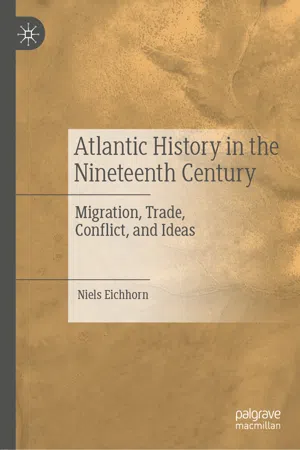
Atlantic History in the Nineteenth Century
Migration, Trade, Conflict, and Ideas
- English
- ePUB (mobile friendly)
- Available on iOS & Android
eBook - ePub
About this book
This book argues that a vibrant, ever-changing Atlantic community persisted into the nineteenth century. As in the early modern Atlantic world, nineteenth-century interactions between the Americas, Africa, and Europe centered on exchange: exchange of people, commodities, and ideas. From 1789 to 1914, new means of transportation and communication allowed revolutionaries, migrants, merchants, settlers, and tourists to crisscross the ocean, share their experiences, and spread knowledge. Extending the conventional chronology of Atlantic world history up to the start of the First World War, Niels Eichhorn uncovers the complex dynamics of transition and transformation that marked the nineteenth-century Atlantic world.
Information
© The Author(s) 2019
N. EichhornAtlantic History in the Nineteenth Centuryhttps://doi.org/10.1007/978-3-030-27640-9_11. Introduction
Niels Eichhorn1
(1)
Middle Georgia State University, Macon, GA, USA
Niels Eichhorn
On April 30, 1849, the Hamburg native, Georg Laué Julius Bendixen, sailed through the Golden Gate into San Francisco. Unlike many of the passengers and crew, who quickly disembarked for the goldfields in the interior, Bendixen came to San Francisco to work for Cross, Hobson, and Company, a merchant firm. Bendixen was just one of over 300,000 migrants who arrived in California between 1849 and 1854, and one among millions who crisscrossed the Atlantic Ocean during those years. Bendixen started his journey with his father only two years earlier when the two departed their native Hamburg for Valparaiso, Chile. Born on November 19, 1828, in Apenrade, Schleswig, Bendixen grew up with his father away captaining a sailing vessel.1 Coming from a family of mariners, Bendixen represented the nineteenth-century Atlantic world’s population of seafarers, merchants, and migrants.
Bendixen had no interest to follow in his father’s footstep and suffer the hardships of an ocean-going profession; instead, he embraced a merchant career with an apprenticeship in a local spice store. In the fall of 1847, he joined his father on a trip to Valparaiso, Chile. Bendixen’s luck held; with the growing trade interest of Hamburg’s merchant houses in South America, an employment opportunity arose. Two merchants, who had only recently opened a branch office for Hochgreve und Vorwerk, hired the young Bendixen. The contact with people from his home region and their expansive trade network had offered Bendixen employment.2 He, like so many, benefitted from these nineteenth-century Atlantic merchant communities and networks that spanned the region.
In Valparaiso, Bendixen and his father encountered a merchants group from the bustling port of San Francisco. His father hired on as captain for a copper shipment to Hamburg. When the ship ran aground and the owners auctioned the vessel off to the San Francisco-based Cross, Hobson, and Company, Alexander Cross, a Scottish immigrant, used the opportunity to establish a branch office for his company in Valparaiso and hired Bendixen’s father to bring the refloated vessel to San Francisco. As a result of this business interaction, Georg Bendixen received a job offer in Cross’s business in San Francisco.3
Once in San Francisco, Bendixen assisted Cross, Hobson, and Company with the massive amount of commodities they purchased and sold. These goods arrived from numerous parts of the world. As a respected member of San Francisco society and deeply familiar with the ordered and orderly society of Hamburg, San Francisco struck Bendixen as a lawless place. He joined the local Vigilance Comité, carrying a revolver, and working police duties.4 Bendixen had a conservative outlook; he desired to bring order, law, and government to this frontier environment, not dissimilar from hundreds of others in the Atlantic world during the nineteenth century. For Bendixen, California was not the global crossroad that Chinese miners and railroad works as well as Australian miners made it, but the very edge or last frontier of the Atlantic world of the nineteenth century.
Bendixen did not stay in Cross’s service for long, wishing to establish his own company. He relied on the many connections he made in Hamburg, Valparaiso, and San Francisco, as well as the personal interactions with young individuals from his home region scattered around the world. For the next, almost ten years and despite setbacks as a result of major fires in San Francisco, Bendixen gained respectability and an income as a merchant. Like many of his countrymen, Bendixen sought a position in an auction house. He eventually married Amalie Fischer, from a German family, and in 1865 left San Francisco to return to Hamburg.5 Bendixen continued to rely on his personal relations for his business successes in the competitive Atlantic world environment.
Bendixen represents the nineteenth-century Atlantic world. He left his home in the German states for the economic opportunities offered in the Americas, just like thousands had done previously, stretching as far back as the Colonial era. Bendixen relied on the intricate and long-established trade networks and linkages when he searched for jobs, but also when he tried his own business luck. He faced the difficulties of political, social, and national transformations as he tried to bring his idea of law and order to the California frontier. Nevertheless, he was like many, not a stationary character. He embodied the traveler, who moved about, but at heart remained loyal to his home country. Many stories like his remain unrecognized as scholars continue to restrain themselves in the nineteenth-century nation-state narratives, avoiding application of a transnational or Atlantic approach to the Atlantic world of this era.
Historians usually do not consider Bendixen’s Atlantic world of the 1850s and 1860s as part of the Atlantic world narrative. This work seeks to challenge previously held chronological assumptions about the Atlantic world and especially the claim that the Atlantic world transformed into part of a global narrative after 1825. Importantly, Atlantic history, in the words of Philip Morgan and Jack Greene, represents an “analytic construct.”6 Historians dissatisfied with the limitation of nation-state narratives, influenced by Fernand Braudel’s work on the Mediterranean, and the overlapping colonial experiences during the age of exploration and colonization, embraced the broader narrative opportunities offered by Atlantic history, which allowed them to not only study one empire, colony, or region, but to place their works in a broader international framework. However, as some critics have pointed out, Atlantic history may be imperial history by another name, and that the Atlantic lacks the same cohesion as the Mediterranean.7 However, as David Eltis convincingly shows, “The end result [of Atlantic histories] was, if not a single Atlantic society, a set of societies fundamentally different from what they would have been without participation in the new transatlantic network.”8 This work sees the Atlantic world in similar terms. The Atlantic world encompasses people who shared similar experiences in different parts of the Atlantic region and some who transferred ideas and experiences in person around the Atlantic basin.
At the same time, the Atlantic world was never a self-contained unit.9 After all, the early Atlantic world was a highway to the riches of Asia. The Viceroyalty of New Spain transshipped Chinese silk from the Manila Galleon onto Spain-bound vessels.10 Furthermore, the British East India Company, the Vereenigde Oost-Indische Compagnie, and the Compagnie des Indes Orientales all relied on stopping points in the Atlantic basin to bring home the massive profits of the East India trade and replenish their vessels.11 Historians have quarreled about the delineation between Atlantic history and Global history. In the Atlantic world, all regions developed differently because of the interactions between the various parts which contrasted from the Indian Ocean world where Europeans joined long-established trade systems as junior partners. Some historians have argued that for example “contract labor and capital flows to Asia were a nineteenth century phenomena.”12 This work begs to differ. Asia certainly grew in importance during the nineteenth century, but did not gain the same significance that the Atlantic trade network had. This work will illustrate that people continued to think in Atlantic and not global terms during the nineteenth century.
Similarly, considering the origins of Atlantic history in the era of the early Cold War and the emergence of NATO, there is a level of regionalism.13 Technically, there were two Atlantic worlds, North and South Atlantic. Where Brazilian plantations received slaves from the Portuguese trade partners in Congo and Angola, the North Atlantic system witnessed a diverse interaction between imperial metropoles, Africa slave ports, and the American colonies.14 Whereas the colonial era systems operated often autonomous of each other, after 1800, migration into South American from Europe increased and Brazil made efforts for closer ties with Europe. During the nineteenth century, the North and South Atlantic systems grew closer together and transformed into something more akin to one Atlantic world, even if a significant focus remained on the North Atlantic system.
Keeping in mind that the Atlantic world is an “analytic construct,” the chronological framework is a similarly arbitrary construct. The vast majority of works have adopted an endpoint around the independence of the Spanish American colonies, c.1825. They argue that with the end of the colonial empires, the Atlantic world disappeared as a cohesive unit. The foremost Atlantic history theorist and founder of the International Seminar on the History of the Atlantic World, Bernard Bailyn has defined the chronological boundaries of Atlantic history in Atlantic History: Concept and Contours as the period “from the first encounters of Europeans with the Western Hemisphere through the Revolutionary era.” In other words, he proposed a chronology from 1492 to c.1825. He, like many others, claims that after the Age of Revolution, trends were global and no longer Atlantic.15 Bailyn argues that once the colonies in the Americas, from New Hampshire to Chile, gained their independence, Atlantic connections dissolved. However, Canada, Cuba, and Puerto Rico remained colonies for most of the nineteenth century. Some Caribbean islands remain European colonies, controlled by the Dutch, the British, and the French, to this day. Along with trade, intellectual and political ties remain strong between the former colonies and their metropoles as individuals traveled from the Americas and Africa to Europe for education. The claim of an end of the Atlantic world with the end of the European empires is problematic.
Dissatisfied with such an imperial-looking chronology, recent scholarship by Thomas Benjamin and the authors of The Atlantic World textbook have suggested a different chronological endpoint. To the authors of The Atlantic World, the abolition of slavery “diminished [the] coherence of the Atlantic as a self-contained unit of analysis.”16 Similarly, Benjamin sees slavery as the final of the “fundamental structures that connected and defined the Atlantic World,” whose collapse meant the region no longer existed as a cohesive unit and was submerged in growing global trends.17 However, in both cases closing in 1888 or 1900 still has a rather imperial perspective of the Atlantic World and more importantly, the focus on abolition in the Americas frequently devolves into case studies rather than an integrated and encompassing Atlantic narrative. Even more, the narrative tends to focus on the Americas at the expense of especially Africa.
Where the arbitrary endpoints in c.1825 and c.1888 are deeply ingrained in Atlantic world scholarship, some ethnic-based studies have adopted a different ending. In divergence, Jace Weaver ends his presentation of a Native American-Red Atlantic with a Native delegation to the League of Nations and Inuit contributions to an Arctic exploration, placing the end in 1924.18 In contrast, Paul Gilroy looks at a smaller number of individuals of African descent ...
Table of contents
- Cover
- Front Matter
- 1. Introduction
- 2. Migration
- 3. Trade Relations
- 4. National Revolutions
- 5. Constitutional Revolutions
- 6. Garibaldi’s Revolutionary Atlantic
- 7. Slave Trade and the Return to Africa
- 8. Emancipation
- 9. Conquest of Frontiers
- 10. Imperial Projects and Expansion
- 11. Henry Sylvester Williams’s Black Atlantic
- 12. Conservative Revolutions
- 13. Atlantic Tourism
- 14. Atlantic Financial Entanglements
- 15. Industrial Reform, Progressivism, and Socialism
- 16. A New Atlantic World
- Back Matter
Trusted by 375,005 students
Access to over 1.5 million titles for a fair monthly price.
Study more efficiently using our study tools.
Frequently asked questions
Yes, you can cancel anytime from the Subscription tab in your account settings on the Perlego website. Your subscription will stay active until the end of your current billing period. Learn how to cancel your subscription
No, books cannot be downloaded as external files, such as PDFs, for use outside of Perlego. However, you can download books within the Perlego app for offline reading on mobile or tablet. Learn how to download books offline
Perlego offers two plans: Essential and Complete
- Essential is ideal for learners and professionals who enjoy exploring a wide range of subjects. Access the Essential Library with 800,000+ trusted titles and best-sellers across business, personal growth, and the humanities. Includes unlimited reading time and Standard Read Aloud voice.
- Complete: Perfect for advanced learners and researchers needing full, unrestricted access. Unlock 1.5M+ books across hundreds of subjects, including academic and specialized titles. The Complete Plan also includes advanced features like Premium Read Aloud and Research Assistant.
We are an online textbook subscription service, where you can get access to an entire online library for less than the price of a single book per month. With over 1.5 million books across 990+ topics, we’ve got you covered! Learn about our mission
Look out for the read-aloud symbol on your next book to see if you can listen to it. The read-aloud tool reads text aloud for you, highlighting the text as it is being read. You can pause it, speed it up and slow it down. Learn more about Read Aloud
Yes! You can use the Perlego app on both iOS and Android devices to read anytime, anywhere — even offline. Perfect for commutes or when you’re on the go.
Please note we cannot support devices running on iOS 13 and Android 7 or earlier. Learn more about using the app
Please note we cannot support devices running on iOS 13 and Android 7 or earlier. Learn more about using the app
Yes, you can access Atlantic History in the Nineteenth Century by Niels Eichhorn in PDF and/or ePUB format, as well as other popular books in History & Modern History. We have over 1.5 million books available in our catalogue for you to explore.