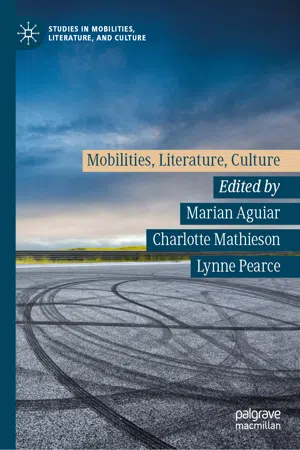
This is the first book dedicated to literary and cultural scholars' engagement with mobilities scholarship. As such, the volume both advances new theoretical approaches to the study of culture and furthers the recent "humanities turn" in mobilities studies. The book's scholarship is deeply informed by cultural geography's vision of a mobilised reconceptualisation of space and place, but also by the contribution of literary scholars in articulating questions of travel, technologies of transport, (post)colonialism and migration through a close engagement with textual materials. A comprehensive introduction maps pre-histories and emerging directions of this exciting interdisciplinary endeavor while taking up the theoretical and methodological challenges of the burgeoning subfield. Contributions range across geographical and disciplinary boundaries to address questions of embodied subjectivities, mobility and the nation, geopolitics of migration, and mobilities futures.
eBook - ePub
Mobilities, Literature, Culture
- English
- ePUB (mobile friendly)
- Available on iOS & Android
eBook - ePub
Mobilities, Literature, Culture
About this book
Information
© The Author(s) 2019
M. Aguiar et al. (eds.)Mobilities, Literature, CultureStudies in Mobilities, Literature, and Culturehttps://doi.org/10.1007/978-3-030-27072-8_11. Introduction: Mobilities, Literature, Culture
Marian Aguiar1 , Charlotte Mathieson2 and Lynne Pearce3
(1)
Department of English, Carnegie Mellon University, Pittsburgh, PA, USA
(2)
School of Literature and Languages, University of Surrey, Guildford, UK
(3)
Department of English Literature and Creative Writing, Lancaster University, Lancaster, UK
Marian Aguiar (Corresponding author)
Charlotte Mathieson
Lynne Pearce
This collection has its origins in an international conference of the same name which was held at Lancaster University (UK) in April 2017. Papers were delivered by scholars from an exceptionally wide range of humanities disciplines including English, American and Global Literature, Creative Writing, History, Geography, Film Studies, the Visual Arts and Performance Studies, as well as from the social sciences. Over half of those who participated were established academics, and delegates travelled to Lancaster from all over the world including New Zealand, the USA, and South Africa as well as from continental Europe and the Middle East. Mobilities, Literature, Culture represents some of that early thinking brought to fruition. Our prime objective in putting this collection together is to further advance the recent “humanities turn” in mobilities studies with a particular focus on scholars who approach the field through literary and cultural studies. Mobilities studies works towards a rigorous assessment of the social and spatial aspects of mobile practices within their cultural milieu. Its focus encompasses a wide range of movements , from the large-scale technologies of global travel, to transnational interconnections, to everyday local mobilities—including journeys by foot, road, rail, air, and sea, at local, regional, national and transnational levels. Mobilities studies recognises that mobility operates at multiple scales of meaning, any and all of which constitutes a society’s mobile culture. This volume charts the ways literary and cultural studies has already played a significant role in developing a field often identified with the social sciences. The book’s scholarship is deeply informed by cultural geography’s vision of a mobilised reconceptualisation of space and place, but also by the contribution of literary scholars in articulating questions of travel, technologies of transport , migration and (post)colonialism through a close engagement with textual materials. In this way, our hope is that the collection will speak to scholars working in both the humanities and social sciences as well as across that divide.
Interest in the field of mobilities studies has been growing exponentially since the millennium. Most notably, Lancaster’s Centre for Mobilities Research [CeMoRe], started by John Urry and Mimi Sheller in 2003, now has a mailing list of nearly 1000 scholars from every possible disciplinary background (see https://www.lancs.ac.uk/cemore/), while its recently launched Global Mobilities Network shows that over forty institutions around the world are now engaged in mobilities research (see wp.lancs.ac.uk/globalmobilities/). Most recently, we have witnessed the emergence of two new centres dedicated specifically to mobilities and the humanities : one at the University of Padua in Italy (see https://www.dissgea.unipd.it/en/research/mobility-and-humanities) and the other at the University of Konkuk, South Korea (see mobilityhumanities.org for details of this programme and the Konkuk Asian Mobility Humanities Network [AHMN]). One of our aspirations for the Mobilities, Literature, Culture collection, and for the larger book series to which it belongs, is that our timely intervention will speak to these interdisciplinary debates and encourage a new generation of literary scholars to explore the usefulness of mobilities theory for their research, as well as signal to social scientists the contribution text-based materials can make to their own methodologies.
Here it is important to note that we follow some groundbreaking scholarship from the past decade in cultivating this subfield; the international centres cited above may be new, but mobilities research which draws upon literary and cultural materials and textual approaches is already well established; when we range across cognate subjects such as historical and cultural geography, we see that publications on cultural mobilities of all kinds are already well established (see subsection following for details), and many more are waiting in the wings judging from the numerous submissions that have passed our desks since the inauguration of the series in 2017. Further, the three editors of the series have been working in this emerging field for some time: Lynne Pearce has (together with Peter Merriman) spearheaded mapping the relation between mobilities and humanities (see section following for details) as well as publishing on literary representations of automobility and the mobilities of intimate personal relationships; Charlotte Mathieson has been researching and publishing on nineteenth-century British sea narratives and other travel literature as well as exploring the mobilities of the nineteenth-century novel; and Marian Aguiar, based in the U.S., has published on both African and South Asian representations of colonial and postcolonial railways, and has been researching new scholarship on refugee migration for the past few years. Several other scholars who have been trailblazers in this area of research are named in the section which follows and in the individual chapters of this book. Thus, with this edited volume, we are not so much claiming the invention of a further mobilities subfield as much as identifying a confluence of different thinking, theorising a critical genealogy for mobilities from a humanities (and specifically literary) perspective, and affording this extraordinarily rich interdisciplinary field greater visibility. This is particularly critical for North America, where—notwithstanding some significant scholarship that approaches mobility-related topics from a humanities perspective—there are not the same networks as those that have been established in the UK and Europe. Similarly, mobilities studies is still in its relative infancy when it comes to rethinking technologies of transport and the social construction of movement in non-Western spaces. Representations of these global spaces appear throughout this volume—commuter trains in South Africa, runners in Singapore, refugees in the Mediterranean and migrant labourers in the Gulf region —where they are connected thematically in order to show how movement has become a constitutive part of so many different social, historical and geographical practices, situations and events.
Following an opening section which aims to provide an overview of how textual criticism of different kinds is contributing to the humanities turn within mobilities studies, the Introduction proceeds to provide readers with summaries of the four sections into which the book has been organised—Mobility and Nation, Embodied Subjectivities, Geopolitics of Migration, and Mobility Futures —each of which combines reflections on the individual chapters with a contextualisation of the thematic focus concerned.
Literary Criticism Meets the “Mobilities Turn”
Literary criticism is arguably one of the last disciplines to annex the mobilities theories devised and developed by geographers and sociologists in the 1990s and early 2000s. Indeed, ours is the first published volume to bring mobilities research and literary scholarship together in a dedicated way even though certain sub-groups, such as those working on children’s literature (e.g., Murray and Overall 2017), and individuals , such as the editors of this collection, have been doing so for the b...
Table of contents
- Cover
- Front Matter
- 1. Introduction: Mobilities, Literature, Culture
- Part I. Mobility and Nation
- Part II. Embodied Subjectivities
- Part III. Geopolitics of Migration
- Part IV. Mobility Futures
- Back Matter
Trusted by 375,005 students
Access to over 1.5 million titles for a fair monthly price.
Study more efficiently using our study tools.
Frequently asked questions
Yes, you can cancel anytime from the Subscription tab in your account settings on the Perlego website. Your subscription will stay active until the end of your current billing period. Learn how to cancel your subscription
No, books cannot be downloaded as external files, such as PDFs, for use outside of Perlego. However, you can download books within the Perlego app for offline reading on mobile or tablet. Learn how to download books offline
Perlego offers two plans: Essential and Complete
- Essential is ideal for learners and professionals who enjoy exploring a wide range of subjects. Access the Essential Library with 800,000+ trusted titles and best-sellers across business, personal growth, and the humanities. Includes unlimited reading time and Standard Read Aloud voice.
- Complete: Perfect for advanced learners and researchers needing full, unrestricted access. Unlock 1.5M+ books across hundreds of subjects, including academic and specialized titles. The Complete Plan also includes advanced features like Premium Read Aloud and Research Assistant.
We are an online textbook subscription service, where you can get access to an entire online library for less than the price of a single book per month. With over 1.5 million books across 990+ topics, we’ve got you covered! Learn about our mission
Look out for the read-aloud symbol on your next book to see if you can listen to it. The read-aloud tool reads text aloud for you, highlighting the text as it is being read. You can pause it, speed it up and slow it down. Learn more about Read Aloud
Yes! You can use the Perlego app on both iOS and Android devices to read anytime, anywhere — even offline. Perfect for commutes or when you’re on the go.
Please note we cannot support devices running on iOS 13 and Android 7 or earlier. Learn more about using the app
Please note we cannot support devices running on iOS 13 and Android 7 or earlier. Learn more about using the app
Yes, you can access Mobilities, Literature, Culture by Marian Aguiar, Charlotte Mathieson, Lynne Pearce, Marian Aguiar,Charlotte Mathieson,Lynne Pearce in PDF and/or ePUB format, as well as other popular books in Literature & Literary Criticism. We have over 1.5 million books available in our catalogue for you to explore.