This book puts radical theology and political theology into an interdisciplinary conversation with sustained and serious readings of resistance. Using an anthropology of ritual as a common thread, Jordan E. Miller explores the reality of the relationship between political theology, radical theology, and political theory, action, and power without cynicism in a creative, forward-moving way. The first half of the book develops a radical political theology and the second half applies that theory to a series of social movements, including The AIDS Coalition to Unleash Power (ACT UP), Occupy Wall Street, and #BlackLivesMatter, and includes reflections on the events at Standing Rock, ND.
eBook - ePub
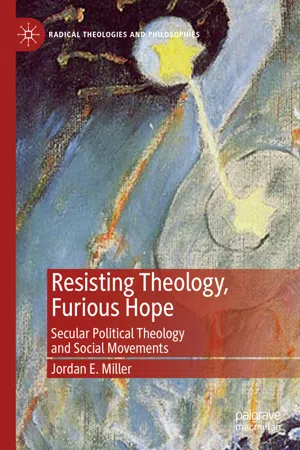
Resisting Theology, Furious Hope
Secular Political Theology and Social Movements
- English
- ePUB (mobile friendly)
- Available on iOS & Android
eBook - ePub
About this book
Information
Topic
Theology & ReligionSubtopic
Political History & Theory© The Author(s) 2019
Jordan E. MillerResisting Theology, Furious HopeRadical Theologies and Philosophieshttps://doi.org/10.1007/978-3-030-17391-3_11. Introduction to Resisting Theology
Jordan E. Miller1
(1)
Independent Scholar, Newport, RI, USA
Jordan E. Miller
The world always appears new. Politics and religion , sovereignty and theology, resistance and ritual play key roles in the making, maintaining, and remaking of that world. This may be counterintuitive. According to conventional wisdom, the world had been losing its religion. From the nineteenth century until the last few decades, in both scholarly and popular outlets, the proponents of this secularization thesis seemed to dominate the discourse about religion. Science and technology, through the twin legacies of the Enlightenment and industrialization, would ultimately erode the sphere of human meaning typically occupied by religion, thus bringing humanity into a new, secular-humanist epoch. Modernity would destroy religion.1 But despite exponentially advancing technological and scientific change and vast improvements in world literacy and education, the world has not secularized as it had been predicted. Especially since the Iranian Revolution, the rise of the Moral Majority and Christian evangelicalism in American politics, the rise of religious extremism and violence, and the Arab Spring, it has become increasingly clear that the secularization thesis, while ubiquitous in the middle of the twentieth century, was––quite simply––wrong. Religion did not disappear. And yet neither is this a simple case of a return. The religion that seems to have returned is different than it had been. The relationship between religion and the secular has thus proven to be more complex and nuanced than previously imagined.
In response to this so-called return of religion, there has been a growing body of scholarship that, over the last 30 years or so and increasing in volume and frequency, has attempted to re-conceive religion, politics, the secular, and the relationships between them.2 Talal Asad’s Formations of the Secular: Christianity, Islam, Modernity is a prominent and important example. In it, Asad explains that the growing academic disenchantment with the secularization thesis is not just a result of the new importance that religion seems to be playing in politics. He writes:
This is a typical example of the ways in which a traditional understanding of the secular needs to be frustrated and reexamined. For Asad, both are expressions of power and the State. So not only do the secular and the religious depend on one another, but the religious and the political implicate each other as well. Studying the religious, the secular, or the political thus requires studying all three. As a result, this has profound implications for both political philosophy and theology, as well as for their hybrid, political theology.In a sense what many would anachronistically call “religion” was always involved in the world of power. If the secularization thesis no longer carries the conviction it once did, this is because the categories of “politics” and “religion” turn out to implicate each other more profoundly than we thought, a discovery that has accompanied our growing understanding of the powers of the modern nation-state. The concept of the secular cannot do without the idea of religion.3
We are living through a time of renewed emphasis on religion. Further, it is not coincidental that we are also living in a time of increasingly accelerating political and social change around the world. Most notably, recent phenomena such as the Arab Spring, the Occupy Movement, the Zapatista Rebellion, the 15-M Movement in Spain, the activities in Gezi Park in Istanbul, the Umbrella Revolution in Hong Kong, Idle No More in Canada, #BlackLivesMatter, and the encampments at Standing Rock in North Dakota have demonstrated a trend of peoples’ unwillingness to accept the imposition of injustice through neoliberal globalization and its allies. Increasing wealth disparity, the depletion of natural resources, and political and social violence through racism, misogyny, and homophobia are all features of the emerging, dominant political-economic system on the planet. There has been an explosion in political theory in recent years attempting to resist neoliberalism through rethinking such tried and true political concepts as democracy, anarchy, and socialism.4 In light of Asad’s connection of religion and the secular to the political sphere, any understanding of the human condition in today’s world requires an understanding of resistance movements occurring within the contexts of religion, the secular, and neoliberalism.
Political theology is a way of thinking that has the potential to shed light on this matrix of religion, politics, and social change. Political theology is not theology that is political or has political implications. It is a hybrid branch of political philosophy, philosophy of religion, and theology that investigates ways in which religious concepts, postures, and thinking underlie political, social, economic, and cultural discourses and institutions. Perhaps its most famous proponent is Carl Schmitt whose Political Theology, written in 1922, lays out the theory that political sovereignty is a secularization of divine sovereignty and, thus, political theory and theology are disciplinary cognates.5 The social-creative powers of religion and politics thus lend themselves to a political-theological understanding.
The principal questions guiding the trajectory of this book are: (1) how might political theology understand contemporary political resistance? and its reciprocal, (2) how will an examination of contemporary resistance force a reconsideration of political theology? To answer these questions, the project begins by investigating the historical development of the relationship between religion and politics and their common foundations. I propose certain ways in which religion works to create a meaningful, political world in which one might live. I then critically investigate the relationship between radical theology and its relationship to the construction of community and political activity. The culmination of this project takes place in its second half: experimental and creative performances of resisting theology. The relationship, tension, and translatability between religion and politics are constant points of reference.
Subjunctivity is common to both religion and political resistance. In using that term, I’m appropriating a concept that refers to the grammatical mood of a verb used to express uncertainty, hypothesis, contingency, possibility, desire, potentiality, necessity, or hope and extrapolating it out into a concept.6 This idea has been theorized most fully in Adam B. Seligman, Robert P. Weller, Michael J. Puett, and Bennett Simon’s Ritual and Its Consequences: An Essay on the Limits of Sincerity, in which they develop one of the anthropologist Roy A. Rappaport’s most significant insights: that the work of any given ritual, regardless of its particular meaning, is to create an order that is self-consciously distinct from other possible social worlds.7 In short, the subjunctive describes the world, not as it is, but as it might be. This “might be” is the root of both movements of political resistance which seek to model...
Table of contents
- Cover
- Front Matter
- 1. Introduction to Resisting Theology
- 2. Subjunctivity
- 3. Political Theology
- 4. Resisting Theology Part 2
- 5. Act Up
- 6. Occupy Wall Street
- 7. #BlackLivesMatter
- 8. Conclusion: Standing Rock
- Back Matter
Trusted by 375,005 students
Access to over 1.5 million titles for a fair monthly price.
Study more efficiently using our study tools.
Frequently asked questions
Yes, you can cancel anytime from the Subscription tab in your account settings on the Perlego website. Your subscription will stay active until the end of your current billing period. Learn how to cancel your subscription
No, books cannot be downloaded as external files, such as PDFs, for use outside of Perlego. However, you can download books within the Perlego app for offline reading on mobile or tablet. Learn how to download books offline
Perlego offers two plans: Essential and Complete
- Essential is ideal for learners and professionals who enjoy exploring a wide range of subjects. Access the Essential Library with 800,000+ trusted titles and best-sellers across business, personal growth, and the humanities. Includes unlimited reading time and Standard Read Aloud voice.
- Complete: Perfect for advanced learners and researchers needing full, unrestricted access. Unlock 1.5M+ books across hundreds of subjects, including academic and specialized titles. The Complete Plan also includes advanced features like Premium Read Aloud and Research Assistant.
We are an online textbook subscription service, where you can get access to an entire online library for less than the price of a single book per month. With over 1.5 million books across 990+ topics, we’ve got you covered! Learn about our mission
Look out for the read-aloud symbol on your next book to see if you can listen to it. The read-aloud tool reads text aloud for you, highlighting the text as it is being read. You can pause it, speed it up and slow it down. Learn more about Read Aloud
Yes! You can use the Perlego app on both iOS and Android devices to read anytime, anywhere — even offline. Perfect for commutes or when you’re on the go.
Please note we cannot support devices running on iOS 13 and Android 7 or earlier. Learn more about using the app
Please note we cannot support devices running on iOS 13 and Android 7 or earlier. Learn more about using the app
Yes, you can access Resisting Theology, Furious Hope by Jordan E. Miller in PDF and/or ePUB format, as well as other popular books in Theology & Religion & Political History & Theory. We have over 1.5 million books available in our catalogue for you to explore.