Winner of the Medieval and Renaissance Drama Society's 2021 Bevington Award for Best New Book
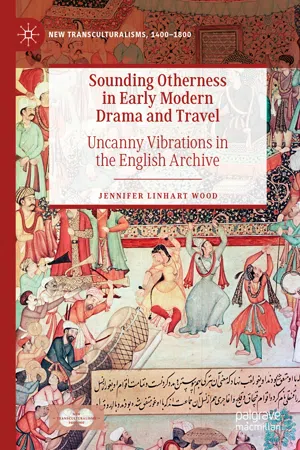
eBook - ePub
Sounding Otherness in Early Modern Drama and Travel
Uncanny Vibrations in the English Archive
- English
- ePUB (mobile friendly)
- Available on iOS & Android
eBook - ePub
Sounding Otherness in Early Modern Drama and Travel
Uncanny Vibrations in the English Archive
About this book
Information
© The Author(s) 2019
Jennifer Linhart WoodSounding Otherness in Early Modern Drama and TravelNew Transculturalisms, 1400–1800https://doi.org/10.1007/978-3-030-12224-9_2Part I: New World Symphony
Jennifer Linhart Wood1, 2
(1)
St. Mary’s College of Maryland, Saint Mary’s City, MD, USA
(2)
The Folger Shakespeare Library, Washington, DC, USA
Jennifer Linhart Wood
The exhibition galleries at Jamestown Settlement in Jamestown, Virginia, appeal to the senses to introduce its visitors to the different cultural groups present in the area at the beginning of the seventeenth century.1 The galleries employ the conventional modern practice of placing artifacts carefully and safely behind a glass partition, distancing the museumgoer from these objects deemed worthy of preservation. This separates the potentially destructive present from the curated past these relics represent, except through the visual spectrum. But the first sense that may be engaged is hearing, for each exhibit in the gallery representing the year 1607 is preceded by a “sound-stick.” To use this sound-stick, one must pick it up and place it next to her ear, actively participating in order to engage with the sounds of a past cultural moment. Since there were obviously no recording devices in the early days of Jamestown, the soundbytes at the Jamestown Settlement museum are reconstructions. One of the sound-sticks plays a recording of the Lenape language, which is presented as the closest relative to the extinct Algonquian family of languages, while another sound-stick features the Kimbundu language, a dialect of Bantu, and similar to that spoken by the first Africans brought by force to the New World in 1619. While these cannot be “historically accurate” representations of that language or its sounds, the curators of the museum clearly desired to provide a sonic medium for the museum patron to hear as part of the experience of “1607 Jamestown.”
As I contend throughout this book, it is clear that from the earliest written records that sound played an integral role in cross-cultural encounters. This legacy continues, as the Jamestown Settlement museum would suggest, for sounds (or, to modern museumgoers, reproductions of sounds) of the so-called New World are a vital component of the experience of this space.2 Unlike the arrowheads, pottery, garments, and other artifacts partitioned behind glass, the recordings of the sound-sticks allow the languages of the different cultural groups to interact with one’s ear and other bodily mechanisms. They vibrate and shake up the listener, as well as provide a different sensory avenue of touching and being touched by the past.
Besides the African and “Indian” languages, the English language of the early seventeenth century is presented for modern audiences to hear, should they choose. This sound-stick is in many ways the most fascinating, for it distances many members of the museum’s audience from their native tongue. Presenting a representation of “Renaissance English” suggests that this type of English is archaic, even possibly foreign, and not the style or dialect of English one speaks or hears nowadays. At the same time, the sound-stick calibrates the listener to that very frequency of supposedly “different” sound. This double move—pulling in opposite directions—enacts a phenomenological experience of the sonic uncanny in the listener. Even more remarkable, however, are the words the listener hears: lines from Shakespeare’s Tempest . Not only are we meant to hear Renaissance English, but words from the most venerated writer in the history of the English language, indicating the huge cultural that capital Shakespeare’s name bears. But the lines we hear are ones spoken by the fool Trinculo, who derisively comments upon the English after he spies Caliban for the first time: “Were I in England now, as once I was, and had but this fish painted,” he speculates, “not a holiday-fool there but would give a piece of silver. There would this monster make a man—any strange beast there makes a man. When they will not give a doit to relieve a lame beggar, they will lay out ten to see a dead Indian” (2.2.26–31). The term “Indian” here is often interpreted as indicating indigenous peoples of the “New World,” and its use in the museum exhibit endorses this reading instead of recognizing the instability of word “Indian” in this passage—a term that simultaneously points East and West of England.3 James Kearney argues that this moment is one in which Trinculo attempts “to divine the value of the exotic native on the European marketplace” through a humorous critique of both “holiday-fools and idle aristocrats” who are characterized as “rubes taken in by monsters and strange beasts.”4 Yet, I wonder how many museumgoers realize the meta-reference to ourselves in this soundbyte, giving our hard-earned “pieces of silver” in exchange for entering this museum precisely to see and hear the “exotic” from days long past; this passage, moreover, suggests an uneasy similitude between representations of the native peoples museumgoers have just viewed and the fishy “islander” Caliban that Trinculo had just described.
Furthermore, the reference to a “dead Indian” emphasizes the (perhaps deliberately) oft-neglected dark and tragic side of the “American” foundational story apparent in Trinculo’s lines5: as Scott Manning Stevens argues, “Both the land and the inhabitants of the Americas had an effect on the Europeans. For the indigenous population, contact would very often prove fatal and would inevitably result in cultural disruptions that are difficult for most of us to appreciate today.”6 The pathogens termed “invisible bullets” by Thomas Harriot and discussed famously by Stephen Greenblatt resulted in the decimation of indigenous peoples; these deaths, however, were—as Trinculo posits—marketable for Anglo-Europeans.7 Even the presentation of live Indians in England could be profitable: scholars estimate that dozens of “New World Indians” were brought to England, many to London. These include Pocahontas, who died at Gravesend; Eiakintomino, who was pictured in his native dress in St. James’s Park; Kalicho, who was brought to England by Martin Frobisher and died soon after; and Epenow, who was “shewed up and downe London for money as a wonder,” according to John Smith, but was one of the few who was eventually able to escape his captors.8
While there are no skeletal or organic remains of “Indians” on display at Jamestown Settlement in the manner that Trinculo describes, the museum displays statues of “dead Indians,” as well as artifacts from their village. In an ironic twist, one can travel the short distance over to Historic Jamestowne and see the remains, not of a “dead Indian,” but of three dead colonists, including Bartholomew Gosnold, in the Voorhees Archaearium. If the museum functions like Trinculo, and the exhibits like the spectacular “strange beast” Caliban, then we are the “holiday-fools” seeking a novel experience in Jamestown.
Sound is clearly one way to experience culture. This sentiment was expressed in the 2018 Shakespeare Association of America panel on “Indigenous Shakespeare and Cultural Translations”: two of the four panelists began their presentations by speaking words in their native languages, sharing sounds of otherness with the audience. Scott Manning Stevens greeted us with a Mohawk salutation and Laura Lehua Yim with one spoken in Hawaiian. And all panelists spoke about the importance of Amerindian languages, especially as it related to performance of Shakespeare. Stevens made the point that “Language is the one thing we want to share,” and by speaking Mohawk words to the audience, he did precisely that, calibrating everyone in the conference meeting room, the chairs, the walls, the bodies, and the building all present on Native American land to the frequency of Mohawk linguistic vibrations.
The title of this section suggests that the fascination with Amerindian and “New World Indian” sound still pervades modern American culture. The “New World Symphony” is the popular name of Antonín Dvořák’s Ninth Symphony (1893), which was subsequently taken to the moon during the Apollo 11 exploration of another “new world.” The title as I deploy it is not meant to colonize the sounds of the “New World” with a Western orchestral scheme of music, but rather, to open up the meaning of “symphony” to include nonmusical sounds and sonic collaborations between different cultures. Dvořák’s symphony itself cites “Native American Indian” music and African spirituals, even as this piece was performed with the standard instruments of a Western orchestra. The terms in this title can even be temporally relocated to the early modern period: the word “symphony,” in the Renaissance, was suggestive of both a variety of instruments and their beautiful harmony, rather than an orchestral work.9 The phrase “New World” is absolutely a problematic one on many levels, and not least because it temporally and physically negates the millions of peoples who had been living in the region for centuries before Europeans arrived and called this world “New.”10 In a similar way, “Indian” is a term that highlights the very mistake the non-native newcomers made; it was first misapplied by Columbus, who termed the indigenous peoples “indios” because he (wrongly) assumed he was on the opposite side of the globe. While this term enacts another colonizing move, some modern-day peoples embrace this term because of that very mistake. Because early modern English and European peoples understood the Western hemisphere of the globe under the imprecise and incorrect conceptual framework of the “New World,” rather than individual and individuated tribes, I retain that phrase in this study because of its use in the early modern period and to remind readers that travelers to the “New World” possessed, at best, a perfunctory understanding of the Occidental hemisphere of the globe. Although I will henceforth dispense w...
Table of contents
- Cover
- Front Matter
- Introduction: Soundings
- Part I: New World Symphony
- Rattling Soundscapes of Witch Drama and the New World
- Hell’s Bells: Delight in Transatlantic Jinglings
- Interlude: Intercultural Remixes
- Part II: Songs of the Orient
- An Organ’s Metamorphosis: Thomas Dallam’s Sonic Transformations in the Ottoman Empire
- “Drums Rumble Within”: Embodied Experiences of Temples in the East and on the London Stage
- Interlude: A Tale of Two Toms: Dallam and Coryate Speaking in Oriental Tongues
- Part III: World Music: East Is West
- “Something Rich and Strange”: Global Listening and The Tempest
- Coda: “Songs from the Wood”
- Back Matter
Trusted by 375,005 students
Access to over 1.5 million titles for a fair monthly price.
Study more efficiently using our study tools.
Frequently asked questions
Yes, you can cancel anytime from the Subscription tab in your account settings on the Perlego website. Your subscription will stay active until the end of your current billing period. Learn how to cancel your subscription
No, books cannot be downloaded as external files, such as PDFs, for use outside of Perlego. However, you can download books within the Perlego app for offline reading on mobile or tablet. Learn how to download books offline
We are an online textbook subscription service, where you can get access to an entire online library for less than the price of a single book per month. With over 1.5 million books across 990+ topics, we’ve got you covered! Learn about our mission
Look out for the read-aloud symbol on your next book to see if you can listen to it. The read-aloud tool reads text aloud for you, highlighting the text as it is being read. You can pause it, speed it up and slow it down. Learn more about Read Aloud
Yes! You can use the Perlego app on both iOS and Android devices to read anytime, anywhere — even offline. Perfect for commutes or when you’re on the go.
Please note we cannot support devices running on iOS 13 and Android 7 or earlier. Learn more about using the app
Please note we cannot support devices running on iOS 13 and Android 7 or earlier. Learn more about using the app
Yes, you can access Sounding Otherness in Early Modern Drama and Travel by Jennifer Linhart Wood in PDF and/or ePUB format, as well as other popular books in History & European History. We have over 1.5 million books available in our catalogue for you to explore.