eBook - ePub
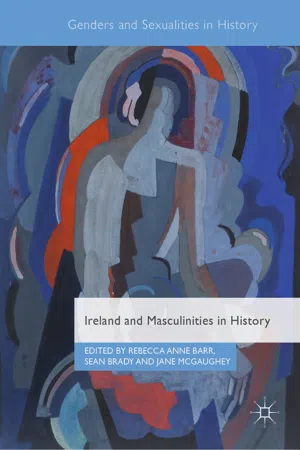
Ireland and Masculinities in History
- English
- ePUB (mobile friendly)
- Available on iOS & Android
eBook - ePub
Ireland and Masculinities in History
About this book
This edited collection presents a selection of essays on the history of Irish masculinities. Beginning with representations of masculinity in eighteenth-century drama, economics, and satire, and concluding with work on the politics of masculinity post Good-Friday Agreement in Northern Ireland, the collection advances the importance of masculinities in our understanding of Irish history and historiography. Using a variety of approaches, including literary and legal theory as well as cultural, political and local histories, this collection illuminates the differing forms, roles, and representations of Irish masculinities. Themes include the politicisation of Irishmen in both the Republic of Ireland and in Northern Ireland; muscular manliness in the Irish Diaspora; Orangewomen and political agency; the disruptive possibility of the rural bachelor; and aspirational constructions of boyhood. Several essays explore how masculinity is constructed and performed by women, thus emphasizing the necessity of differentiating masculinity from maleness. These essays demonstrate the value of gender and masculinities for historical research and the transformative potential of these concepts in how we envision Ireland's past, present, and future.
Information
Topic
HistoireSubtopic
Histoire de la Grande-Bretagne© The Author(s) 2019
Rebecca Anne Barr, Sean Brady and Jane McGaughey (eds.)Ireland and Masculinities in HistoryGenders and Sexualities in Historyhttps://doi.org/10.1007/978-3-030-02638-7_11. Ireland and Masculinities in History: An Introduction
Rebecca Anne Barr1 , Sean Brady2 and Jane McGaughey3
(1)
National University of Ireland, Galway, Ireland
(2)
Birkbeck College, University of London, London, UK
(3)
School of Irish Studies, Concordia University, Montreal, QC, Canada
Questions of masculinities have come late to the Irish historical paradigm. In many Irish historical studies gender continues to be seen as a ‘women’s issue’: in other words, that questions regarding gender relate to the effects of patriarchy on women alone. This is no surprise, given that women continue to be underrepresented in the political, academic, and cultural life in both the Republic of Ireland and Northern Ireland. Such inequity is constitutionally enshrined in Article 41.2 of the Irish Constitution, which delineates women’s role in the state as domestic support within heterosexual marriage, and exemplified by Northern Ireland’s exemption from the UK’s 1967 Abortion Act. Such marginalisation was brought to light during the 2015–2016 public controversy over the Abbey Theatre’s commemorative centenary programme, which included only one female playwright in its programme of ten plays. 1 More viscerally, the McAleese Report on state involvement with the Magdalene Laundries and Catherine Corless’s investigation into the high mortality rates and unmarked mass burials in Tuam’s Mother and Baby Home, point to the devastating real effects of cultural, social and political marginalisation. But the status quo is increasingly contested. In the wake of 2018’s landslide referendum repealing the eighth amendment the campaign for abortion rights in Northern Ireland has intensified dramatically and, in the Republic, debates continue as whether article 41.2 should be removed or amended before it is brought to a national referendum.
Women’s history in Ireland is clearly an urgent and necessary riposte to the erasure of women: a disciplinary focus which counters the sidelining and erasure of women’s experiences, political agency, and the material and cultural life of the domestic spheres in older historical methodologies. The act of ‘writing women into Irish history’ was seen as a ‘subversive activity’ which continues to be met with (in some quarters) resistance during this decade of commemorations. 2 Moreover, despite the burgeoning of women’s history and gender history in Ireland since the 1970s, the effects of such scholarship have not been fully assimilated into Irish historiography as a whole. Yet notwithstanding the increasingly extensive research focused on recovering women’s history, there has nonetheless ‘been surprisingly little expectation that a focus on gender will change the way Irish history is written…[an attitude] partly explained by the lingering prejudice that gender history…has no serious implications for the study of established political or social themes’. 3 This lack is, arguably, partly a result of the assumption that gender history is synonymous with women’s history and as such, ‘automatically …separate from other history’. 4 This might be characterized as a Field Day approach in which women’s history and gender studies are sequestered as a separate supplement rather than being integrated into, and thus renovating, the corpus. Historians have long been calling for this omission to be addressed. In 2002, Linda Connolly argued that ‘a gendered history of Ireland…requires [an] illumination of masculinity’ and cautioned that ‘automatically transferring the history of women into a history of gender, while evading the construction of masculinity as a subject of scrutiny in historical writing’ would result in ‘only a partial understanding of gender’. 5 An important publication which endeavoured to catalyse gender studies in Ireland is Gender and Power in Irish History (2009), edited by Maryann Gialanella Valiulis. This showcased a diverse selection of work on women’s history and gender, demonstrating the utility and productiveness of gender paradigms for the understanding of Irish history, particularly in relation to gender’s ability to illuminate and interrogate power relations. 6 Yet Valiulis’ 2009 collection included only one essay which specifically addressed masculinities and, even more revealingly, only one male historian contributed to the collection. Gender history was clearly perceived as ‘women’s work’. Eight years later still Catríona Kennedy laments that ‘Irish masculinities remains a chronically understudied area’ where the ‘relative dearth in the history of Irish masculinities’ makes it difficult to establish ‘a longer historical perspective’. While ‘the study of masculinities has long been directly or indirectly central to the agenda of women’s history’, she acknowledges, an ‘explicitly gendered history of Irish men remains one of the most promising avenues for future research’. 7
This brief overview suggests that the relative lack of attention by scholars to masculinities in Ireland’s history is a side-effect of the politically necessary focus on women’s histories and is reflective of a persistent conservatism still reluctant to recognise the gendering of men. In Irish history, then, men ‘remain the unanalysed norm, women the exception which merits specific mention’. 8 The supposed primacy of the political (and the implicit distinction of ‘mainstream’ politics from gender politics) often renders gender a consideration of seemingly secondary importance when compared with questions of political legitimacy, nationalism and the nation-state, violence and colonialism. 9 Such occlusion is further exacerbated by the terms of debate. As Connolly notes, ‘the prominent role history, historians and politics are generally afforded in the Irish public sphere’ is frequently ‘a largely masculinist phenomenon and performance’ conducted between men, excluding women, and the history writing that results is often ‘selective, partial and ideological in relation to women’s history and unequal power’. 10 Essentialist presumption underwrites silence on masculinities.
While work on historical masculinities generally tends to be ‘unevenly distributed across geographical areas of focus’, the neglect of Irish masculinities—and of genders and sexualities in general—as sites of historical enquiry is notable, especially when compared with the development of these areas in the historiography of the United States and Britain for more than a generation. 11 The flourishing of Irish diaspora studies in North America in recent decades has resulted in scholarly attention to gender and the Irish in North America and to the Irish female emigrant experience in Britain. 12 But this has had little direct impact on approaches to Irish history itself. The relative lack of attention by historians to gender and masculinities in Ireland is even more remarkable as Ireland, in both jurisdictions, has been dominated historically by competing religiously orientated masculinities. Though ‘confessional differences …might influence understandings and practices of gender’ the tensions, conflicts and legacy of ‘ethno-nationalist’ violence in this island are deeply inflected by discourses of masculinisation, virility and emasculation. 13 The depth and pervasiveness of religiously inspired and inflected social conservatism has had direct impact of the formation of masculinities in Ireland, including the many men who did not conform to social and cultural expectations of their gender. Throughout the twentieth and twenty-first centuries, state, society and its institutions in the two Irelands have been characterised by male dominance and the ‘patriarchal dividend’. This has had direct consequences for the lives, bodies, and agency of women and sexual minorities.
Ireland and Masculinities in History aims to catalyse work on masculinities by showcasing a variety of research into Irish masculinities from a multiplicity of perspectives and periods. The collection moves towards a longer framework for historical studies of masculinities in Ireland, as delineated by Kennedy. Since the beginning of the twenty-first century, literary and cultural critics have led the way in introducing critical approaches to masculinities in the Irish scholarly paradigm. Anne Mulhall’s groundbreaking work on heteronormativity and queer identity in modern and postmodern Ireland, 14 Diane Negra’s collection, Gendering the Recession: Media and Culture in an Age of Austerity (2014), and collections such as Caroline Magennis and Raymond Mullen’s Irish Masculinities: Reflections on Literature and Culture (2011) 15 and Conn Holohan and Tony Tracy’s Masculinity and Irish Popular Culture: Tiger’s Tales (2014) all explore the continuing effects of Ireland’s patriarchal and conservative heritage on contemporary society. As Holohan and Tracy state, from a near-absence of these questions in Irish scholarship, in the last few years, the discipline has ‘caught up dramatically to rapidly constitute a burgeoning field of new Irish masculinity studies’. 16 Furthermore, as Debbie Ging argues in Men and Masculinities in Irish Cinema (2013), since the 1980s Irish filmmakers have been at the forefront of ‘some of the most astutely observed and gender-progressive accounts of Irish men and masculinity’. 17 A significant strand of popular Irish culture thus not merely makes ‘maleness… visible’ but also often ‘savagely critiques’ ‘patriarchal privilege’. 18 Yet historians have been slower than cultural and literary critics to interrogate the role of masculinities. Among historians, the paucity of analysis on Irish historical masculinities is not simply a matter of neglect, or ‘being behind’. Due to the focus on the national questi...
Table of contents
- Cover
- Front Matter
- 1. Ireland and Masculinities in History: An Introduction
- 2. Caught in a Contract: Congreve, Farquhar and Contractarian Masculinities
- 3. ‘Whole Swarms of Bastards’: A Modest Proposal, the Discourse of Economic Improvement and Protestant Masculinity in Ireland, 1720–1738
- 4. Bog Men: Celtic Landscapes in Mid-Eighteenth-Century Satire
- 5. Primogeniture, Strict Settlement and the Rituals of Masculinity on an Irish Landed Estate, 1855–90
- 6. Thomas A. Hickey: The ‘Uncrowned King’ and Irish Masculinity on Two Continents
- 7. Games for Boys: Masculinity, Boyhood and Play 1922–1939
- 8. Fianna Fáil’s Agrarian Man and the Economics of National Salvation
- 9. Bachelor Trouble, Troubled Bachelors: The Cultural Figure of the Bachelor in Ballybunion and Mullingar
- 10. Irish Fatherhood in the Twentieth Century
- 11. ‘No Idle Sightseers’: The Ulster Women’s Unionist Council and the Masculine World of Politics During the Ulster Crisis, 1912–14
- 12. Irish Protestant Masculinities and Orangewomen in Scotland, Canada and England, 1890–1918
- 13. Masculinities, Political Transition and Power: A Case Study of Northern Ireland
- 14. Afterword: Irish Masculinities and Gender History
- Back Matter
Trusted by 375,005 students
Access to over 1.5 million titles for a fair monthly price.
Study more efficiently using our study tools.
Frequently asked questions
Yes, you can cancel anytime from the Subscription tab in your account settings on the Perlego website. Your subscription will stay active until the end of your current billing period. Learn how to cancel your subscription
No, books cannot be downloaded as external files, such as PDFs, for use outside of Perlego. However, you can download books within the Perlego app for offline reading on mobile or tablet. Learn how to download books offline
We are an online textbook subscription service, where you can get access to an entire online library for less than the price of a single book per month. With over 1.5 million books across 990+ topics, we’ve got you covered! Learn about our mission
Look out for the read-aloud symbol on your next book to see if you can listen to it. The read-aloud tool reads text aloud for you, highlighting the text as it is being read. You can pause it, speed it up and slow it down. Learn more about Read Aloud
Yes! You can use the Perlego app on both iOS and Android devices to read anytime, anywhere — even offline. Perfect for commutes or when you’re on the go.
Please note we cannot support devices running on iOS 13 and Android 7 or earlier. Learn more about using the app
Please note we cannot support devices running on iOS 13 and Android 7 or earlier. Learn more about using the app
Yes, you can access Ireland and Masculinities in History by Rebecca Anne Barr, Sean Brady, Jane McGaughey, Rebecca Anne Barr,Sean Brady,Jane McGaughey in PDF and/or ePUB format, as well as other popular books in Histoire & Histoire de la Grande-Bretagne. We have over 1.5 million books available in our catalogue for you to explore.