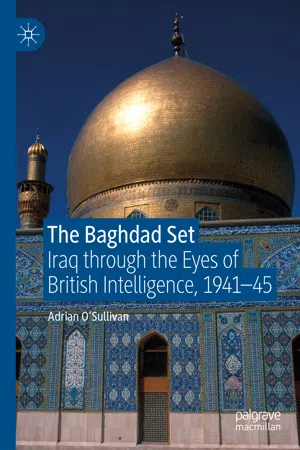
This book provides the first ever intelligence history of Iraq from 1941 to 1945, and is the third and final volume of a trilogy on regional intelligence and counterintelligence operations that includes Nazi Secret Warfare in Occupied Persia (Iran) (2014), and Espionage and Counterintelligence in Occupied Persia (Iran) (2015). This account of covert operations in Iraq during the Second World War is based on archival documents, diaries, and memoirs, interspersed with descriptions of all kinds of clandestine activity, and contextualized with analysis showing the significance of what happened regionally in terms of the greater war. After outlining the circumstances of the rise and fall of the fascist Gaylani regime, Adrian O'Sullivan examines the activities of the Allied secret services (CICI, SOE, SIS, and OSS) in Iraq, and the Axis initiatives planned or mounted against them. O'Sullivan emphasizes the social nature of human intelligence work and introducesthe reader to a number of interesting, talented personalities who performed secret roles in Iraq, including the distinguished author Dame Freya Stark.
- English
- ePUB (mobile friendly)
- Available on iOS & Android
eBook - ePub
About this book
Information
Topic
StoriaSubtopic
Storia mediorientale© The Author(s) 2019
Adrian O'SullivanThe Baghdad Sethttps://doi.org/10.1007/978-3-030-15183-6_11. Prologue: Of Spies, Scouts, and Cover
Spies are like ghosts—people seem to have had a general feeling that there might be such things, but they did not at the same time believe in them—because they never saw them, and seldom met anyone who had had first-hand experience of them. But … they do exist, and in very large numbers, not only in England but in every part of Europe.
—Sir Robert Baden-Powell
Robert Baden-Powell, My Adventures as a Spy (Mineola, NY: Dover, 2011), 1.
End AbstractProbably the most intelligent of intelligencers to work in Iraq during the Second World War were two close friends and former members of Section D of the Secret Intelligence Service (SIS)1: the celebrated travel writer and photographer Freya Madeline Stark (1893–1993) and her dear friend and frequent companion, the brilliant Anglo-Irishman, Old Etonian, and former Anglican monk, Herbert Francis ‘Adrian’ Bishop (1898–1942), known to his family as ‘Frank,’ to Freya Stark as ‘Bish,’ and to many of his Baghdad friends as ‘Brother Tom,’ on account of the fact that he had only recently left the cloisters of Nashdom Abbey, where his religious name had been Brother Thomas More.2 On the face of things, Freya Stark and Adrian Bishop were an odd couple: Bishop—a tall man, heavy-set like a rugby prop-forward, with a loud, booming voice—towered over the diminutive Stark. Openly homosexual but celibate, and very masculine, he delighted in sharing with Stark his daily breviary readings in the beautiful gardens of the Baghdad embassy, while she was doubtless temporarily forced to suppress her naturally coquettish ways. In reality, however, the two had far more in common than met the eye, as both were gifted linguists and literate conversationalists, both were well-travelled and wise to the world, and both had a deep knowledge of and interest in Arab and Persian affairs, including the contemporary issues around Zionism, pan-Arabism, and of course fascism. When in England and Europe before the war, both had moved in glittering literary circles, and between them they had known many celebrities, including Isaiah Berlin, John Betjeman, Osbert Lancaster, Harold Nicolson, Virginia Woolf, and Rose Macaulay among others, not to mention many distinguished academics. For years before—and even after Bishop’s religious epiphany in 1935—his partner had been the eminent classics don and Master of Wadham College, Maurice Bowra (1898–1971).3 Few doors at Oxford and Cambridge were closed to the couple. Apart from insignificant snippets mentioned by Stark in her memoirs and correspondence, we cannot know precisely what she and Bishop discussed during their daily conversations or on other social occasions in Baghdad. An entry in the Special Operations Executive (SOE) War Diary in late April 1941 certainly suggests that they may have been discussing profound secrets. It says that the entire British community were being interviewed at the embassy and were being enrolled into a whispering organization, while other more secret organizations were being created under Bishop, who was coordinating all propaganda.4 Certainly there must have been much to discuss, for both Stark and Bishop shared one great secret that was at the very core of their friendship: they were both spies, and they had both been spying for Britain during most of the interwar years—in one way or another.5
To spy is merely to watch, and a spy is therefore merely an observer, usually of some enemy or other, or even of an ally or a friend. In the secret world of clandestine or ‘special’ operations, however, there is really no such thing as a spy, for operatives who inhabit this twilight zone are specifically tasked with complex activities that go far beyond mere gazing. Each of these players bears the unique label of his or her own nuanced occupational role: intelligence agent, security officer, propagandist, saboteur, codebreaker, and so forth. Unfortunately, some labels are widely misunderstood and conflated. Intelligence ‘agents,’ for instance, are not synonymous with intelligence ‘officers’: the former are usually contracted externally and rewarded by an intelligence ‘agency’ for services rendered, whereas the latter are generally employed internally by it as members of it. Confusingly, however, officers of the wartime American military-intelligence and security-intelligence organizations—the Office of Strategic Services (OSS), and the Counter Intelligence Corps (CIC)—were officially called ‘agents.’ Conversely, many people refer inaccurately to officers of the Secret Intelligence Service (SIS or MI6) and of the Security Service (MI5) as ‘intelligence agents,’ which as employees they are clearly not. In popular parlance, the latter are also often referred to as ‘spies,’ when it would of course be more accurate to call them ‘spycatchers.’
In the Middle East during the Second World War, every conceivable covert function was to be found both at Cairo headquarters and in the field. To plan and implement the clandestine operations that were to be executed by the many different role-players scattered throughout North Africa and the desert lands east of Suez, a preposterous, entangled jungle of highly competitive, often overlapping secret organizations was allowed to proliferate. So vicious was the feuding and so frenzied the politics among these Cairo intelligence bailiwicks that one senior SOE officer6 habitually referred to the region as the ‘Muddle’ East, while one junior SOE officer (a friend of Freya Stark’s) was able to distil from his Cairo experiences not one but two satirical bestsellers.7 Despite the notorious intriguing and infighting at senior levels of the Cairo-based clandestine services, external liaison among individual officers of the various entities was generally amicable and fully functional, at least at the tactical operational level. At the individual level, the borderlines were also frequently blurred. Throughout the war, personnel would transfer from SIS to SOE or from SOE to SIS.8 After transferring, some SIS operatives would continue to use their SOE identity as extra cover in addition to their Foreign Office (FO) diplomatic or consular cover. Consequently, in some cases, it is unclear which service they actually belonged to, or whether they answered to more than one. Freya Stark (SIS/MOI /FO )9 and Adrian Bishop (SIS/SOE/FO ), as well as their friends Aidan Philip, Pat Domvile, and Robin Zaehner (all SIS/SOE/FO), are typical of SIS operatives in the Middle East and elsewhere who maintained this kind of ambivalent cover-within-cover after leaving or joining SIS.10 Our continued confusion, especially when operatives were under a third layer of FO camouflage, is of course a measure of the fluidity, effectiveness, and durability of such double or triple cover.11
And how wondrously diverse were the roles these participants played and how varied the covert spaces they inhabited. Imagine planning officers in crisp tropical service dress coolly sipping their pink gins and chota pegs before dinner on the front terrace of Shepheard’s Hotel in Cairo, while swapping the latest inter- and intraservice gossip or initiating schemes to further the interests of their operational causes. Such operatives were a world away from officers in the field, sweating it out perhaps in the superheated hell of life under canvas in western, southern, or northern Iraq: coping with creepy-crawlies and swarming flies, surviving on army rations, learning how to find shade behind a jeep or even a telegraph pole,12 struggling perhaps with a temperamental W/T set. The former had little more to concern themselves with than their hush-hush careers and their next best political trick. The latter on the other hand could be in serious danger with every personal contact or chance remark. Their relative safety depended much upon the opacity of their cover and the nature of their work. Propaganda officers under embassy cover in Baghdad were arguably at less risk than sabotage officers in Kurdistan preparing tribesmen to resist a German invasion. On the Persia and Iraq Force (PAIFORCE ) war establishment, 337 people worked to ensure the security of the territory and polity of the two nation-states of Persia (Iran) and Iraq. There were defence security officers (DSOs), assistant defence security officers (ADSOs ), area ...
Table of contents
- Cover
- Front Matter
- 1. Prologue: Of Spies, Scouts, and Cover
- 2. Prelude to Conflict and the Embassy Siege
- 3. War within War
- 4. Restoring the Peace
- 5. South Gate
- 6. The Moon Palace
- 7. Border Security and Boots on the Ground
- 8. Six: His Britannic Majesty’s Secret Intelligence Service
- 9. A Place in the Shade
- 10. Oh So Social
- 11. Epilogue: The Baghdad Set
- Back Matter
Trusted by 375,005 students
Access to over 1.5 million titles for a fair monthly price.
Study more efficiently using our study tools.
Frequently asked questions
Yes, you can cancel anytime from the Subscription tab in your account settings on the Perlego website. Your subscription will stay active until the end of your current billing period. Learn how to cancel your subscription
No, books cannot be downloaded as external files, such as PDFs, for use outside of Perlego. However, you can download books within the Perlego app for offline reading on mobile or tablet. Learn how to download books offline
Perlego offers two plans: Essential and Complete
- Essential is ideal for learners and professionals who enjoy exploring a wide range of subjects. Access the Essential Library with 800,000+ trusted titles and best-sellers across business, personal growth, and the humanities. Includes unlimited reading time and Standard Read Aloud voice.
- Complete: Perfect for advanced learners and researchers needing full, unrestricted access. Unlock 1.5M+ books across hundreds of subjects, including academic and specialized titles. The Complete Plan also includes advanced features like Premium Read Aloud and Research Assistant.
We are an online textbook subscription service, where you can get access to an entire online library for less than the price of a single book per month. With over 1.5 million books across 990+ topics, we’ve got you covered! Learn about our mission
Look out for the read-aloud symbol on your next book to see if you can listen to it. The read-aloud tool reads text aloud for you, highlighting the text as it is being read. You can pause it, speed it up and slow it down. Learn more about Read Aloud
Yes! You can use the Perlego app on both iOS and Android devices to read anytime, anywhere — even offline. Perfect for commutes or when you’re on the go.
Please note we cannot support devices running on iOS 13 and Android 7 or earlier. Learn more about using the app
Please note we cannot support devices running on iOS 13 and Android 7 or earlier. Learn more about using the app
Yes, you can access The Baghdad Set by Adrian O'Sullivan in PDF and/or ePUB format, as well as other popular books in Storia & Storia mediorientale. We have over 1.5 million books available in our catalogue for you to explore.