This book provides the first historical and comparative study of the 'transnational activist'. A range of important recent scholarship has considered the rise of global social movements, the presence of transnational networks, and the transfer or diffusion of political techniques. Much of this writing has registered the pivotal role of 'transnational' or 'global' activists. However, if the significance of the 'transnational activist' is now routinely acknowledged, then the history of this actor is still something of a mystery. Most commentators have associated the figure with contemporary history. Hence much of the debate around 'transnational activism' is ahistorical, and claims for novelty are not often based on developed historical comparison. As this volume argues, it is possible to identify the 'transnational activist' in earlier decades and even centuries. But when did this figure first appear? What are the historical conditions that nurtured its emergence? What are the principal moments in the development of the transnational activist? And do the transnational activists of the Internet age differ in number or nature from those of earlier years? These historical questions will be at the heart of this volume.
eBook - ePub
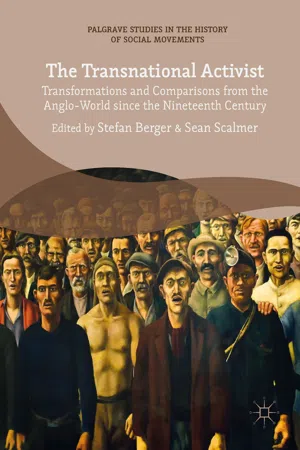
The Transnational Activist
Transformations and Comparisons from the Anglo-World since the Nineteenth Century
- English
- ePUB (mobile friendly)
- Available on iOS & Android
eBook - ePub
The Transnational Activist
Transformations and Comparisons from the Anglo-World since the Nineteenth Century
About this book
Information
© The Author(s) 2018
Stefan Berger and Sean Scalmer (eds.)The Transnational ActivistPalgrave Studies in the History of Social Movementshttps://doi.org/10.1007/978-3-319-66206-0_11. The Transnational Activist: An Introduction
Stefan Berger1 and Sean Scalmer2
(1)
Ruhr University Bochum , Bochum, Germany
(2)
University of Melbourne, Melbourne, VIC, Australia
The activist, the Oxford English Dictionary instructs, is one engaged in or advocating vigorous political activity, an active campaigner. The now ubiquitous term gained currency in English in the early part of the twentieth century, applied first to British supporters of “direct action,” originating in France , and Russian Bolshevism.1 Right from the start, therefore, ‘activism’ implied an internationalist inspiration or connection.
It is an identity and association not yet registered in detailed historical scholarship. Political history has principally been written within a national framework,2 and as a result it has mostly granted transnational relationships only limited attention. ‘The activist’ has conventionally been treated as a creature of national politics: the history of the ‘transnational activist’ remains to be written.
This is a lack only recently acknowledged. Contemporary sociology, of course, was relatively quick to recognise the significance of global processes.3 Global social movements are now the subject of a large and growing body of literature.4 More recently, historians, often inspired by historical sociologists, have also begun to explore social movements in the global historical perspective.5 There is now also a first English-language journal portraying social movements in historical perspective and thereby accompanying the more established social science journals on social movements.6 Rich studies consider the relationship between transnational social movements and global capitalism ,7 international institutions,8 and new information technologies.9 The ‘transfer’ or ‘diffusion’ of collective campaigns—the “most familiar” and “oldest” form of transnational contention10—has attracted especially detailed treatment.11
Much of this research has granted especially full attention to the import of structural forces in the promotion of transnational social movements. Scholars influenced by the Marxist tradition, proponents of the so-called world-systems theory, have explored how the dynamics of the capitalist world economy have shaped the trajectory of social movement mobilisation around the globe. They have traced the complex and dialectical relationships between capital mobility, social movement unrest, and state action. They have also argued that moments of crisis in the world economic order—such as the present time—promote anti-systemic or transgressive activism.12
Similarly, the role of organisations has also attracted much perceptive scholarship, especially in the social sciences where, starting from the 1980s, scholars have produced insightful and often comparative studies on transnational social movement organisation and its impact on diverse issues such as peace, the environment, women’s rights , civil rights , human rights , and global justice .13 The assumption of much of that social science literature has been that, until the 1960s, the nation-state was the main framework in which social movements operated. Hence, much of the newer research concentrated on the transnationalisation of social movement activism from the 1960s onwards, emphasizing in particular the processes of diffusion, domestication, and externalization. The existing literature has traced the spread of ideas and practices (sometimes referred to as frames) from one country to another. It has also portrayed the way in which global issues have been received in different nation-states and at sub-state level, leading to similarities and differences in the mobilisation of social movements against such global problems. Finally, the existing literature has emphasized how supranational institutions, from the United Nations (UN) to transnational regional associations such as the European Union , have increasingly become the direct addressees of social movement mobilisation. Donatella della Porta and Sidney Tarrow have defined ‘transnational collective action’ as “coordinated international campaigns on the part of networks of activists against international actors, other states, or international institutions.”14
The role of transnational activists in deeper historical perspective has perhaps inspired less systematic and concentrated scholarly interest.15 Certainly, it should be acknowledged that leading treatments of the ‘diffusion’ of social movement contention have confirmed the centrality of cosmopolitan and globally connected actors. Everett Rogers ’ Diffusion of Innovations, the classic work of diffusion theory, especially privileged the role of “cosmopolitan opinion leaders” in the process of transfer, emphasising their status as role models for later adopters or followers.16 In Rogers’ latest iteration of the theory, innovators are described as “cosmopolites,”17 and students of political diffusion also have increasingly adopted or reworked this key concept.
Sidney Tarrow’s The New Transnational Activism (2006) is the most influential and important of these works. Tarrow argues that the “increased” presence of “transnational activism ” is a product of a “fundamental sociocultural change.” This change is the growth of a “stratum of individuals” who travel abroad regularly, are well acquainted with foreign literature and the arts, and collaborate with those based in cities overseas. Members of the stratum include, among others, civil servants and business executives18; global activists are their radical cousins.
The cultural formation of the global activist makes this significant figure into what Tarrow calls a “rooted cosmopolitan.” As the unorthodox and almost oxymoronic connotations of this neologism suggest, the “rooted cosmopolitan” is neither free-floating nor completely tethered. Rather, the term describes an individual who reaches outward physically and cognitively to make connections with other worlds, and yet also maintains strong ties to the experiences and networks of that person’s own society.19 Bridging the local and the global, they help to forge new political relationships and thereby to foster the transfer of political campaigns and techniques.
Yet, as Tarrow explicitly includes social movements of the political right, we wonder whether ‘cosmopolitan’ is the right expression to use for those individuals. Cosmopolitanism is so much connected in European intellectual traditions with humanism and the Enlightenment20 that it seems to suggest an open, tolerant, and intercultural approach to transnationalism . Hence, the designation would appear ideologically too narrow to describe all forms of transnationalism connected to social movements. It would be rather odd to refer to imperialist, nationalist, or, indeed, fascist transnational activists as cosmopolitan. It may reflect the well-known fact that social movement studies have traditionally been blind in the right eye and have privileged the study of left-of-centre social movements. But this predilection, which remains a central weakness, should not lead us to adopt problematic conceptual terms. Hence we propose, in this volume, the more neutral term ‘transnational activist,’ as it seems to us more suitable as an umbrella term covering many different ideological and institutional forms of transnationalism.
Although Tarrow’s work is clearly the most developed exploration of the concept of the transnational activist, others have shared in his general approach. A number of scholars have identified synonymous public figures over recent years: “citizen pilgrims,”21 “global spiders,”22 “grassroots globalists,”23 and “translators”24 are chief among these. Subsequent research has also applied the concept of the “rooted cosmopolitan” in fine-grained research: contrasting this actor’s continuing respect for local culture and causes with the “footloose experts” of global business and government,25 and identifying a “rooted” and “local” politics, linked with “struggles from below,” as an important and distinctive challenge to dominant approaches to the international order.26
Nonetheless, if the existence and the potential significance of the transnational activist is now widely acknowledged, the history of this actor is still something of a mystery. Five central controversies remain unresolved: periodisation, context, action, form, and...
Table of contents
- Cover
- Frontmatter
- 1. The Transnational Activist: An Introduction
- 2. Activism in the Antipodes: Transnational Quaker Humanitarianism and the Troubled Politics of Compassion in the Early Nineteenth Century
- 3. Not a Man of His Own Time: Roger Casement and Transnational Activism
- 4. Empire and Activism: Gandhi, Imperialism, and the Global Career of Satyagraha
- 5. Translating Anti-Capitalism Throughout the Empire: Tom Mann and John Curtin as Transnational Activists, 1902–1916
- 6. Marceau Pivert and the Travails of an International Socialist
- 7. The Making of a Transnational Activist: The Indonesian Human Rights Campaigner Carmel Budiardjo
- 8. Speaking Out for Justice: Bella Galhos and the International Campaign for the Independence of East Timor
- 9. Jessie Street: Activism Without Discrimination
- 10. A Very Rooted Cosmopolitan: E.P. Thompson’s Englishness and His Transnational Activism
- 11. From the Local to the Global and Back Again: The Rainforest Information Centre and Transnational Environmental Activism in the 1980s
- 12. Animal Rights Without Borders: Lyn White and Transnational Investigative Campaigning
- 13. Afterword: Transnational Activisms in Social Movement Studies
- Backmatter
Trusted by 375,005 students
Access to over 1.5 million titles for a fair monthly price.
Study more efficiently using our study tools.
Frequently asked questions
Yes, you can cancel anytime from the Subscription tab in your account settings on the Perlego website. Your subscription will stay active until the end of your current billing period. Learn how to cancel your subscription
No, books cannot be downloaded as external files, such as PDFs, for use outside of Perlego. However, you can download books within the Perlego app for offline reading on mobile or tablet. Learn how to download books offline
Perlego offers two plans: Essential and Complete
- Essential is ideal for learners and professionals who enjoy exploring a wide range of subjects. Access the Essential Library with 800,000+ trusted titles and best-sellers across business, personal growth, and the humanities. Includes unlimited reading time and Standard Read Aloud voice.
- Complete: Perfect for advanced learners and researchers needing full, unrestricted access. Unlock 1.5M+ books across hundreds of subjects, including academic and specialized titles. The Complete Plan also includes advanced features like Premium Read Aloud and Research Assistant.
We are an online textbook subscription service, where you can get access to an entire online library for less than the price of a single book per month. With over 1.5 million books across 990+ topics, we’ve got you covered! Learn about our mission
Look out for the read-aloud symbol on your next book to see if you can listen to it. The read-aloud tool reads text aloud for you, highlighting the text as it is being read. You can pause it, speed it up and slow it down. Learn more about Read Aloud
Yes! You can use the Perlego app on both iOS and Android devices to read anytime, anywhere — even offline. Perfect for commutes or when you’re on the go.
Please note we cannot support devices running on iOS 13 and Android 7 or earlier. Learn more about using the app
Please note we cannot support devices running on iOS 13 and Android 7 or earlier. Learn more about using the app
Yes, you can access The Transnational Activist by Stefan Berger, Sean Scalmer, Stefan Berger,Sean Scalmer in PDF and/or ePUB format, as well as other popular books in History & Modern History. We have over 1.5 million books available in our catalogue for you to explore.