An ethnographic study on Design Thinking, this book offers profound insights into the popular innovation method, centrally exploring how design thinking's practice relates to the vast promises surrounding it. Through a close study of a Berlin-based innovation agency, Tim Seitz finds both mundane knowledge practices and promises of transformation. He unpacks the relationships between these discourses and practices and undertakes an exploratory movement that leads him from practice theory to pragmatism. In the course of this movement, Seitz makes design thinking understandable as a phenomenon of what Boltanski and Chiapello described as the "new spirit of capitalism"—that is, an ideological structure that incorporates criticism and therefore strengthens capitalism.
eBook - ePub
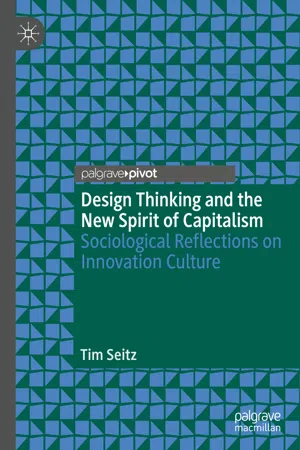
Design Thinking and the New Spirit of Capitalism
Sociological Reflections on Innovation Culture
- English
- ePUB (mobile friendly)
- Available on iOS & Android
eBook - ePub
Design Thinking and the New Spirit of Capitalism
Sociological Reflections on Innovation Culture
About this book
Information
Topic
Scienze socialiSubtopic
Economia del lavoro© The Author(s) 2020
T. SeitzDesign Thinking and the New Spirit of Capitalismhttps://doi.org/10.1007/978-3-030-31715-7_11. Introduction
“We have to get into the boardrooms because that’s where you can change people’s thinking. If we make it there, we might really shake things up!”
Fieldnotes, June 5, 2015
Abstract
This introductory chapter departs from the citation of a design thinker: “We have to get into the boardrooms because that’s where you can change people’s thinking. If we make it there, we might really shake things up!.” This quotation captures some of the self-understanding of design thinking as a general problem solver. It reveals a tension that underlies the entire book: how do the practices of design thinking relate to its great promises? I give a brief overview of the historical roots of design thinking as a research program that was later translated into a standardized method of problem solving. This is followed by theoretical reflections on the relationship of practices and discourses that set the base for my subsequent elaborations.
Keywords
PracticesDiscoursesEthnographyI am awed by Paul’s1 visionary spirit. We are talking at a launch party for an innovation agency in Berlin, and I listen, spellbound, to how he plans to change people’s thinking and thereby, change the world. I am doing participant observation in the field of design thinking, and the Trojan Horse with which Paul thinks he is going to hijack executive boardrooms is the object my study. Paul himself works for a design thinking agency in Berlin that has already been around for a few years. It is also the one that I am observing, in order to find out how exactly the aforementioned changes are supposed to come about. Paul didn’t come to this party in order to size up the competition that will consolidate at the new agency. On the contrary, he is excited about the growth of the industry, since everyone is in some way working toward the same ends, and there is more than enough work to go around. In any case, everyone here knows each other. The atmosphere reminds me of those departmental parties at the beginning of college where all the attendees knew each other from one thing or another. The connective element of this party was not like in those days; not Sociology, Freiburg but Design Thinking, Potsdam. The latter context is established through an additional certification program that almost everyone at the party has completed. But unlike sociology, design thinking sells itself as a service, and by providing such services one is qualified to start up an agency. It isn’t a discipline in itself, but a method by which disciplinary thinking ought to be overcome, insofar as the disciplines are no longer able to deal with the complexity of the world. It is thus not without irony that throughout my study, it is exactly the disciplinary function of design thinking that moves ever more into focus.
My agency and the one whose launch we happen to be celebrating have very similar origin stories: the members know each other from their design thinking training program and decided together to put their education into practice and start up their own business, rather than looking elsewhere for a job. They became design thinkers in Potsdam, and after they finished at the d.school —that’s the name of the training institute—they wanted to stay on that track. Indeed, the objectives and forms of cooperation at other jobs that one could find on the job market are fundamentally different than working with the design thinking method. Of course, they could try to find employment in the field of their primary college degree, but in contrast to what design thinking promises to offer, those options somehow seem less appealing:
Our society is becoming more complex. Through globalization and technological innovations, our pace of life is accelerating, and the way we live and work is becoming more diverse and sophisticated. Companies and institutions face an uphill battle. The pressure to change and to manage this growing complexity is increasing. This is where Design Thinking comes into play. (HPI School of Design Thinking 2019a)
But What Is Design Thinking?
Generally, design thinking is associated with a “human-centered approach to problem solving” (Kimbell 2011: 287). Instead of departing from technological opportunities or managerial calculus, with design thinking the “user is the main focus of the emphatic approach and its development” (HPI School of Design Thinking 2019a). The design thinking creative process begins with observing and polling potential users in order to understand their experiences and identify the problems they might encounter. By way of methods common to empirical social research like interviews or participant observation, the process begins by generating information about users, which can then be incorporated into the development of solutions. With design thinking “[t]he user is seen from a social-scientific perspective, with a view that is always open to something new” (HPI School of Design Thinking 2019b). According to its promise, design thinking creates the conditions to develop user-friendly products and services that are able to solve the actual problems users encounter in their lives. The right product and the right service rather than senseless commodities—this is what design thinking promises. In specifically arranged modular rooms, interdisciplinary teams undergo the iterations of the design thinking process while always integrating user-sourced feedback, which stems from regularly testing interim results. Design thinking conceives of itself as operating with actual human beings in mind, in order to satisfy their real needs and in this way, make a positive contribution to society. This is the aspirational gesture of my study’s introductory epigraph that talks about executive access as the key to change.
The term “design thinking” cropped up for the first time at the beginning of the 1980s to describe a research program in design that had already been around since the 1960s (cf. Mareis 2011: 34–54). At first, the term didn’t have anything to do with a specific method. The “design thinking” research program studied the specific work processes of professional designers in order to find out “how designers think” (Lawson 1983; cf. Rowe 1987). This community of researchers met for the first time at the 1991 Design Thinking Research Symposium in Delft. The introduction to the proceedings from the symposium (Cross et al. 1992) highlighted the participants’ intellectual concern with reforming design training programs, which were, since the 1980s, increasingly institutionally situated (cf. Mareis 2011: 54–60). As a theory of self-reflection (cf. Kieserling 2004: 56–63), design thinking research was primarily preoccupied with shining a light on the functionality of its object:
My current study has little to do with this research field. As I have encountered it, design thinking isn’t about accruing knowledge through researching design processes, but about a prescriptive method of the same name that has grown in popularity since the mid aughts and proports to endow anyone with the kinds of the problem-solving skills used by designers (cf. Dorst 2006) that are applicable in all areas of life—“no matter what the problem is” (Mareis 2010: 3).Design thinking—the cognitive processes that are manifested in design action has become recognized as a key area of research for understanding the development of design capability in individuals and for the improvement of design practice and design education. The aims of this Workshop on Research in Design Thinking at the Faculty of Industrial Design Engineering at the Technological University of Delft were to review the current state of knowledge in this research field and to identify ways and means of using this new knowledge in design education. (Cross et al. 1992: 1)
So says Tim Brown, the corporate head and president of the leading globally-operating market research and innovation institute IDEO, which is also constantly referred to as the birthplace of the design thinking method (cf. ibid.: 6; Kelley and Littman 2001). With his book Change by Design (Brown 2009), Brown popularized the concept and appointed himself as the “global discourse agent of design within the strong growth in practice oriented literature” (Weber 2019: 236). Brown makes appearances at TED2 (2009) as well as the World Economic Forum in Davos (cf. Rawsthorn 2010) in order to promote design thinking as a “general problem solver” (Jonas 2011). In in the course of this study, I will often utilize Brown’s introductory primer on the subject of design thinking in order to highlight its interconnected hopes and promises. Related to IDEO, the Hasso Plattner Institute of Design was founded at Stanford University in 2005 and is led by IDEO co-founder David Kelley. The year 2007 saw the establishment of the HPI School of Design Thinking in Potsdam, also financed by the SAP-founder Hasso Plattner. My informants completed their post-graduate study in design thinking at the d.school in Potsdam. There, students can enroll in a year-long basic or advance track course of study, and they carry out genuine design th...[A]s design thinking begins to move out of the studio and into the corporation, the service sector, and the public sphere, it can help us to grapple with a vastly greater range of problems than has previously been the case. Design can help to improve our lives in the present. Design thinking can help us chart a path into the future. (Brown 2009: 149)
Table of contents
- Cover
- Front Matter
- 1. Introduction
- 2. The Temporality of Design Thinking
- 3. The Materiality of Design Thinking
- 4. Design Thinking and the New Spirit of Capitalism
- 5. Conclusion
- Back Matter
Trusted by 375,005 students
Access to over 1.5 million titles for a fair monthly price.
Study more efficiently using our study tools.
Frequently asked questions
Yes, you can cancel anytime from the Subscription tab in your account settings on the Perlego website. Your subscription will stay active until the end of your current billing period. Learn how to cancel your subscription
No, books cannot be downloaded as external files, such as PDFs, for use outside of Perlego. However, you can download books within the Perlego app for offline reading on mobile or tablet. Learn how to download books offline
Perlego offers two plans: Essential and Complete
- Essential is ideal for learners and professionals who enjoy exploring a wide range of subjects. Access the Essential Library with 800,000+ trusted titles and best-sellers across business, personal growth, and the humanities. Includes unlimited reading time and Standard Read Aloud voice.
- Complete: Perfect for advanced learners and researchers needing full, unrestricted access. Unlock 1.5M+ books across hundreds of subjects, including academic and specialized titles. The Complete Plan also includes advanced features like Premium Read Aloud and Research Assistant.
We are an online textbook subscription service, where you can get access to an entire online library for less than the price of a single book per month. With over 1.5 million books across 990+ topics, we’ve got you covered! Learn about our mission
Look out for the read-aloud symbol on your next book to see if you can listen to it. The read-aloud tool reads text aloud for you, highlighting the text as it is being read. You can pause it, speed it up and slow it down. Learn more about Read Aloud
Yes! You can use the Perlego app on both iOS and Android devices to read anytime, anywhere — even offline. Perfect for commutes or when you’re on the go.
Please note we cannot support devices running on iOS 13 and Android 7 or earlier. Learn more about using the app
Please note we cannot support devices running on iOS 13 and Android 7 or earlier. Learn more about using the app
Yes, you can access Design Thinking and the New Spirit of Capitalism by Tim Seitz in PDF and/or ePUB format, as well as other popular books in Scienze sociali & Economia del lavoro. We have over 1.5 million books available in our catalogue for you to explore.