eBook - ePub
Shakespeare and Contemporary Irish Literature
- English
- ePUB (mobile friendly)
- Available on iOS & Android
eBook - ePub
Shakespeare and Contemporary Irish Literature
About this book
Information
Subtopic
European Literary Criticism© The Author(s) 2018
Nicholas Taylor-Collins and Stanley van der Ziel (eds.)Shakespeare and Contemporary Irish Literaturehttps://doi.org/10.1007/978-3-319-95924-5_11. Introduction: Shakespeare, Ireland and the Contemporary
Nicholas Taylor-Collins1 and Stanley van der Ziel2
(1)
Department of English and Comparative Literary Studies, Swansea University, Swansea, UK
(2)
Department of English, Maynooth University, Maynooth, Ireland
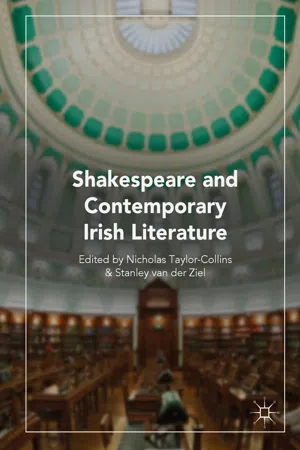
The most famous engagement with the legacy of Shakespeare in Irish literature is undoubtedly the Scylla and Charybdis episode in James Joyce’s Ulysses (1922). Set under the magnificent domed ceiling of the reading room of the National Library of Ireland on Kildare Street, it records the literary talk of Stephen Dedalus and his contemporaries. It focuses particularly on their thoughts and opinions of Shakespeare. Like his Modernist contemporary T.S. Eliot, Joyce was acutely aware that Shakespeare could be made to assume many contemporary guises, from pitiful cuckold to radical social thinker. Both men were also conscious of the more outlandish modern garb in which Shakespeare was being dressed by some of their contemporaries; these were comically enumerated in the opening paragraph of one of Eliot’s essays, which lists (among others) ‘the fatigued Shakespeare, a retired Anglo-Indian, presented by Mr. Lytton Strachey’ and ‘the messianic Shakespeare, bringing a new philosophy and a new system of yoga, presented by Mr. Middleton Murray’. 1 The latter, in particular, hints that some of these contemporary readings made Shakespeare not into a true contemporary but rather into a faddish follower of fashions.
Joyce diverges from Eliot not only in his awareness of the specific Irish contemporary incarnations of Shakespeare, but also in his willingness to engage in his fiction not just with Shakespeare’s plays but with contemporary trends in polemical criticism that vied to enlist playwright and plays for their own political ends. The subjects of Joyce’s satire in the library episode of Ulysses are many and varied, and among them are precisely the uses to which Shakespeare and his plays were being put by his contemporaries in Dublin. The targets in his sights are drawn from across the cultural and political spectrum. On the one hand, these include Victorian establishment figures of a unionist persuasion, and particularly Edward Dowden, the erstwhile professor of English at Trinity College Dublin. 2 Dowden’s make-over of Shakespeare as a respectable Victorian gentleman who (in the words of Adam Putz’s recent account of the period) ‘embodies the virtues not only of the Elizabethan age, but also those shaping the mid-nineteenth-century cultural and political moment’, 3 one who even if he is not exactly a servant of Empire certainly embodies its values, had been mocked by W.B. Yeats in his 1901 essay ‘At Stratford-on-Avon’. 4 Readings that saw the author of the plays through a materialist imperial lens are taken off in Stephen Dedalus’s comment in Scylla and Charybdis that Shakespeare was ‘a rich countrygentleman […] with a coat of arms and landed estate at Stratford and a house in Ireland yard, a capitalist shareholder, a bill promotor, a tithefarmer’, and identified explicitly with Dowden in his irreverent thought on the following page: ‘William Shakespeare and company, limited. The people’s William. For terms apply: E. Dowden, Highfield house…’ 5
On the other hand, Joyce also positions himself in relation to the strain in Irish Revivalism which sought to claim Shakespeare as an Irishman, one of their own irascible Celtic blood. Stephen alludes to the existence of attempts to make Shakespeare Irish when he refers to Cordelia as ‘Lir’s […] daughter’, conflating Shakespeare’s tragedy set in pre-Saxon Britain with the Irish legend of the Children of Lír, or when he asks ‘Why is the underplot of King Lear in which Edmund figures lifted out of Sidney’s Arcadia and spatchcocked on to a Celtic legend older than history?’ 6 Thus, Shakespeare is hauled from his pedestal as the father of English literature and reduced to merely an anachronistic imitator of indigenous Irish genius—the ‘chap that writes like Synge’ of Buck Mulligan’s famous witticism. 7 In addition, Joyce’s characters also regurgitate Yeats’s influential reading, in ‘At Stratford-on-Avon’, of Shakespeare’s history plays as an allegory of Anglo-Irish relations. On the first page of the episode, Joyce’s ‘quaker librarian’ refers to Hamlet as ‘A hesitating soul taking arms against a sea of troubles, torn by conflicting doubts,’ and as ‘The beautiful ineffectual dreamer who comes to grief against hard facts.’ 8 These statements refer not only to the argument in the ‘priceless pages’ of Goethe’s Wilhelm Meister to which the text refers but also, more pertinently in the Irish context of the novel, to Yeats’s reading of Hamlet and Richard II as paradigmatic plays about the clash between poetic but ineffectual dreamers and their worldly, practical rivals. 9 For Yeats, the contrast between the practical ‘Anglo-Saxon temperament’ of characters such as Bolingbroke or Henry V so admired by utilitarian Victorian critics like Dowden on the one hand, and the ‘capricious fancy’ of the poet-king Richard II (who in Yeats’s account resembled one of Matthew Arnold’s stereotypical ‘Celts’) on the other, was that between ‘resounding rhetoric’ and ‘lyrical fantasy’, between imperial English and romantic Irish ways of acting and seeing. 10
The majority of criticism on Shakespeare’s influence in Irish literary and intellectual life has focused on the late nineteenth and the first half of the twentieth century. The uses to which Shakespeare was put by writers as diverse as Wilde, Yeats, Joyce, Shaw and O’Casey, in particular, have been the subject of repeated study, with Mark Thornton Burnett and Ramona Wray’s Shakespeare and Ireland (1997), Janet Clare and Stephen O’Neill’s Shakespeare and the Irish Writer (2010), Robin E. Bates’s Shakespeare and the Cultural Colonization of Ireland (2008) and Adam Putz’s The Celtic Revival in Shakespeare’s Wake (2013) of particular interest. 11 Much of this existing criticism has tended to understand Shakespeare’s ambivalent significance to the Irish writer precisely in such politicised terms: as a writer who, in Bates’s summary, is ‘both their own cultural inheritance and yet a cultural representation of their colonial oppression.’ 12 There have been two dominant schools of thought within this. The first of these documents how Shakespeare, as the prime exemplar of English civilisation, has been used as a tool of colonial oppression. To this end, Bates focuses on the process through which Shakespeare’s Irish discourse positions those on Britain’s western isle as ‘both a member and an other’ of the British Empire, particularly as a concept of ‘Britain’ developed from the early modern period. The apt metaphor she selects to illustrate this is that of ‘The military practice of impressment into service […]: the forced service of those whom the state thought would be useful to fill the ranks of the military in time of need.’ Necessarily, this argument concedes that the Irish writer, simultaneously separated from and included in the imperial project, is ‘press ganged’ into service. This has its benefits, of course, because ‘Shakespeare’s cultural impressment of the Irish made them part of his work, and so it belongs to them as much as it belongs to those who used it against them.’ This leads to Irish writers responding ‘with a combination of respect and resentment that shaped their use of Shakespeare as a literary father.’ 13 Thornton Burnett argues along similar lines when he suggests that owing to the ‘legacy of English colonial policy’ in twentieth-century Irish culture, ‘Shakespeare represents a vehicle for separating out the claims of competing cultural imperatives, and that the dramatist’s work could function as a register of tensions at vexed moments in Ireland’s evolving political consciousness.’ 14 The colonial legacy is such that, even in moments of postcolonial ‘writing back’, Shakespeare becomes the mode of expressing dissent.
Other critics have focused instead on ways in which Shakespeare has been used as an avenue to freedom. Critics like Putz, in The Celtic Revival in Shakespeare’s Wake, and Matthew Creasy, in his essay ‘ Hamlet Among the Celts’, have shown how Irish authors from the Revival period around the turn of the century subverted the Shakespearean legacy by ‘appropriating’ his works in the project of national self-definition. Yeats’s appropriation of the figures of Hamlet and Richard II as Romantic Arnoldian ‘Celts’, poetic dreamers at odds with the dominant imperial way of thinking, is obviously part of this project of self-definition that drew on Shakespearean energies and examples, but other ways in which the empire wrote back—sometimes as Gaeilge 15 —over or through the Shakespearean text have been well documented. To cite but one particularly fruitful case in point, Creasy reads backwards from Joyce to the ‘Shakespearean parodies’ published in The Leader , an organ from the turn of the twentieth century that was created to further the cause of the Irish Ireland movement. The fascinating conclusion that emerges from this exercise is that while it ‘might be thought that the explicit political agenda of this Irish nationalist journal would produce a violent rejection of Shakespeare and everything he represents’, in fact ‘Shakespearean ghosts haunt […] The Leader in such ways that make terms such as tribute, travesty, influence, burlesque and resource apposite too.’ 16 Such ‘appropriated’ versions of Shakespeare can be made to speak against the values of British imperialism which they had traditionally been seen to validate. One outcome of this is that readings of Shakespeare by Irish writers and critics, as by those from other colonial and postcolonial contexts, often stress the playwright’s empathy with the marginalised and the oppressed—whether it be with the Irish captain Macmorris in Henry V or with the ‘salvage and deformed slave’ Caliban in The Tempest . 17 For a critic ...
Table of contents
- Cover
- Front Matter
- 1. Introduction: Shakespeare, Ireland and the Contemporary
- 2. ‘Memory Like Mitigation’: Heaney, Shakespeare and Ireland
- 3. ‘An Inconstant Stay’: Paul Muldoon, Seamus Heaney and the Ends of Shakespeare’s Sonnets
- 4. Moving the Statue: Myths of Motherhood in Eavan Boland, Shakespeare and Early Modern Culture
- 5. ‘This Rough Magic’: Late Derek Mahon and Late Shakespeare
- 6. The Politics of Translation in Brian Friel’s Translations and Shakespeare’s Henry Plays
- 7. Conjuring Ghosts: Shakespeare, Dramaturgy and the Plays of Frank McGuinness
- 8. ‘Filial Ingratitude’: Marina Carr’s Bond with Shakespeare
- 9. McGahern’s Lear, or: Tragedy in the Barracks
- 10. Performing Prospero: Intertextual Strategies in John Banville’s Ghosts
- Back Matter
Trusted by 375,005 students
Access to over 1.5 million titles for a fair monthly price.
Study more efficiently using our study tools.
Frequently asked questions
Yes, you can cancel anytime from the Subscription tab in your account settings on the Perlego website. Your subscription will stay active until the end of your current billing period. Learn how to cancel your subscription
No, books cannot be downloaded as external files, such as PDFs, for use outside of Perlego. However, you can download books within the Perlego app for offline reading on mobile or tablet. Learn how to download books offline
Perlego offers two plans: Essential and Complete
- Essential is ideal for learners and professionals who enjoy exploring a wide range of subjects. Access the Essential Library with 800,000+ trusted titles and best-sellers across business, personal growth, and the humanities. Includes unlimited reading time and Standard Read Aloud voice.
- Complete: Perfect for advanced learners and researchers needing full, unrestricted access. Unlock 1.5M+ books across hundreds of subjects, including academic and specialized titles. The Complete Plan also includes advanced features like Premium Read Aloud and Research Assistant.
We are an online textbook subscription service, where you can get access to an entire online library for less than the price of a single book per month. With over 1.5 million books across 990+ topics, we’ve got you covered! Learn about our mission
Look out for the read-aloud symbol on your next book to see if you can listen to it. The read-aloud tool reads text aloud for you, highlighting the text as it is being read. You can pause it, speed it up and slow it down. Learn more about Read Aloud
Yes! You can use the Perlego app on both iOS and Android devices to read anytime, anywhere — even offline. Perfect for commutes or when you’re on the go.
Please note we cannot support devices running on iOS 13 and Android 7 or earlier. Learn more about using the app
Please note we cannot support devices running on iOS 13 and Android 7 or earlier. Learn more about using the app
Yes, you can access Shakespeare and Contemporary Irish Literature by Nicholas Taylor-Collins, Stanley van der Ziel, Nicholas Taylor-Collins,Stanley van der Ziel in PDF and/or ePUB format, as well as other popular books in Media & Performing Arts & European Literary Criticism. We have over 1.5 million books available in our catalogue for you to explore.