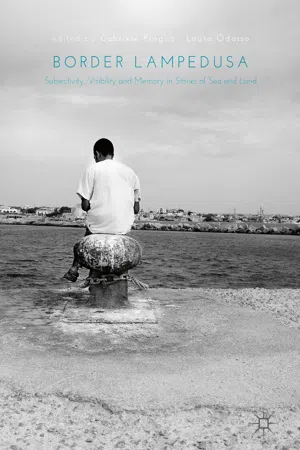
This book analyses the European border at Lampedusa as a metaphor for visible and invisible powers that impinge on relations between Europe and Africa/Asia. Taking an interdisciplinary approach (political, social, cultural, economic and artistic), it explores the island as a place where social relations based around race, gender, sex, age and class are being reproduced and/or subverted. The authors argue that Lampedusa should be understood as a synecdoche for European borders and boundaries. Widening the classical definition of the term 'border', the authors examine the different meanings assigned to the term by migrants, the local population, seafarers and associative actors based on their subjective and embodied experiences. They reveal how migration policies, international relations with African, Middle Eastern and Asian countries, and the perpetuation of new forms of colonization and imperialism entail heavy consequences for the European Union. This work will appeal to a widereadership, from scholars of migration, anthropology and sociology, to students of political science, Italian, African and cultural studies.
eBook - ePub
Border Lampedusa
Subjectivity, Visibility and Memory in Stories of Sea and Land
- English
- ePUB (mobile friendly)
- Available on iOS & Android
eBook - ePub
Border Lampedusa
Subjectivity, Visibility and Memory in Stories of Sea and Land
About this book
Information
Topic
Sciences socialesSubtopic
Droits civiques en droit© The Author(s) 2018
Gabriele Proglio and Laura Odasso (eds.)Border Lampedusahttps://doi.org/10.1007/978-3-319-59330-2_11. General Introduction
Laura Odasso1 and Gabriele Proglio2, 3
(1)
Laboratoire méditerranéen de Sociologie LAMES-CNRS, Aix-Marseille Université, Marseille, France
(2)
Centro de Estudos Sociais (CES), Universidade de Coimbra, Coimbra, Portugal
(3)
European University Institute, Fiesole, Italy
Laura Odasso (Corresponding author)
Gabriele Proglio
Laura Odasso
is a postdoctoral researcher at the Laboratoire méditerranéen de Sociologie CNRS-LAMES and at the group Temps, Espaces, Langage, Europe Méridionale, Méditerranée CNRS-TELEMME, Aix-Marseille University (program LabexMed), France. During 2014–2016, she was Marie Skłodowska-Curie fellow at the University of Brussels (project AMORE Awareness and Migration: Organizations for Binational Family Rights Empowerment). She collaborates regularly with the University of Strasbourg and with the international master Crossing the Mediterranean: towards Investment and Integration (MIM), Ca’ Foscari University of Venice. One of her recent publications is: Mixités conjugales. Discrédits, résistances et créativités dans les familles avec un partenaire arabe (PUR, 2016). Her researches are about family migration, binational unions, mixedness, gender, intersectionality, performed citizenship.
Gabriele Proglio
is an FCT (Fundação para a Ciência e a Tecnologia) postdoctoral fellowship recipient (2017–2023) at the CES (Centro de Estudos Sociais), Universidade de Coimbra (Portugal) with a research project titled “Mobilities of Memory, Memory of Mobilities. Western Mediterranean Crossings in the Twentieth and Twenty-first Century”. He was Assistant Professor in History of the Mediterranean at the University of Tunis “El Manar” and a research fellow at the European University Institute, completing an ERC (European Research Council) project “Bodies Across Borders. Oral and Visual Memory in Europe and Beyond”). He edited Decolonising the Mediterranean: European Colonial Heritages in North Africa and the Middle East (Cambridge Scholars Publishing, 2016). He published several essays on the European colonial legacies, migrations across the Mediterranean, racial constructions, orientalism, postcolonial literature, and visual arts in historical perspective. He is one of the founders of InteRGRace (Interdisciplinary Research Group on Race and Racisms) and MedWorlds, a research network on the Mediterranean.
Lampedusa is many things to many people. The thousands of lives claimed by the Mediterranean Sea make it a symbol of death. Yet, to the white, mostly European tourists crowding its sunny beaches, lulled by that same sea, Lampedusa is a metaphor for life, holidays, happiness and leisure. It has become a trope of hope for those who flee wars, famines, and a bleak future, but the small island also embodies European borders and boundaries, as well as the double face of migration policies 1 —similarly poised between selection procedures and hospitality. Finally, Lampedusa is an emblem of fear for many European neo-nationalist movements that see migrant landings as the prelude to an invasion. All these dichotomies are firmly implanted in the media-driven discourse (de Genova 2013; Cuttitta 2012) on the small Mediterranean island, whose narratives have long emphasised and continue to stress today the liminal nature of Lampedusa as the last outpost of Italy—but in close proximity to other worlds. These worlds are distant and remain so in the discursive production on the sharp distinction between “us” and “them”—the Others, the “invaders”—who materialise on our TV screens and fill newspaper columns. They are a menace we need to counter. At times, they briefly disappear from the media and political discourse only to reappear a short while later as scapegoats for the problems of liberal societies themselves. Since 1992, we have grown accustomed to the dialectic image of the situation; yet, on a closer look, we find that it goes back much further—to the colonial era. What Lampedusa seems to suggest is that reality is a multifaceted conglomeration of the past and present that we are called to study both for its tangible aspects and for the emotional and symbolic ones.
The duplication of reality through the production of an oppositional couple is part of a visual device where the self-identity is confirmed through the categorisation and identification of the Other as different from the Self. But who is the “Self”? This is the question we as scholars should answer, if we are to understand the reasons behind the prevailing narrative strategy. From a sociological and historical point of view, we might have to deconstruct the notion of Italian imagined community and investigate how legacies of the past—of the colonial past and fascism, in particular—exerted considerable influence on the construction of a collective identity. Depending on the positionality of the subject, this collective identity is multiple and variable: “multiple” because it consists of a range of possible shared identities; “variable” because every positionality involves a specific genealogy of power relations. In our opinion, this intersectional perspective is crucial to understanding the multiplication of borders inside as well as outside the national frontier (Mezzadra and Neilson 2013). The border is unmistakably a space-constructing device.
Is Lampedusa Only Lampedusa? Border as Space Production
In the light of these considerations, we propose a shift from the view of Lampedusa as a mere and Italian-only border to the understanding that it is a sign of the European condition. This change of perspective can be useful for two reasons: first, according to statistics, Lampedusa is not the first port of landing; second, Italy was and continues to be one of the main gateways to Europe. Not only do data from the UNHCR indicate the Strait of Sicily as a point of arrival, but also a dramatically sharp rise in the number of people who choose the Mediterranean route to Europe. In 2016 alone, 167,091 people reached Europe from the shores of Algeria, Tunisia and Libya; 170,712, instead, arrived through Greece from Egypt, Turkey or Syria.
The Mediterranean has become an open-air cemetery: 4621 migrants died or went missing in 2016, and more than 10,000 casualties have been reported since 2014. The death toll has led some activists to replace the term shipwreck victims with desaparecidos (Drudi 2016). Migrants’ places of origin reveal that migration is closely linked to a context of war with great social, economic and political instability: 29 percent of migrants came from Syria, 13 percent from Afghanistan. These people left their countries for an idea of Europe as the place that would provide them with a better future, economic prosperity, and a second chance. They came from Nigeria, Iraq, Pakistan, Guinea, Gambia, Sudan, the Ivory Coast; 55 percent of people arriving in Europe were men, 18 percent were women and 27 percent were minors (UNHCR 2016).
Faced with the decades-long crisis in the Mediterranean (and not only there) Europe has put up walls: intangible walls of silence and indifference; concrete blockades and militarised borders such as the ones in Ventimiglia, on the border between France and Italy; walls that marginalise migrants, reducing them to mere numbers or holding them captive to stereotypical representations—an omen of bad luck or the emblem of terror. Finally, as both national and international laws are suspended due to the extraordinariness of the situation, walls of discrimination bring to mind a state of exception (Agamben 2003) on the one hand, and the idea of a perpetual crisis, a permanent state of emergency on the other. As if we were leaning on the threshold of the Apocalypse, and the end of the world were around the corner. Surprisingly, at a time of the worst economic crisis in decades, as the social pyramid becomes steeper and income inequality increases, so does the distance between those who are, albeit in a different manner, subject to exploitation. In this scenario, immigration and its management only engender a “gouvernementalité par l’inquietude” (Bigo 1998); colonial imaginaries just add to the picture. Deeply ingrained in national identities and in the concept of Europeanness itself, these imaginaries reappear in the guise of fear of the other, be they black, African, Muslim, Arab terrorists, or just plain different—fear of the Other stealing our land, our women and then, in a symbolic/psychoanalytic perspective, our future.
Nonetheless, we must adopt a new look in the coming years, and grow out of the spectacularised narrative, the silence, and Fortress Europe’s traditional role. We must, that is, ask ourselves whether immigration as a transnational and at times transcontinental phenomenon is indeed having a major role in rewriting the cultural geography of Europe, the Mediterranean, North Africa and the Middle East. We believe this is the direction where we should be heading: beyond the legal devices, the classifications and the control practices, and towards the production of space by non-European individuals and groups. This Europe is there already—a black, Muslim and Arab Europe that contains cultures and subjects regarded as non-European. In this book we aim to approach Lampedusa from this same perspective, revealing practices and strategies of counter-narrative in various fields of cultural production.
The stories of subjectivity collected by the authors of this book can help grasp the hidden meanings of spectacularisation and misrepresentation in political discourses, practices, and media coverage of the events surrounding Lampedusa. The comparison with other migrations (or their representations) at different historical times makes this approach fruitful and open to generalisation. Widening the classical notion of the border as a political, geographical and institutional entity—or as an unstable divide between groups and communities—the book delves into what it is about Lampedusa that makes it a subjective border experience, and aims to present the different meanings assigned to the island by migrants, the local population, seafarers, and associative actors. As several of the chapters point out, the border defines state sovereignty at different levels, yet “Border-Lampedusa” is also a symbol of less questioned hidden powers. Thus, through a cultural and anthropological approach to migration, the stories in this book—from interviews, documentaries and other documents—show the impact Lampedusa has on individuals as well as on transforming the themes of “crisis” and “emergency” generally associated with the island and any merely socio-political interpretation. Instead of a simple debate opposing responsibility (national, European, international) over time and normalisation of migration management, the contributions in this book provide not only an in-depth analysis through the lens of different empirical materials (e.g. oral testimonies, interviews, ethnographic notes, etc.) and secondary sources (e.g. literary and cinematographic documents, photographs, etc.) but also the opportunity for problematizing Lampedusa both as a European and Italian border, outside the dichotomy humanitarianism-invasion.
Book Overview
The book aims to provide new insights into the relation between subjectivity, visibility and the border. It is organised into two sections—“Subjective and Embodied Experiences” and “Visibility and Memories”.
The first section opens with an essay by Rosita de Luigi—“The Traces of Journeys and Migrants’ Perspectives: The Knots of Memory and the Unravelled Plans”—where the author describes how the migration choice generates new uncertain borders for migrants. The death journeys to Lampedusa map onto downtrodden lives and shipwrecked hopes. Life stories take unexpected routes, leaving behind traces of humanity—the screams, silence, tears and hugs that accompany the migrants’ journey to the urban peripheries where the reception centres are located. In the tangles of underground immigration, where forms of reciprocity, solidarity and proximity in micro contexts stand in stark contrast with the macro dynamics of power and conflict, sea stories turn into stories of land.
The interactions between the actors dealing with on-site first aid to migrants are the focus of Gianluca Gatta’s “‘Half Devil and Half Child’: An Ethnographic Perspective on the Treatment of Migrants on their Arrival in Lampedusa”. Based on long-term fieldwork that began in 2005 in the harbour of Lampedusa, the chapter discusses the biopolitical management of migrants intercepted in the Mediterranean Sea by the Italian authorities. Relying on his direct ethnographic experience, the author is able to focus on the migrant “body” as well as the “bodies” of other actors involved in the dynamics of the landing phase. Disciplining, caring and observation practices by guards, humanitarian actors, media and the locals are examined, as well as the presentation of the self performed by migrants, the practices of negotiating pain, the management of space during landing procedures, and the active role of border guards in evoking or directly producing a specific image of the “arrivals”.
The two chapters that follow focus on two topics already addressed in Gatta’s contribution: assistance and the migrant bodies.
In “Oh, Hear Us When We Cry to Thee”, Katy Budge retraces the path of the most ancient and fundamental seafaring custom: the duty to provide assistance to those in distress. This chapter collates eyewitness accounts, gathered from diaries and personal interviews, of seafarers who have provided such assistance in the waters between Lampedusa and North Africa. The accounts provide a unique perspective on a tragic episode and illustrate that “the impulsive desire to save human life in peril is one of the most beneficial instincts of humanity, and is nowhere more salutary in its results than in bringing help to those who, exposed to the destruction from the fury of the winds and waves, would perish if left without assistance” (see Cockburn 1880).
In “The Colour(s) of Lampedusa”, Gaia Giuliani analyses the dystopian space of Lampedusa as a representation of the hyper-real functioning (or dis-functioning) of border control. The site of biometrics and definitions of the European “imagined community”, Lampedusa is the conundrum of a number of colour lines/borders that have old and more recent origins: the North–South (Continental Europe vs. Mediterranean Europe), the South–South (Mediterranean Europe vs...
Table of contents
- Cover
- Frontmatter
- 1. General Introduction
- 2. The Traces of Journeys and Migrants’ Perspectives: The Knots of Memory and the Unravelled Plans
- 3. “Half Devil and Half Child”: An Ethnographic Perspective on the Treatment of Migrants on their Arrival in Lampedusa
- 4. O Hear Us When We Cry to Thee
- 5. The Colour(s) of Lampedusa
- 6. A Politics of the Body as Body Politics: Rethinking Europe’s Worksites of Democracy
- 7. (Un)framing Lampedusa: Regimes of Visibility and the Politics of Affect in Italian Media Representations
- 8. Connecting Shores: Libya’s Colonial Ghost and Europe’s Migrant Crisis in Colonial and Postcolonial Cinematic Representations
- 9. Defragmenting Visual Representations of Border Lampedusa: Intersubjectivity and Memories from the Horn of Africa
- 10. Objects, Debris and Memory of the Mediterranean Passage: Porto M in Lampedusa
- 11. Nossa Senhora de Lampedosa, Protectress of Slaves and Refugees: On Mourning, Cultural Resilience and the Oniric Dimension of History
Trusted by 375,005 students
Access to over 1.5 million titles for a fair monthly price.
Study more efficiently using our study tools.
Frequently asked questions
Yes, you can cancel anytime from the Subscription tab in your account settings on the Perlego website. Your subscription will stay active until the end of your current billing period. Learn how to cancel your subscription
No, books cannot be downloaded as external files, such as PDFs, for use outside of Perlego. However, you can download books within the Perlego app for offline reading on mobile or tablet. Learn how to download books offline
Perlego offers two plans: Essential and Complete
- Essential is ideal for learners and professionals who enjoy exploring a wide range of subjects. Access the Essential Library with 800,000+ trusted titles and best-sellers across business, personal growth, and the humanities. Includes unlimited reading time and Standard Read Aloud voice.
- Complete: Perfect for advanced learners and researchers needing full, unrestricted access. Unlock 1.5M+ books across hundreds of subjects, including academic and specialized titles. The Complete Plan also includes advanced features like Premium Read Aloud and Research Assistant.
We are an online textbook subscription service, where you can get access to an entire online library for less than the price of a single book per month. With over 1.5 million books across 990+ topics, we’ve got you covered! Learn about our mission
Look out for the read-aloud symbol on your next book to see if you can listen to it. The read-aloud tool reads text aloud for you, highlighting the text as it is being read. You can pause it, speed it up and slow it down. Learn more about Read Aloud
Yes! You can use the Perlego app on both iOS and Android devices to read anytime, anywhere — even offline. Perfect for commutes or when you’re on the go.
Please note we cannot support devices running on iOS 13 and Android 7 or earlier. Learn more about using the app
Please note we cannot support devices running on iOS 13 and Android 7 or earlier. Learn more about using the app
Yes, you can access Border Lampedusa by Gabriele Proglio, Laura Odasso, Gabriele Proglio,Laura Odasso in PDF and/or ePUB format, as well as other popular books in Sciences sociales & Droits civiques en droit. We have over 1.5 million books available in our catalogue for you to explore.