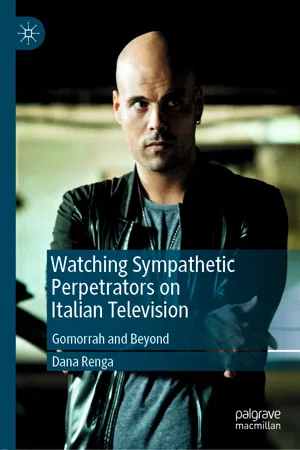
This book offers the first comprehensive study of recent, popular Italian television. Building on work in American television studies, audience and reception theory, and masculinity studies, Sympathetic Perpetrators and their Audiences on Italian Television examines how and why viewers are positioned to engage emotionally with—and root for—Italian television antiheroes. Italy's most popular exported series feature alluring and attractive criminal antiheroes, offer fictionalized accounts of historical events or figures, and highlight the routine violence of daily life in the mafia, the police force, and the political sphere. Renga argues that Italian broadcasters have made an international name for themselves by presenting dark and violent subjects in formats that are visually pleasurable and, for many across the globe, highly addictive. Taken as a whole, this book investigates what recent Italian perpetrator television can teach us about television audiences, andour viewing habits and preferences.
- English
- ePUB (mobile friendly)
- Available on iOS & Android
eBook - ePub
About this book
Information
Subtopic
Film & Video© The Author(s) 2019
Dana RengaWatching Sympathetic Perpetrators on Italian Televisionhttps://doi.org/10.1007/978-3-030-11503-6_11. Introduction: Sympathetic Serial Offenders
Dana Renga1
(1)
The Department of French and Italian, The Ohio State University, Columbus, OH, USA
The Face of Recent Italian Criminal Television
On May 10, 2016, two mafia-centered television programs were screened on different Italian networks at nearly the same time. At 9:10 pm, the second season of the smash hit television series Gomorrah (2014–) premiered on the Italian pay TV network Sky to an unsurpassed network viewership of close to 1.2 million. That night, Andrea Scrosati, who is responsible for Sky content, tweeted that viewership is up 80% with respect to Gomorrah 1 . 1 He also noted that Gomorrah 2 attracted scores more spectators to Sky than the most recent seasons of the American cult TV serials Game of Thrones and House of Cards (402 and 547% respectively) (Twitter 2016). That same Tuesday at 9:20 pm, Gianfranco Albano’s made-for-television movie Felicia Impastato was screened on the Italian public television channel Rai 1 and was watched by close to seven million viewers and received the largest share viewership of all Italian networks for that evening at 27% (la Repubblica 2016). Gomorrah, a clear example of the so-called quality television , focuses on the Camorra —the Italian mafia of the Campania region—from the inside and narrates the criminal, familial, and amorous exploits of gangsters, many of whom, as this book argues, are depicted in highly sympathetic terms. The following section of the introduction outlines the motives for which viewers might feel sympathy for small screen perpetrators. Felicia Impastato is instead a biopic concentrating on the titular character who is the mother of well-known antimafia martyr Giuseppe Impastato , murdered by the Sicilian Cosa Nostra in 1978, and tells the story of her battle to ensure justice was served and that those responsible for her son’s death were put behind bars.
This deliberate programming amalgam took the form of a showdown pitting evil against good where viewers (at least those with more than basic cable ) were asked to choose sides and tune into watch one of two onscreen mafia prototypes that have been circulating contemporaneously on small Italian screens for about a decade. Those who opted for Sky would be rewarded with high production values, and would be immersed in the Camorra -universe to likely root for one of the many bad guys who did horrible things the previous season, and (spoiler alert) will do even worse things during Gomorrah 2 and Gomorrah 3 . Instead, the Rai alternative would surely be more pedagogical and position viewers on the side of justice while sending a message that the mafia can be defeated if indeed we do not give up the just fight. The next day, reviews and discussions flooded the Internet. Two critics proclaimed that Felicia Impastato “won” the network battle. 2 Scores of others spoke to Sky ’s record numbers and praised the Gomorrah 2 for, among other things, its stylistic integrity, plot and character development, and “realism.” This last criterion—whereby the series might offer a faithful representation of gang life in and around Naples—is heated and opens up debates surrounding the polemics of representing criminality in what some argue is a glamorized light, which is a key theme of this book. 3
The curious face-off between these two mafia-related small screen products is fascinating, especially when considering the influx of sympathetic perpetrators—criminals, mobsters, corrupt politicians—who have flooded Italian television screens over the last ten years or so. As I have argued elsewhere, depicting a criminal in a sentimental light in the cinema is nothing new, especially in the Hollywood gangster tradition where members of organized crime syndicates are presented in sympathetic terms—think of The Godfather trilogy (Francis Ford Coppola , 1972, 1974, 1990), Goodfellas (Martin Scorsese , 1990), Donnie Brasco (Mike Newell, 1997), and so on. 4 Such a poignant representation of perpetrators, however, is, up until recently, scarce in the Italian tradition especially in films and television series in which compassion is usually aligned with those fallen in the battle against the mafia (Renga 2013, 131). 5 For example, in the numerous mafia movies and serial dramas made in Italy spanning genres from the 1950s until the early 2000s, mafiosi are represented in ambiguous terms or are cast as straightforward villains, and the same is true about depictions of terrorists and other malfeasant types. 6 More presently, however, in Italian television, gangsters, criminals, and unscrupulous politicians and businessmen are constructed to warrant compassion in a much more straightforward manner than we have ever seen before onscreen in the Italian tradition. And this is indeed a striking turn.
In an effort to understand this shift, we can look to Gregory Currie’s work on sympathetic engagement with fictional characters. In his work on caring, Currie asks a fundamental question:
We frequently like and take the part of people in fiction whom we would not like or take the part of in real life. The desires we seem to have concerning fictional things can be very unlike the desires we have concerning real life – so dissimilar, indeed, that it is hard to see how such disparate desires could exist within any reasonably integrated human mental economy. Why the disparity? (Currie 1997, 65)
Why is it that we forge deep relationships with onscreen characters whom we would regard as undeserving of positive ethical judgment were we to meet them in our day-to-day lives? Why is it that, via the medium of television, we invite them into our homes, even though we would strive to protect ourselves from their nonfictional counterparts? How does narrative transform “villains” into more ethically complex characters while still representing their villainous behavior? To answer these questions, this book looks at the representation and appeal of criminals when they are the subject of popular fictionalized accounts, focusing on a selection of recent, well-known Italian television series that humanize and create sympathy for perpetrators. Shakespeare long ago provided a blueprint for this situation in Macbeth (Crane 1953, 34–35), but contemporary televisual storytellers have added their own specs to that blueprint. In particular, sympathetic perpetrators on Italian television are conventionally attractive , and narratives are based upon historical figures and events.
In 2014, Giancarlo Lombardi pointed to a recent, albeit limited, body of scholarship in Italian screen studies focusing on Italian television (Lombardi 2014, 261). During the last few years, however, substantially more work has become available in Italian television studies, much of it focusing on series and miniseries treating the Holocaust, terrorism , and organized crime, political talk shows, public service broadcasting , reality television, the television program “Carosello” and advertising, and Italian network and production models. 7 This book builds on recent work on American television studies, audience and reception theory, and masculinity studies to offer the first comprehensive study of how and why viewers are positioned to emotionally engage with—and root for—sympathetic perpetrators on small Italian screens. I personally believe that the only literature that deals with the mafia should be police reports and legal rulings by judges. Except for scho...
Table of contents
- Cover
- Front Matter
- 1. Introduction: Sympathetic Serial Offenders
- 2. Rai: “Educate While Entertaining—Entertain While Educating” in L’ultimo dei Corleonesi, “Niente di personale,” and Il segreto dell’acqua
- 3. Mediaset’s Middlebrow Model: Il capo dei capi, L’ultimo padrino, Il clan dei camorristi, and L’onore e il rispetto
- 4. Sky’s Offer You Can’t Refuse and Romanzo criminale. La serie’s Criminal Payoffs
- 5. Faccia d’angelo: “The Allure of Evil”
- 6. 1992 and 1993’s Difficult Masculinities
- 7. Making Men in Gomorrah 1 and Gomorrah 2
- 8. #ciaonetflix: Suburra. La serie as “International Patrimony”
- 9. Conclusions: Gomorrah 3 and Italian Television Abroad
- Back Matter
Trusted by 375,005 students
Access to over 1.5 million titles for a fair monthly price.
Study more efficiently using our study tools.
Frequently asked questions
Yes, you can cancel anytime from the Subscription tab in your account settings on the Perlego website. Your subscription will stay active until the end of your current billing period. Learn how to cancel your subscription
No, books cannot be downloaded as external files, such as PDFs, for use outside of Perlego. However, you can download books within the Perlego app for offline reading on mobile or tablet. Learn how to download books offline
Perlego offers two plans: Essential and Complete
- Essential is ideal for learners and professionals who enjoy exploring a wide range of subjects. Access the Essential Library with 800,000+ trusted titles and best-sellers across business, personal growth, and the humanities. Includes unlimited reading time and Standard Read Aloud voice.
- Complete: Perfect for advanced learners and researchers needing full, unrestricted access. Unlock 1.5M+ books across hundreds of subjects, including academic and specialized titles. The Complete Plan also includes advanced features like Premium Read Aloud and Research Assistant.
We are an online textbook subscription service, where you can get access to an entire online library for less than the price of a single book per month. With over 1.5 million books across 990+ topics, we’ve got you covered! Learn about our mission
Look out for the read-aloud symbol on your next book to see if you can listen to it. The read-aloud tool reads text aloud for you, highlighting the text as it is being read. You can pause it, speed it up and slow it down. Learn more about Read Aloud
Yes! You can use the Perlego app on both iOS and Android devices to read anytime, anywhere — even offline. Perfect for commutes or when you’re on the go.
Please note we cannot support devices running on iOS 13 and Android 7 or earlier. Learn more about using the app
Please note we cannot support devices running on iOS 13 and Android 7 or earlier. Learn more about using the app
Yes, you can access Watching Sympathetic Perpetrators on Italian Television by Dana Renga in PDF and/or ePUB format, as well as other popular books in Media & Performing Arts & Film & Video. We have over 1.5 million books available in our catalogue for you to explore.