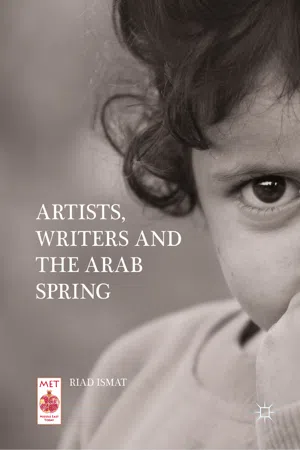
The book aims to explore the foresight of prominent Middle Eastern authors and artists who anticipated the Arab Spring, which resulted in demands for change in the repressive and corrupted regimes. Eventually, it led to cracking down on the protests with excessive force, which caused tremendous human suffering, destruction, and also escalation of extreme insurgency. The author analyzes major literary and artistic works from Egypt, Syria and Tunisia, and their political context. This monograph will be helpful to scholars and students in the growing field of Middle Eastern and North African Studies and everyone who is interested in the politics of MENA.
- English
- ePUB (mobile friendly)
- Available on iOS & Android
eBook - ePub
Artists, Writers and The Arab Spring
About this book
Information
© The Author(s) 2019
Riad IsmatArtists, Writers and The Arab SpringMiddle East Todayhttps://doi.org/10.1007/978-3-030-02668-4_11. Introduction
Riad Ismat1
(1)
Buffett Institute for Global Studies, Northwestern University, Evanston, IL, USA
Riad Ismat
It is generally agreed that the flame of the Arab Spring was sparked by a Tunisian street vendor named Muhammad Bouazizi , who publicly self-immolated after being insulted by a policewoman in Sidi Bouzid, a suburb of the Tunisian capital. He doused himself with gasoline and set himself alight with a match, subsequently suffering severe and fatal burns across most of his body. The tragic incident, although not tied to any organised political agenda, ignited a rebellion that witnessed thousands flooding the streets of Tunis, the capital, as well as many other cities. Almost immediately, the Tunisian army seized power in a white coup, and President Zine el-Abidin Ben Ali , along with his extravagant spouse and close circle of aides, fled Tunisia to seek safe haven in Saudi Arabia. There was no concrete evidence of a Western conspiracy, despite this being among the early assumptions that followed the event based on the popular whisperings in the Middle East of a “conspiracy theory”. The corruption and dictatorship, pervasive in many Middle Eastern countries, led to an explosion of dissent in Tunisia that the national army refused to crack down upon with force; the military believed that the authoritarian regime model had expired, and that now was the right time to change it.
In Cairo, the “Kefaya ” (meaning “Enough”) movement had been demonstrating against President Hosni Mubarak for many years, seeking to terminate his rule and, more importantly, to prevent the anticipated succession of his son, Gamal , which he denied in several interviews. Kefaya was a versatile movement, mainly composed of nationalists, pro-Nasser activists, Communists and Muslim Brotherhood members. Finally pushed to a breaking point, people of all ideological leanings swept the streets of Cairo and occupied Tahrir Square . Mubarak initially resisted, offering reconciliation speeches that failed to impact the demonstrators, before stepping down after a short period of only 18days. Some say that this quick resignation was due to sincere advice from his wife Susan Mubarak . However, Hosni Mubarak and his two sons chose not to leave Egypt; they were detained and subjected to trial, but after extensive testimony from witnesses, Mubarak was found not to be responsible for issuing direct orders to his security forces to violently disperse the protests by shooting to kill. The infamous incident known as “the Camel” (referring to the unleashing of a camel to trample protesters) occurred without his endorsement. While it did indeed have the effect of fuel thrown on a fire, it is suspected that “the Camel” was the work of fanatical thugs rather than official forces. The late Omar Suleiman , the head of security apparatus who was appointed Egypt’s vice-president under Mubarak in his final phase, related that when Mubarak acknowledged the fact that the demonstrations were seeking his resignation, he agreed to step down with no resistance. One can conclude a significant lesson from the incident of “the Camel”: once the thugs are unleashed, they are beyond control and inflict more damage on the head of the regime than anyone could imagine.
The stance of the American administration was surprising to many; Mubarak was known to be a close ally of the USA, who had maintained the peace treaty with Israel since President Sadat’s Camp David Accord in 1978 and his policies were considered a pillar of stability for the whole region. However, President Obama did not support Mubarak at the onset of the uprising; he seemed to be taken by surprise by what was happening, and he pushed for Mubarak’s resignation to calm the situation in the Arab world’s most populated country.
Among the numerous reasons for the popular revolution in Egypt were the oppression inflicted by Mubarak’s secret police (known infamously in Arabic as mukhabarat), the corruption of his inner circle, the absence of any promise of economic relief to the lower or even middle classes, high inflation and increasing poverty. All of these factors festered in indignation, exacerbated further by Mubarak’s prolonged term in power, until they finally erupted in a large-scale revolution. Again, a Western conspiracy theory to topple down the regime does not seem probable in the case of Egypt, and, although there were some rumours, no evidence of foreign intervention is detected. Far more credible is the theory that the leadership’s failure to anticipate the consequences of the frustration and anger of the people, along with its isolation in an ivory tower, led to the explosion that was labelled “The Arab Spring ”. Later on, the Egyptian revolution of Tahrir Square was hijacked by the Muslim Brotherhood movement, which won the presidential election of 2012 and seized power; then, in 2013, a military coup d’état led by General Abdel Fattah el-Sisi ousted President Muhammad Morsi by force and took over, reinstating an even stronger hold of the regime and embarking upon a different trajectory; but the new regime retains many of the autocratic characteristics the people’s uprising in Tahrir Square sought to eradicate, and there are increasing censorship, in addition to inflation and economic challenges that increase the Egyptian people’s suffering.
“Syria is different” was the slogan used extensively by all levels of Syrian officials, even while the ashes of Bouazizi and the victims of Tahrir Square had not yet cooled, to say nothing of the Libyan civil war against President Gaddafi and the turbulence in Yemen after the ousting of President Ali Abdullah Saleh . When the question of why the Arab Spring could not flourish in Syria was raised, there were several alibis ready, including “the regime is very stable and powerful”, “the Ba’ath party has command over society and government”, “the Intelligence Apparatus is in full control of the situation” and “the regime is a guarantee of protection for all ethnic minorities”. In brief, the whole regime was in a state of denial.
Just days before the toppling of the regime in Egypt and the resignation of Mubarak, the Syrian top officials believed that there was no way the Egyptian regime could fall and Mubarak would step down. Evidently, the opposite proved true. The Egyptians—like many other Arabs—were fed up with poverty and humiliation of their dignity, unbeknownst to the ruling elite, who did not recognise their suffering, acknowledge the increasingly popular urge for democracy, or concede the need for rotation of power and freedom of expression. Unfortunately, even after the Egyptian revolution succeeded in ousting Mubarak’s regime and although I myself attended an official celebration of the revolution’s anniversary at the Egyptian Embassy in Damascus during President Morsi and the Muslim Brotherhood’s brief tenure, while the Muslim Brotherhood members were sentenced to capital punishment in Syria, it was obvious that most Syrian officials learned nil from the lesson of Egypt. The regime could not foresee that relying on excessive force would no longer be sufficient to quash such spontaneous upheavals in the twenty-first century and that there were legitimate reasons behind them. The regime’s undisclosedpolicy was simply to not give an inch, to refuse implementing any credible change, because the protestors would demandmore, whilenothing could possibly shake the stability and security of the Syrian regime. This conviction was based on forty years of a stronghold by one party rule with the support of a sectarian comprised high-ranking army/security officers, business leaders and government officials, forming a kleptocracy. Therefore, the regime hurried to retaliate by spreading check points, soldiers, security forces and even Shabiha (meaning mercenary recruited thugs) everywhere in Damascus and other cities to scare anyone who would dare even think of protesting. All these countermeasures nicknamed as “the security/military solution” were not discussed or voted on by the government at any cabinet meeting. Regrettably, theygradually motivated many peaceful protestors to arm themselves and retaliate against force with force, which escalated violence acrossthe whole country.
In fact, when the Arab Spring began in Tunisia and, soon after, in Egypt, the Syrian President Bashar al-Assad did not lack a few sincere advisers and friends who anticipated the approaching storm and sincerely advised him to implement immediate, large-scale reforms that would satisfy his people and calm things down. Obviously, the Syrian people suffered from the dubious practices of the inherited bureaucracies and the tyrannical methods of the numerous security branches. Therefore, there was notable optimism during the first decade of Bashar al-Assad’s presidency, and many were especially hopeful that he might fulfil the long-awaited promises of reform. Many writers, artists and intellectuals were cooperative with the state, and had their works published, produced or exhibited, because Syria hardly witnessed any blood shedding during the first eleven years of the young al-Assad’s tenure, despite the frustration following “Damascus Spring” 1 between 17 July 2000 and 17 February 2001, which ended with stopping all civil society activities that flourished after the President’s first public speech. Although there were some indications of the President’s culpability of what was going on after the upheaval, many Syrians tended to deny it and clung to the hope that some other officials might prove responsible for issuing orders to use brutality against unarmed civilians. For many Syrians, the regime was one thing, and the president himself was another. Gradually, those who beseeched the president to protect them from the atrocities and punish their persecutors turned against him, and their frustration led them to calling for the president accountability. Unfortunately, unleashing Shabiha without control or punishment worsened the situation rather than helped in controlling it. When the internationally acclaimed Syrian cartoonist, Ali Farzat , was kidnapped by a bunch of Shabiha, severely beaten and thrown on a highway in August 2011 for his daring illustrations, narrowly escaping with his life, his supposed friend, the president, did not utter a word of recompense or issue a search warrant for his attackers. Simply, this created a sense of uncertainty, disappointment and fear among many creative people.
The first spark of revolt came from the heart of the old city of Damascus on 17 February 2011 when a substantial number of citizens stood up for someone who was beaten by the police in al-Hariqa souk. 2 The shop owners closed their shops and protested in support of that citizen, turning the scene into a large demonstration. The Minister of Interior then personally ran to the souk to defuse the tension; he calmed the crowd down, drove the victim away to his office in his own car and ended the event peacefully. Tellingly, he was disposed of in the new cabinet formation a few weeks after that incident.
The following manifestation of revolt took place in the city of Daraa in the southern part of Syria in mid-March 2011 with the arrest of a group of teenagers by state intelligence, after revolutionary graffiti was found written on their school’s wall. 3 When their fathers went to plead for their release, there were rumours that their honour was insulted by the head of intelligence and the governor. The flame sparked suddenly across the whole province of the conservative Daraa, but the protestors were chanting pleas to President to lift martial law measures and implement justice. Some Arab and foreign leaders among the president’s close friends intervened and beseeched him to resolve the problem peacefully by going to Daraa, ordering the release of the imprisoned teenagers and replacing those officials who caused such indignation. Instead, suddenly, unidentified snipers fatally shot some of the unarmed protestors in the streets of Daraa. Flames of agony immediately spread across the whole country, from south to north, turning a primitive, small revolt into a large-scale revolution. Regrettably, the regime declared war against those who were labelled as “traitors and conspirators”, concluding that the country was facing an international conspiracy and an onslaught of attacks from foreign terrorist gangs. Video and photographic evidence of repression and humiliation of civilians were circulated on satellite stations, deliberately shot by those who committed these atrocities. Who else could dare to film such footage in such circumstances without being killed or arrested?
Surprisingly, the regime embarked upon two contradictory paths at the same time. On the one hand, the president held meetings in his palace with community leaders from the provinces to pledge beneficial reforms, and commissioned his Vice President Farouk al-Sharaa then to lead a public dialogue for steps to a comprehensive reconciliation and an amendment of laws, most notably the elimination of Article 8 from the constitution, which stipulated Ba’ath party dominance over society and government. On the other hand, Damascus’ inhabitants heard on daily basis the sound of heavy artillery’s indiscriminative shelling of rebellious villages in the countryside of the capital, no matter how many civilian casualties were incurred or how much property damage resulted. Regrettably, even though the president himself implicitly admitted in some early interviews that some of the protestors’ requests were legitimate and promised issuing four decrees as steps of reform, the violent measures suggested by the so-called Old Guard seem to have prevailed, prompting a turning point in the revolution as it militarised itself after six to nine months of relativelypeaceful protests, which were consistently met with bloodshed, violence or detention. The Syrian regime went as far as arresting those posting critical remarks on the Facebook and donating foodstuff or medicines to suffering people in the besieged areas around outskirts of Damascus.
Soon after the military instructions changed from using bayonets to scare the protestors off to instructions of shooting to kill, there was a sudden reshuffle in the government on 8 August 2011 that disposed of the veteran Minister of Defense General Ali Habib Mahmud. Regrettably, substantial numbers among the military and the police defected and joined some civilians who established what is called The Free Syrian Army , while many other citizens fled Syria to live as refugees under difficult conditions in neighbouring Turkey, Lebanon and Jordan, besides those who illegally and dangerously emigrated by death-boats across the sea to find safe haven in European countries. Rumours claimed that the dismissed Vice President al-Sharaa was kept under home confinement in fear of possible defection as Riad Hijab, the third prime minister since the eruption of the turbulence.
As a consequence of countering opposition with such harsh methods, the tolerant Syrian people suffered painful fracturing into division, sectarianism and insecurity. An unexpected hell of proxy wars swept the country to threaten regional stability and international peace. Eventually, the harsh measures taken by the regime led many fanatic Sunni insurgents to infiltrate the Syrian borders from abroad to join the multitude of small, extremist factions within the country. They controlled vast territories and claimed that they came to fight oppression and to defend their brothers and sisters, while they took civilians as human shields in their stronghold territories, kidnapped and enslaved many girls from other religions and sects, besides executing some men for trivial reasons such as smoking or drinking or not performing their religious duties. The militant group of Jabhat al-Nusra declared its affiliation with al-Qaeda, while ISIS was later enigmatically created in Iraq and infiltrated into Syria without anyone knowing how it suddenly emerged, what powers subsidise it with heavy arms and through which means. Al-Nusra dominated the province of Idlib, and ISIS took Raqqa as its stronghold, committing crimes against citizens and persecuting ethnic minorities by trying to enforce Sharia law, which offended the majority of the moderate Muslim citizens. Shockingly enough, it was leaked that hundreds of these militants were released—mostly but not exclusively—from Iraqi jails to demonise the Syrian revolution and fight fierce battles with the Free Syrian Army in particular, while many other insurgents infiltrated Syria’s borders to commit acts of terrorism that marred the revolution and distorted the image of Islam.
Several car bombs mysteriously crossed the regimes’ check points and hit targets in Damascus causing collateral damage and killing innocent victims. Mortar and Grad shelled quarters of Damascus, mostly inhabited by ethnic minorities su...
Table of contents
- Cover
- Front Matter
- 1. Introduction
- Part I. The Pioneers of Social Justice
- Part II. Rebellious Fiction Writers
- Part III. Drama of Revolt
- Back Matter
Trusted by 375,005 students
Access to over 1.5 million titles for a fair monthly price.
Study more efficiently using our study tools.
Frequently asked questions
Yes, you can cancel anytime from the Subscription tab in your account settings on the Perlego website. Your subscription will stay active until the end of your current billing period. Learn how to cancel your subscription
No, books cannot be downloaded as external files, such as PDFs, for use outside of Perlego. However, you can download books within the Perlego app for offline reading on mobile or tablet. Learn how to download books offline
We are an online textbook subscription service, where you can get access to an entire online library for less than the price of a single book per month. With over 1.5 million books across 990+ topics, we’ve got you covered! Learn about our mission
Look out for the read-aloud symbol on your next book to see if you can listen to it. The read-aloud tool reads text aloud for you, highlighting the text as it is being read. You can pause it, speed it up and slow it down. Learn more about Read Aloud
Yes! You can use the Perlego app on both iOS and Android devices to read anytime, anywhere — even offline. Perfect for commutes or when you’re on the go.
Please note we cannot support devices running on iOS 13 and Android 7 or earlier. Learn more about using the app
Please note we cannot support devices running on iOS 13 and Android 7 or earlier. Learn more about using the app
Yes, you can access Artists, Writers and The Arab Spring by Riad Ismat in PDF and/or ePUB format, as well as other popular books in Politics & International Relations & African Politics. We have over 1.5 million books available in our catalogue for you to explore.