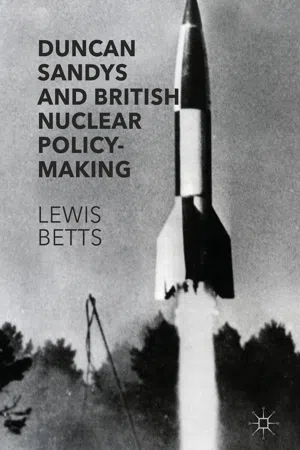
This book offers new perspectives on British nuclear policy-making at the height of the Cold War, arguing that the decisions taken by the British government during the 1950s and 1960s in pursuit of its nuclear ambitions cannot be properly understood without close reference to Duncan Sandys, and in particular the policy preferences that emerged from his experiences of the Second World War and his efforts leading Britain's campaign against the V-1 and V-2. Immersing himself in this campaign against unmanned weaponry, Sandys came to see ballistic missiles as the only guarantor of nuclear credibility in the post-war world, placing them at the centre of his strategic thinking and developing a sincerely-held and logically-consistent belief system which he carried with him through a succession of ministerial roles, allowing him to exert a previously undocumented level of influence on the nature of Britain's nuclear capabilities and its approach to the Cold War. This book shows the profound influence Sandys' personal belief system had on Britain's attempts to acquire a credible nuclear deterrent.
- English
- ePUB (mobile friendly)
- Available on iOS & Android
eBook - ePub
Duncan Sandys and British Nuclear Policy-Making
About this book
Information
© The Author(s) 2016
Lewis BettsDuncan Sandys and British Nuclear Policy-Making10.1057/978-1-137-58547-9_11. Introduction
Lewis Betts1
(1)
Independent Scholar, Hedon, UK
Duncan Sandys was one of the most significant British politicians of the 1950s, serving in successive Conservative administrations from 1951 to 1964, and holding a number of key posts. Most significantly, he was Minister of Defence at the time of the controversial 1957 White Paper on Defence, which set out a radical vison for the future of the British military, and would have profound effects on defence policy and the defence industry in the years that followed. Yet, unlike many politicians of his generation, Sandys has not been the subject of any detailed study. There have been no biographies published, and his personal memoirs remained unfinished, with entire sections incomplete or missing. 1 In the absence of any serious historical interest, and when not simply referring to him to in passing as Winston Churchill’s son-in-law, the discussion of Sandys tends to focus on his supposedly difficult character—we hear that Harold Macmillan thought that his prickly character might have been down to ‘German blood’, and that Ian Smith, the notably intransigent Rhodesian white minority leader with whom Sandys dealt with as Secretary of State for the Colonies, found him ‘abrupt, even tending to aggressiveness’, and ‘completely devoid of those qualities of diplomacy and tact associated with British “statesmen”’. 2
This lack of interest in Sandys means that we are left with an incomplete understanding of the man and his policy preferences. This book argues that this represents a significant gap in our knowledge, and that failure to properly understand Sandys weakens our comprehension of British nuclear policy-making since 1945. Sandys was an important figure in that field during the pivotal decision-making years that saw both the creation of British nuclear weaponry, and significant developments in British strategic thinking about how to use these new weapons, and it is only through careful analysis of how his approach to the Cold War was influenced by his experiences of the Second World War that several major decisions taken by Britain in pursuit of its independent nuclear capabilities can be properly understood.
Where Sandys has been discussed in direct relation to the policy-making process, historians have tended to neglect any meaningful analysis of the influence that his experiences and memories of the Second World War came to have on his policy preferences. Martin S. Navias has studied Sandys’ first year at the Ministry of Defence, writing that the Second World War had left a ‘lasting impression’ on him insofar as he ‘considered himself well cognizant of the major changes taking place in the realm of military technology—especially when it came to missile and nuclear weapons and their implications’. 3 Unfortunately, in framing Sandys’ experiences as having developed into little more than a loosely defined reference point, rather than a sincerely-held and intellectually coherent strategic concept, Navias’ analysis tends to misinterpret the motives behind Sandys’ decision-making by emphasising his ‘predilection towards cost-cutting’. 4 To date it has been this focus on spending reductions that has dominated what little discussion there has been of Sandys, which has led to some historians minimising Sandys’ role in the policy shifts laid down in the pivotal 1957 White Paper, where British defence policy was re-orientated to rely on the nuclear umbrella at the expense of other branches of the military.
Whilst Sandys is often credited with utilising his aforementioned abrasiveness to finally bring together the major themes of previous defence reviews, this interpretation merely perpetuates the idea that his policy choices were coldly logical reactions to existing defence debates and financial realities. 5 There was certainly a large degree of continuity in what Sandys proposed in 1957, but this book will contextualise that continuity by showing the part Sandys himself had played in setting the terms of those debates with the proposals he had put forward in 1953 and 1954 as the Minister of Supply during the so-called ‘Radical Review’. In showing that there was a degree of consistency in Sandys’ policy preferences over time, the economies he pursued can be seen as having been a significant aspect of his recommendations, but not something that was allowed to take precedence over what he considered to have been sound strategic concerns, the intellectual roots of which are to be found in his wartime reports for the committees tasked with defending Britain from unmanned German weapons. 6
Nuclear Belief Systems
The idea that memories of the Second World War had had an influence on early British nuclear policies is not new. In her official histories of the British nuclear programme, Margaret Gowing described the decision to go nuclear as having been ‘almost instinctive’, and based partly on the belief that ‘Britain as a great power must acquire all major new weapons’. 7 A. J. R. Groom and others thought likewise, conceding that although ‘there can be no doubt that a Soviet threat was perceived … this strategic argument was itself a function of the political question regarding the rôle of nuclear weapons in shoring up Britain’s position in the world’. This gave British nuclear capabilities a dual function as both the ‘means to deter Moscow and to influence Washington’. 8 More recently, Susanna Schrafstetter and Stephen Twigge have given particular weight to the specific memory of ‘standing alone’ in 1940, with nuclear capabilities being seen as both a symbol of Great Power status and as a protection against Britain ever finding itself in such a perilous situation again. 9
In addition to this ‘soft’ cultural aspect, historians such as Ian Clark and Nicholas J. Wheeler, who have sought to re-introduce strategic calculations into the debate, have written that ‘an essential part of any history of British strategic thought in the nuclear age [is] to document the elements of continuity within it’. 10 This feeds into the use of so-called ‘strategic cultures’, and, in their recent history of British nuclear policy-making, John Baylis and Kristan Stoddart have used ‘ideational factors’ (‘beliefs’, ‘culture’, and ‘identity’) to provide a ‘more helpful insight into the process of nuclear decision-making’, and elsewhere they have summarised the uniquely British ‘nuclear belief system’ as having consisted of six major concerns. These were: the necessity of nuclear weapons as a guarantor of national survival; the fear of ‘adversaries or potential adversaries’ acquiring them; as a contingency in case ‘even the closest of allies might not come to Britain’s assistance in times of crisis’; to impress and influence the United States; the belief that Britain had ‘an inalienable right’ to be a nuclear weapons state; and as a confirmation of Great Power status. It was these ideas and beliefs of what has been characterised as a relatively small policy-making elite (in the political, military, and scientific spheres) that they suggest shows ‘ideational, more than materialist, factors have been at the heart of British nuclear policy’. 11
This conception of a ‘nuclear belief system’, as characterised by Baylis and Stoddart, still has deficiencies owing to its nature as something to be subscribed to collectively, whether in a department of state or as a more general mood. When they stress the ‘importance of shared values’, the tenets of any particular idea become too wide-ranging to properly account for its intellectual origins. 12 Just as when Peter J. Katzenstein argues that ‘security interests are defined by actors who respond to cultural factors’, it becomes comparable to how Graham Allison explained the nature of governmental business, where ‘deliberate choices’ are overshadowed by ‘large organisations functioning according to standard patterns of behaviour’. 13 This all serves to present a monolithic type of belief or culture, a kind of organisational memory, whether departmental or strategic, that simply exists as a non-specific influencing factor on those who happened to have encountered it. Martin Ceadel gives a good example of this when he cites ‘defencism’ as having been the main cultural factor at work during Cold War, describing it as a collective belief system where the policy-making elite generally subscribed to the idea that ‘war can be prevented for indefinite periods, and that diplomacy as well as military force plays a part in achieving this’, resulting in the prevailing belief that ‘The best to be hoped for is … an armed truce’. 14
The main drawback of defining beliefs and cultures as a general will in this manner is that it restricts the space for individual initiative. In his work in expanding the field of British nuclear culture, Richard Maguire has gone further, claiming that ‘Beyond a general acceptance that the West needed some form of nuclear force to face the Soviet threat, there was no single, or even dominant, structure of explanation among the politicians, scientists, civil servants and military officers who discussed British nuclear weapons.’ From this, Maguire argues that nuclear policy-making ‘drew upon individual experience, political and social tradition, understandings of technology, and specific Cold War experience’. 15 If this was the case, then it should be acknowledged that within the policy-making ranks not all experiences carried equal weight, and John Simpson has written that, whilst nuclear decision-making remained firmly in the control of the ‘Prime Minister of the day and selected members of Cabinet’, politicians generally ‘found themselves limited in their understanding … by their lack of detailed knowledge’, leaving them ‘increasingly dependent upon advice from officials’. 16 In light of this, the interaction between experiences and those policy-making processes that sought to ensure a more methodical approach is of particular interest. This is especially so when analysing policies devised to maintain Britain’s supposed responsibilities as one of the victorious parties in the aftermath of the Second World War. Due to the extensive mobilisation of British society that the Second World War required, almost everybody serving in any policy-making role throughout the 1950s and 1960s had previous war experiences to draw upon. This is the main reason why the defence backgrounds of politicians as individuals, where they can be discerned, deserves further study.
The Role of the Individual
The analysis of policy preferences as products of experiences and beliefs is a well-worn area of interest, particularly when the results of those experiences and beliefs prove to have acted as a restrictive force. One example of this would be the virtual consensus that has emerged to cast Macmillan’s years as the Member of Parliament for Stockton-on-Tees, from 1924 to 1929 and then again from 1931 to 1945, as having been a ‘prime conditioning factor in his domestic political thinking throughout the rest of his career’. 17 In a similar vein, Jeremi Suri’s Henry Kissinger and the American Century sought to show Kissinger’s policy preferences as having been shaped by his experiences of wider cultural shifts. The rise of Nazism, which forced his family out of Germany, taught him that democracies required ‘decisive leaders’ and ‘protections against themselves’; and his status as a Jewish immigrant allowed him to rise through ‘tradition-bound institutions’ which valued ‘outsiders’. Consequently, ‘Having witnessed the violent “collapse” of a society filled with morally self-righteous figures, Kissinger defined his career as a response’, leading him towards measures that ‘insulated the day-to-day management of foreign policy from public interference’. 18
Over the course of his biography, Suri does not shirk from criticising the inherent rigidity of such an approach, claiming that Kissinger struggled with ‘challenges from people he did not understand’, and that he failed to deal with ‘ideas that ran against his basic assumptions and experiences’. 19 Barbara Keys has built upon this contention, contending that Suri and other biographers of Kissinger tend to treat their subject ‘above all as an intellectual’, and as a ‘rational actor’, relatively unaffected by day-to-day concerns. Keys therefore devotes particular attention to the relationships that Kissinger painstakingly forged with Soviet diplomats, arguing that they serve as the best explanation for him remaining ‘obsessively wedded to bipolarism’, when, had he lived up to his much-vaunted realism, he would have recognised that the world ‘was entering a new era of multipolarity’. 20 Even though Kissinger embraced the new state of affairs to the extent that he was still able to function in his capacity as both National Security Advisor and Secretary of State, Keys writes that his ‘habit of approaching problems through this bipolar “cage” exacerbated instead of resolved them’, ci...
Table of contents
- Cover
- Frontmatter
- 1. Introduction
- 2. The Intellectual Foundations of Sandys’ Belief System
- 3. The Ministry of Supply and the Radical Review: 1953–1954
- 4. The 1957 Defence White Paper
- 5. The Struggle over the Nuclear Delivery System: 1957–1960
- 6. Blue Streak
- 7. Conclusions
- Backmatter
Trusted by 375,005 students
Access to over 1.5 million titles for a fair monthly price.
Study more efficiently using our study tools.
Frequently asked questions
Yes, you can cancel anytime from the Subscription tab in your account settings on the Perlego website. Your subscription will stay active until the end of your current billing period. Learn how to cancel your subscription
No, books cannot be downloaded as external files, such as PDFs, for use outside of Perlego. However, you can download books within the Perlego app for offline reading on mobile or tablet. Learn how to download books offline
Perlego offers two plans: Essential and Complete
- Essential is ideal for learners and professionals who enjoy exploring a wide range of subjects. Access the Essential Library with 800,000+ trusted titles and best-sellers across business, personal growth, and the humanities. Includes unlimited reading time and Standard Read Aloud voice.
- Complete: Perfect for advanced learners and researchers needing full, unrestricted access. Unlock 1.5M+ books across hundreds of subjects, including academic and specialized titles. The Complete Plan also includes advanced features like Premium Read Aloud and Research Assistant.
We are an online textbook subscription service, where you can get access to an entire online library for less than the price of a single book per month. With over 1.5 million books across 990+ topics, we’ve got you covered! Learn about our mission
Look out for the read-aloud symbol on your next book to see if you can listen to it. The read-aloud tool reads text aloud for you, highlighting the text as it is being read. You can pause it, speed it up and slow it down. Learn more about Read Aloud
Yes! You can use the Perlego app on both iOS and Android devices to read anytime, anywhere — even offline. Perfect for commutes or when you’re on the go.
Please note we cannot support devices running on iOS 13 and Android 7 or earlier. Learn more about using the app
Please note we cannot support devices running on iOS 13 and Android 7 or earlier. Learn more about using the app
Yes, you can access Duncan Sandys and British Nuclear Policy-Making by Lewis Betts in PDF and/or ePUB format, as well as other popular books in History & British History. We have over 1.5 million books available in our catalogue for you to explore.