This book is a study of the concept of wil?ya and its developments among Sh??? scholars from the eighteenth to twentieth century. Leila Chamankhah addresses a number of issues by delving into the conceptualizations of wil?ya through the examination and interpretation of key texts. She focuses on the influence of ibn ?Arab?'s mysticism, with regard to the conception of wil?ya, on his Sh??a successors and expositors in later centuries. She also discusses the development and transformation of the conception of wil?ya over two hundred years, from the esoteric school of Shaykh?sm to the politicization of wil?ya in the theory of wil?yat al-faq?h.
eBook - ePub
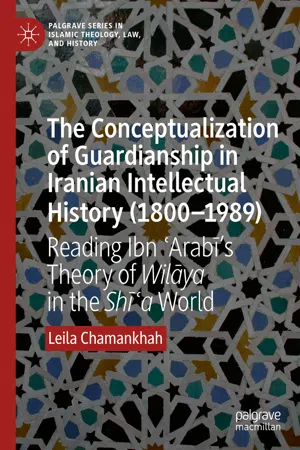
The Conceptualization of Guardianship in Iranian Intellectual History (1800–1989)
Reading Ibn ʿArabī’s Theory of Wilāya in the Shīʿa World
- English
- ePUB (mobile friendly)
- Available on iOS & Android
eBook - ePub
The Conceptualization of Guardianship in Iranian Intellectual History (1800–1989)
Reading Ibn ʿArabī’s Theory of Wilāya in the Shīʿa World
About this book
Information
Topic
Theology & ReligionSubtopic
Languages© The Author(s) 2019
L. ChamankhahThe Conceptualization of Guardianship in Iranian Intellectual History (1800–1989)Palgrave Series in Islamic Theology, Law, and Historyhttps://doi.org/10.1007/978-3-030-22692-3_11. Introduction
Leila Chamankhah1
(1)
University of Dayton, Dayton, OH, USA
Leila Chamankhah
Guardianship (wilāya/walāya) is a key concept in Islamic theology, jurisprudence, and mysticism. Etymologically, it is derived from the etymon of ‘w l y’, which means to place two things next to or close to each other, to the extent that there is no distance between them. ‘W l y’ therefore means closeness and affinity, whether spatial or spiritual. From the root, there engendered a number of derivatives, such as walāya (sainthood, affinity, and sanctity) wilāya (authority and dominion) and mawlā (master, protector, and patron). The Muslim scholar of Qurʾānīc exegesis and the Arabic language, al-Rāghib al-Iṣfahānī (d. 502 H/1108 or 1109), in his al-Mufradāt fī Gharīb al-Qurʾān (Terminology of the Peculiar Qurʾānīc Terms) emphasizes the significance of ‘closeness and attachment’ in applying the terms wilāya/walāya for something. He translates walāya as domination/victory (nuṣra), and wilāya as authority and incumbency (taṣaddī-ya amr), though he reminds us that both can be used interchangeably; referring to one reality, which is to exercise authority and domination over the other, and in the same way, the terms walī/mawlā can embrace affinity and authority both (al-Iṣfahānī 1413 H/1992, p. 885).
As one of the terms most frequently used in the Qurʾān, walī appears in different ways; as a noun, 124 times, and as a verb, 112 times. It is divided into two groups: positive/recommended and negative. By using the term in the first usage, the Lawgiver asks believers to be walī of each other, and by the latter, he warns them to reject the domination and authority of non-Muslims. Here wilāya, like a number of other Qurʾānīc terms such as raḥma (mercy), “is but an imitation on the part of man of the Divine wilāya itself” (Izutsu 1966, p. 19), has fundamental relationship to the nature of God Himself and therefore has basic dependence on Divine wilāya. In his discussion of the ethico-religious concepts of the Qurʾān, Toshihiko Izutsu divides ethical concepts of the Book into two categories of descriptive and evaluative. The author is not sure if wilāya can be regarded as an ethical term, but it is loaded with both descriptive and evaluative connotations and layers of meaning, and as such is a genuine descriptive word, though “invested with an evaluative aura which makes it more than mere description” (Izutsu, p. 21).
Following Izutsu, one can call wilāya a value-word (Ibid.), and since there is no equivalent of this concept in the pre-Islamic context, it should be regarded as a purely Islamic term serving the monotheistic nature of the faith, which is based on absolute submission to the will of God as well as the necessity of closeness and affinity to Him. Also, the egalitarian guardianship believers bounced ideas on each other, springing out of their friendship and affinity toward their brethren, so the context was gradually but steadily eclipsed and eventually replaced by another aspect of wilāya, which was more representative of its subjugating characteristic. This doctrine of wilāya, as Zarrīnkūb ascertains, became incorporated into early Sufi practice and theory, dramatically changed its nature, and facilitated the formation of the Sufi ṭarīqahs of later centuries (Zarrīnkūb 1383 shamsī, p. 73).
Murtiḍā Muṭaharī calls upon the positive wilāya, walāy-i Ithbātī-ya Islāmī (the Islamic positive wilāya), and divides it into two groups: general (ʿāmm) and specific (khāṣṣ). The former refers to the general wilāya that is possessed and exercised by every believer, and the latter belongs to the Prophet and his household. Wilāyat al-khāṣṣah uses different forms, such as walāy-i muḥabbat (the wilāya of love), walāy-i imamate (the wilāya of imamate), walāy-i zaʿāmat (the wilāya of leadership), and walāy-i taṣarruf (the wilāya of disposal) (Muṭaharī 1390 shamsī, pp. 13–17).
Al-Rāghib, whom I mentioned earlier, brings many verses in which walī, wilāya, mawlā, and other paronymous terms appear (al-Iṣfahānī 1413 H/1992, pp. 885–887). On the basis of the Qurʾānīc usages, God is the Protector (walī) of those who believe (2: 257, 7: 196, 3: 68, 47: 11, 66: 4) and has bestowed wilāya upon every believer (9: 71).1 In addition to the Divine wilāya and the wilāya of believers over each other, the Qurʾān acknowledges the wilāya of the Prophet and the imāms, which is bestowed upon them from God (5: 55, 4: 59, 9: 119),2 in order to guide people to the righteous path.
In the Qurʾān, awlīyā have a number of features and are described as individuals who have no fear, nor do they grieve. Muḥammad Hossein Ḥusseynī Tehrānī gives his exegesis of verses sixty-two to sixty-four of the sūrah of Yūnus which state that “Behold! Truly the friends of God, no fear shall come upon them, nor shall they grieve, those who believe and reverent. For them are glad tidings in the life of this world and in the Hereafter” (Nasr 2015, p. 558). He maintains that since piety (taqwā) and fearing God come immediately after the description of awlīyā, the office of wilāya requires a strong faith (īmān), which is only achieved by doing good and avoiding bad. This type of wilāya is called wilāyat al-ilāhīya (Divine wilāya), in which the veil (ḥijāb) between the servant (ʿabd) and God is removed as a result of self-abnegation (Ḥusseynī Tehrānī, vol. 5, 1419 H, p. 37). According to him, the term awlīyā in these verses refers to those who have attained an exalted kind of faith as the result of their righteous deeds, purification of their hearts, strong piety, and remembering God (Ḥusseynī Tehrānī, vol. 5, 1419 H, pp. 37–39). Wilāya equates to blessing because walī is the resident of the world of unity (Ḥusseynī Tehrānī, vol. 5, 1419 H, pp. 40–41).
Along with the Qurʾān, ḥadīth al-qudsī is another source of authority for Muslim scholars, which specifies the features of awlīyā. According to the famous ḥadīth that relates “My friends are hidden under my mantle (qibāb, ḥijāb), no one knows them except for Me” (Hujwīrī n.d., p. 38),3 the office of wilāya entails secrecy and latency—unlike that of imamate. Except for the imāms and the Prophet who are known to people, the holders of the office of wilāya remain hidden from people.4 In interpreting this ḥadīth, Sufi Muslims have developed arguments regarding the attributes of awlīyā, such as the significance of sirr (inmost being), or maqām al-sirr for understanding the office of wilāya.5 They argue that awlīyā are owners—or preservers or inheritors—of Divine sirr, and since the Deity desires to keep His secrets, He has chosen awlīyā to preserve them (Himmatī 1391 shamsī, pp. 6–9 & Pāzūkī 1379 shamsī, p. 81ff).6
The authority of the Prophet and his Sunna, including ḥadīth, makes the second pillar of Islam and is equal to that of the Qurʾān; a fact which is endorsed by the Book itself, though as Fazlur Rahman is certain, this authority “refers to the verbal and performative behaviour of the Prophet outside the Qurʾān” (Rahman 1968, p. 52). What follows from this is that the Prophet’s authority, “has been accepted willingly by all people without bickerings in certain quarters, [and] the Qurʾān would not have intervened” (Fazlur Rahman, p. 53). The logical consequence of this is that the Prophet’s words and behavior have been an unchallenged authority, “outside the Qurʾān in giving judgments and moral and legal precepts” (Rahman, p. 53). As for the authority of sayings of imāms, as Muḥammad Bāqir Majlisī (d. 1110 H/1698) is certain, the authenticity of the akhbār (lit. sayings, sing. khabar) of imāms is absolute and definite, because these figures are intermediaries of emanation from God to His people, and therefore, their aḥādīth embrace Divine knowledge, truths, and gnosis, which are emanated to people, even to other prophets and angels, through them. In their absence, Majlisī maintains, believers should recourse to their akhbār in order to receive emanation and blessing from Him (Majlisī n.d., vol. 1, p. 103).
Sayings of imāms on wilāya/walāya and imamate are scattered throughout the vast body of literature, which is called “ḥadīth compilations”, covering the two genres of kalāmī (theological) and juridical writings. The most well-known of these are the four ḥadīth compilations which constitute the early Imamite doctrine, and in chronological order, includes al-Kāfī (Uṣūl al-Kāfī) by Muḥammad ibn Yaʿqūb al-Kulaynī (d. 328–9 H/939), Man lā yahẓaruhu-l-Faqīh (for One Who Does Not Have Accessibility to Jurist) by Abu Jaʿfar Muḥammad ibn ʿAlī ibn Bābawayh al-Qumī, commonly known as Ibn Bābawayh (Persianized form: ibn Bābūyi) or al-Shaykh al-Ṣadūq (d. 381 H/991), Tahdhīb al-Aḥkām (the Refinements of the Laws), and al-Istibṣār (to Ask for Insights), both by Abū Jaʿfar Muḥammad ibn Ḥassan Ṭūsī (d. 460 H/1067). A number of scholars have drawn upon them to extract the components of the early Imamite doctrine, though the main Imamite sources, including ḥadīth compilations, are not limited to...
Table of contents
- Cover
- Front Matter
- 1. Introduction
- 2. Ibn ʿArabī and Wilāya
- 3. The Shaykhī School and Wilāya
- 4. The Schools of Tehran and Qum and Wilāya
- 5. Khomeini, Wilāya, and the Influence of Ibn ʿArabī
- 6. Khomeini as the Jurist and Wilāya
- 7. Conclusion
- Back Matter
Trusted by 375,005 students
Access to over 1.5 million titles for a fair monthly price.
Study more efficiently using our study tools.
Frequently asked questions
Yes, you can cancel anytime from the Subscription tab in your account settings on the Perlego website. Your subscription will stay active until the end of your current billing period. Learn how to cancel your subscription
No, books cannot be downloaded as external files, such as PDFs, for use outside of Perlego. However, you can download books within the Perlego app for offline reading on mobile or tablet. Learn how to download books offline
Perlego offers two plans: Essential and Complete
- Essential is ideal for learners and professionals who enjoy exploring a wide range of subjects. Access the Essential Library with 800,000+ trusted titles and best-sellers across business, personal growth, and the humanities. Includes unlimited reading time and Standard Read Aloud voice.
- Complete: Perfect for advanced learners and researchers needing full, unrestricted access. Unlock 1.5M+ books across hundreds of subjects, including academic and specialized titles. The Complete Plan also includes advanced features like Premium Read Aloud and Research Assistant.
We are an online textbook subscription service, where you can get access to an entire online library for less than the price of a single book per month. With over 1.5 million books across 990+ topics, we’ve got you covered! Learn about our mission
Look out for the read-aloud symbol on your next book to see if you can listen to it. The read-aloud tool reads text aloud for you, highlighting the text as it is being read. You can pause it, speed it up and slow it down. Learn more about Read Aloud
Yes! You can use the Perlego app on both iOS and Android devices to read anytime, anywhere — even offline. Perfect for commutes or when you’re on the go.
Please note we cannot support devices running on iOS 13 and Android 7 or earlier. Learn more about using the app
Please note we cannot support devices running on iOS 13 and Android 7 or earlier. Learn more about using the app
Yes, you can access The Conceptualization of Guardianship in Iranian Intellectual History (1800–1989) by Leila Chamankhah in PDF and/or ePUB format, as well as other popular books in Theology & Religion & Languages. We have over 1.5 million books available in our catalogue for you to explore.