- English
- ePUB (mobile friendly)
- Available on iOS & Android
eBook - ePub
About this book
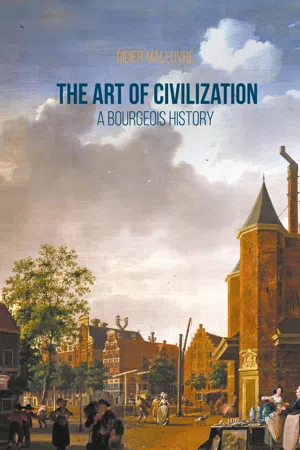
This book tells the story of how art since ancient Greece is inextricably linked to a particular place and social group: the city and its homegrown species, the bourgeois. Despite the fact that it has glorified the crown and the cross for most of its history; despite its mystical, lofty, or subversive aura; despite its oft-professed scorn of the down-to-earth bourgeoisie, in truth art has always been the product of craft and labor. As such it bears the imprint of the workshop and the independent mentality of producers. Breaking with a misty-eyed romantic view of art, The Art of Civilization shows how artistic expression in Western societies has helped the rise of a demystified and pragmatic mindset. Art indeed has civilized us, laying the groundwork for the historical victory of brain over brawn, of reason over mystique, and of productive bourgeois ways over the transcendental.
Information
© The Editor(s) (if applicable) and The Author(s) 2016
Didier MaleuvreThe Art of Civilization10.1057/978-1-349-94869-7_11. Introduction
Didier Maleuvre1
(1)
Department of French and Italian, University of California, Santa Barbara, CA, USA
1.1 City and Civilization
Among the artist Paul Gauguin’s many strange adventures in Tahiti, he recalls that of being thought of a useful human being. A young native had watched him carving a figurine and finally declared that he, Gauguin, ‘was useful to others’. Gauguin could hardly believe his own ears: ‘I believe Totefa is the first human being in the world who used such words towards me.’1 Hadn’t Gauguin been taught to regard art as wonderfully detached, beautifully impractical, a rebuke to utilitarian philistines everywhere? And yet he was charmed by this odd new idea—let’s call it the Totefa Hypothesis: that art and artists might be useful components of society.
How art indeed is useful to civilization, and one civilization in particular, is the subject of this book. Many have been the forms and uses of art in western societies; many have been the mentalities and sensibilities speaking through them. The aim of this book is to chart a direction through this multitude, starting with ancient Greece, tentatively through the long Middle Ages, then decisively after the Renaissance. I call it a direction, not an ‘order’, because it isn’t primly foreordained. Yet a direction it is, which, to put it briefly, tends toward the rationalization of mentalities. Imaginary and fictive as works of art may be, I argue that, so far as our civilization goes, they have served a demystifying function advancing a rationalized (some say ‘disenchanted’, others ‘bourgeois’) frame of mind which, in the specific sense detailed below, we shall call ‘civilized’.
The word ‘civilization’, coupled with the adjective ‘western’, has of late come under the suspicion that it truckles to an exclusivist view of European superiority. The unfortunate obverse of ‘civilized’ that springs to mind is ‘savage’, ‘primitive’, ‘barbarian’. This, needless to say, isn’t the semantic binary in which I wish to put the word ‘civilization’. Nor, in fact, will my use of the term rest on the meaning given to it by nineteenth-century historians, to designate large-scale clusters of cultures held together by geography, religion, and customs. Though this technical definition of ‘civilization’ does circumscribe the geopolitical area of my survey, I will actually prefer a more humble, yet sociologically pertinent and etymologically correct, use of ‘civilization’—one that cracks its abstract shell and brings out the socio-lexical nugget: civilization is per verbum that which pertains to the city. It is the mix of beliefs, attitudes, mores, practices, economic habits, and moral sensibilities that associated with city life. Actually ‘civilization’ elbows its way into the English lexicon in the chaotically urbanizing eighteenth century. The word evoked the effects of bringing people out of rusticity and inducting them into the ways of town-living. Civil, civility, civilian, civilized, and civilization are whatever happens when Homo civitatis, the town-dwelling creature, replaces Homo agri, the agriculturalist, on the cultural driver’s seat. And what has been happening in the city with many false starts and detours since 5000 years ago in the lowlands of Mesopotamia is the development, exchange, multiplication, and hybridization of ideas, technologies, systems of thoughts, religions, and polities.2 The city is where the division and diversity of labor is most developed, where commercial networks are densest and busiest, where political power, administrations, systems of record-keeping and accounting congregate, as well as the education apparatus, the literacy and numeracy to run them. A city, in sum, is where culture adopts managerial and argumentative methods to its own maintenance.
∫
The word ‘culture’ often appears in duality with civilization, and so we a pause to explore their disjunction. It goes back to a polemic begun by German romantics of the late eighteenth century. Kultur, in their scheme, was the native, ancestral, naïve, and wise ways of a locality, a folk, an ethnicity, a kin group. At the opposite end, Zivilization was cosmopolitan, rootless, abstract, impersonal, and deplorably French. Zivilization was the Enlightenment, reason, the demystifying Encyclopédie, the technocracy, Paris; it was fretful, knowing, and cynical—a far cry from the shire, the glen, and the clan of Kultur, as sheltering and solid as the German forest. This invidious distinction between (overweening, judgmental, rootless, and artificial) civilization and (sincere, natural, communal, and colorful) culture is one of the more durable exports of romanticism. Civilization conjures up the image of an imperialistic juggernaut trampling over regional pluralities, crushing local colors and colored people with the myth of its own pre-eminence, and digesting every neighbor it comes across. Next to it, culture seems a model of pacific non-interference. Though not necessarily tolerant, a culture revolves around concrete practices, interactions, and interests. It is too local and self-referential to meddle with other cultures, and seldom devises policies to formulate and impose itself universally.
These, broadly, are the lines of the Zivilization-Kultur feud, whose merits this is not the place to discuss. Suffice it to remark upon one useful facet of the dichotomy, which is that civilization tends to articulate its identity and explain itself to its members, arguing about its values in a way that a culture, by nature more autarkic, doesn’t, or does but to a much lesser degree and less critical extent. And when we consider what the romantics had primarily in mind when lambasting civilization we supposedly the big, bad, bustling, countryside’s civitas—the arrogantly cosmopolitan city that sucks up all the bounty and gives nothing but unwanted advice in return.
∫
Civilization, given a strictly sociological perspective, is the culture of the city. It is what happens to culture when it makes a city its port of call. And the city is first of all dense interaction between people, trades and occupations. This is where forms of life and belief become cognizant of one another and start a mad competitive race. As the division of labor ramifies, and the contest between economic sectors heats up the rate of innovation springs to life. Rural neighboring communities do swap ideas, of course, but these tend to be of a similar stamp and involve variants of ideas already extant. Genuine new springs of information open up when commerce and industry bring together people from far and wide. In the urban lattice-work of information, knowledge grows more voluminous and varied, it challenges itself on the agora, the forum, or the commons. Thus something happens to the quality of urban-based knowledge3: it tends to be more context-independent and critically aware of itself. Knowledge gets defined as a technical, demystified means. Citied culture is culture becoming instrumental, objectified—as some say, uprooted.
This uprooting, it appears, is at the origin of all major civilizations identified by ‘longue durée’ historians (Arnold Toynbee, Pitirim Sorokin, Alfred Kroeber, Caroll Quigley, Jean Bodin, Fernand Braudel). Whether Mesopotamian, Egyptian, Sinic, Indic, Greek, Roman, Christian, Arabic, Khmer, and Mesoamerican, all these civilizations radiate out of, or graft themselves onto, urban hubs.4 Of course it’s not always the case that, having a city at the core means that culture will citify. It happened many times throughout history that warlords and landlords were able to countrify the city, planting their courts on top of the ready supply of urban labor and easily seized booty, and commercial routes, all this without adopting the mindset of the city. In ancient Sumer, Egypt and China, the princely court prevailed and feudalized the city. Even Rome, in the end, was swallowed up and provincialized by its military. According to Fernand Braudel, this courtification or imperialization of the city was rather the rule in world history—until it ran into an exception. This oddity took place around the eleventh century CE in the far northwest corner of the Eurasian landmass—a geographical area which at the time was in political disarray, frayed and tottering after the dismantling of the short-lived Carolingian empire. With no prince powerful enough to put the land under his yoke, cities between the Loire and Rhine rivers and of the Italian peninsula were given leave to grow, develop a taste of self-rule, a legal system of exemptions and liberties, together with the city walls to protect them, which by the time feudal barons turned their greedy eyes to them, found they could not terrorize. As Braudel explains, ‘the miracle of the first great urban centuries in Europe was that the city won hands down’ against the state.5 Of course the king’s court had its revenge in the sixteenth and seventeenth centuries but eventually, with the commercial age, the city did citify the martial and ecclesiastical elite, then the countryside and the state at large, creating what the German romantics called the ‘poison’ of civilization: a society that maintains a skeptical, utilitarian, rationalizing stance vis-à-vis its own lifeways, an imagined community made up of citi-zens who (unlike deni-zens, or denisein, e.g., acculturated indwellers) stand inside and outside at the same time, looking outward, looking inward, never entirely and reliably autochthonous.
The theme of mental distancing is essential to this study of the ‘civilization of art’. The purpose is to show how the civilizing mind (i.e., the view from the city, the town-dweller’s lorgnette) shapes, and is shaped, by artistic expression. More polemically, the aim is to see how art since ancient Greece mostly (though not exclusively, and certainly not uncritically) advances a mentality we should now call by its name, to wit, bourgeois.
∫
A point of terminology. When medieval Europe reinvented city-living, sometimes in the eleventh century, a word had to be found for the new town-dwelling genus. This species was the bourgeoisie, and its specimen, a bourgeois—a word I shall use henceforth without the road-accident italics or the prophylactic quotes. Etymoogically and sociologically, ‘bourgeois’ is a resident of the bourg, burgh, borough, borwg, bur, borg, baurgs, and other kindred terms that designated the fortified town, incorporated city, trading municipality, or administrative seat. There, so-called franc-bourgeois enjoyed certain franchises and exemptions, called ‘liberties’, vis-à-vis feudal lords. Gradually, then decisively with the formation of city-states and nation-states, this polity secured control over the food-producing countryside and culturally citified the larger territory. The outcome of the long-running tug-of-war between city and countryside is, so far, a victorious bourgeoisie that has forced barons, warlords, monks, and serfs to play by the rules of the city (commerce, finance, administration, schooling, rule of law, etc.). The long war against the manor and the monastery has left many scars on the bourgeoisie. To this day, ‘bourgeois’ carries saddles of iniquity heavier than ‘civilization’. The word is carbuncled with associations of materialism, money grubbing, small-minded calculation, and smug opportunism—‘petty’, as the obligatory tag goes. If the bourgeois isn’t godless, he has to be a Pharisee, a hypocrite, a hedonist, a devotee of Mammon (to summarize the charges entered by the priestly class)6; and rich though he may be, a bourgeois remains uncouth, timorous, inglorious, addicted to comfort, ‘the contemptible sort of well-being dreamed of by shopkeepers, Christians, cows, women, Englishmen and other democrats’ (to quote Nietzsche).7 To this rap sheet, Marxism added the charge of ‘ruthless exploiter’ and ‘destroyer of tradition’, and then—to nail that coffin shut—imperialistic, fascist, racist, anti-egalitarian, sexist, and patriarchal.
My purpose isn’t to redress this age-long tradition of calumny—the economist historian Deirdre McCloskey has done a thoroughly convincing job of it in her two watershed studies Bourgeois Virtues: Ethics for an Age of Commerce (2007) and Bourgeois Dignity: Why Economics Can’t Explain the Modern World (2011) (to which the present book is very much in debt).8 My approach is to maintain a neutral anthropological stance toward the bourgeoisie (I’ll grant that it is a bourgeois, urban thing to do, that of hedging one’s bets). Bourgeois is for our purpose the town-dwelling animal, the ‘citi-zen’ who engages in activities of trade, commerce, manufacture, administration, and education. Bourgeois, as per Simon Schama’s technical classification, is citizen and Homo economicus.9 The economicus half of the equation assumes that the homo bit possesses literacy and numeracy, hence a measure of abstract thinking, rationalism, and political pragmatism, together with an aptitude for criticism and the examination of taboos as well as a curious, non-tribal, non-dogmatic approach to morality.
Thus for civilization, the city, and the bourgeoisie, there remains the crucial term in our equation: art. What does it have to do with the city (apart, that is, from its being generally made, traded, and exhibited there)? What is it to the bourgeois? And what is the bourgeois to it?
1.2 Art and the Bourgeois Mind
There is no denying it: bourgeois and art do seem to make odd bedfellows. For most of European history, art was the reserve of the nobility, and therefore a mouthpiece of aristocratic idealism, its mystique, its Platonism, its self-exaltation. As a result, and to this day, art still trails a weightily bejeweled historical mantle. Art was once the princedom of fancy, folly, and divine inspiration. Later it became the redoubt of bohemianism, of romantic dreamers, knights errant of the arrant mind. Always it is descried many miles away from the hardheaded, pragmatic, calculating bourgeois. Art is like the minstrel arthropod in La Fontaine’s ‘Fable of the Cicada and the Ant’: the cicaca sings, is wonderfully impractical, and munificent. Unlike the industrious ant, it doesn’t rationalize and calculate. It sings all summer and makes no provision for winter. Which, when it comes, finds her starving. Told you so, says the petty bourgeois ant who slams the door on her beggary. This poem, incidentally, has been religiously learned by French school boys and girls since the nineteenth century. It’s not just a small example of the resilient strain of anti-ant, bourgeois-stigmatizing prejudice in the French psyche; it betokens a pervasive, atavistically aristocratic way to think about art. Art’s song is careless, big-hearted, generous, noble, and free. It is idealistic, escapist, impractical. It can’t possibly have anything to do with the squinty-eyed ant. In the fable, the latter cruelly abandons the former to her fate.
This schema, which assigns high culture (and by propinquity, art) a place up in the ‘generous’ (code word for ‘noble’) stratum of human activity, isn’t limited to fables. There is a version of it—albeit considerably nuanced—in the landmark study by German sociologist Norbert Elias, The Civilizing Process (1939).10 By all means a remarkable achievement, Elias’ work is not free of prejudice. By ‘civilizing’, Elias designates the gradual pacification, rationalization, and defeudalization of manners and customs from the late Middle Ages onward. It is the process whereby a population of violent warlords, lawless knights, and rustic barons, a profiteering and lazy clergy, a disaffected downtrodden peasantry, by and by turned into the reasonably law-abiding, self-controlled, rule-following, generally placid, productive bourgeois individuals of the m...
Table of contents
- Cover
- Frontmatter
- 1. Introduction
- 2. Birth of the Aesthetic
- 3. The Time of Images
- 4. Into the Time of Art
- 5. The Time of Makers
- 6. The Time of Work
- 7. The Time of Knowledge
- 8. The Time of Taste
- 9. The Time of Ideologies
- 10. The Time of Production
- 11. Triumph of the Aesthetic
- Backmatter
Trusted by 375,005 students
Access to over 1.5 million titles for a fair monthly price.
Study more efficiently using our study tools.
Frequently asked questions
Yes, you can cancel anytime from the Subscription tab in your account settings on the Perlego website. Your subscription will stay active until the end of your current billing period. Learn how to cancel your subscription
No, books cannot be downloaded as external files, such as PDFs, for use outside of Perlego. However, you can download books within the Perlego app for offline reading on mobile or tablet. Learn how to download books offline
Perlego offers two plans: Essential and Complete
- Essential is ideal for learners and professionals who enjoy exploring a wide range of subjects. Access the Essential Library with 800,000+ trusted titles and best-sellers across business, personal growth, and the humanities. Includes unlimited reading time and Standard Read Aloud voice.
- Complete: Perfect for advanced learners and researchers needing full, unrestricted access. Unlock 1.5M+ books across hundreds of subjects, including academic and specialized titles. The Complete Plan also includes advanced features like Premium Read Aloud and Research Assistant.
We are an online textbook subscription service, where you can get access to an entire online library for less than the price of a single book per month. With over 1.5 million books across 990+ topics, we’ve got you covered! Learn about our mission
Look out for the read-aloud symbol on your next book to see if you can listen to it. The read-aloud tool reads text aloud for you, highlighting the text as it is being read. You can pause it, speed it up and slow it down. Learn more about Read Aloud
Yes! You can use the Perlego app on both iOS and Android devices to read anytime, anywhere — even offline. Perfect for commutes or when you’re on the go.
Please note we cannot support devices running on iOS 13 and Android 7 or earlier. Learn more about using the app
Please note we cannot support devices running on iOS 13 and Android 7 or earlier. Learn more about using the app
Yes, you can access The Art of Civilization by Didier Maleuvre in PDF and/or ePUB format, as well as other popular books in Social Sciences & Social History. We have over 1.5 million books available in our catalogue for you to explore.