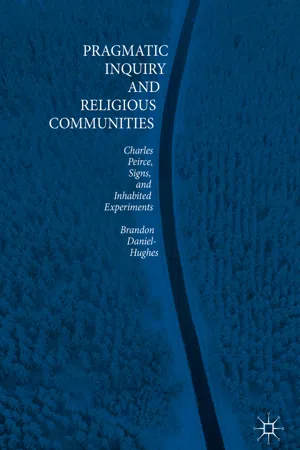
This book examines the ways in which religious communities experimentally engage the world and function as fallible inquisitive agents, despite frequent protests to the contrary. Using the philosophy of inquiry and semiotics of Charles Sanders Peirce, it develops unique naturalist conceptions of religious meaning and ultimate orientation while also arguing for a reappraisal of the ways in which the world's venerable religious traditions enable novel forms of communal inquiry into what Peirce termed "vital matters." Pragmatic inquiry, it argues, is a ubiquitous and continuous phenomenon. Thus, religious participation, though cautiously conservative in many ways, is best understood as a variety of inhabited experimentation. Religious communities embody historically mediated hypotheses about how best to engage the world and curate networks of semiotic resources for rendering those engagements meaningful. Religions best fulfill their inquisitive function when they both deploy and reform their sign systems as they learn better to engage reality.
eBook - ePub
Pragmatic Inquiry and Religious Communities
Charles Peirce, Signs, and Inhabited Experiments
- English
- ePUB (mobile friendly)
- Available on iOS & Android
eBook - ePub
Pragmatic Inquiry and Religious Communities
Charles Peirce, Signs, and Inhabited Experiments
About this book
Information
Topic
PhilosophySubtopic
Pragmatism in Philosophy© The Author(s) 2018
Brandon Daniel-HughesPragmatic Inquiry and Religious Communitieshttps://doi.org/10.1007/978-3-319-94193-6_11. Inquiry and Living Hypotheses
Brandon Daniel-Hughes1
(1)
John Abbott College, Sainte-Anne-De-Bellevue, QC, Canada
Brandon Daniel-Hughes
Keywords
PeirceInhabited experimentsUbiquitous inquiryDoubtHabitBetween November 1877 and January 1878, Popular Science Monthly published two essays by Peirce , The Fixation of Belief and How to Make Our Ideas Clear , which would become perhaps his most famous and anthologized works. They were the first of six essays known collectively as the Illustrations of the Logic of Science , and we know that Peirce himself valued the essays immensely as he planned to include them as chapters in several projected books on logic. The essays are famous, in part, because their portrayal of invested inquiry contrasts so starkly with the antiseptic prescriptions of rationalists like Descartes . Inquiry, for Peirce , is a living practice, a “struggle to attain a state of belief,” not an intellectual affair (CP 5.374).1 Certainly there are problems with the circumscription of inquiry in these works, and I examine these shortcomings later in the chapter, but the first essay in particular serves as a convenient introduction to many of the most important and attractive themes of Peirce ’s philosophy of inquiry. Belief, habit, doubt, reality, truth, fallibilism, and science are all given the formulations to which Peirce will return continuously throughout his career. The essay contains two distinct but related movements that are treated separately in the two following sections. The first movement deals with inquiry generally and formulates the causes and ends of inquiry. The second movement examines several methods of inquiry and compares their relative efficacy, highlighting the fecundity of science.
In Sects. 1.3 and 1.4, I argue that despite his innovative approach, Peirce did not push his theory of inquiry far enough in these early works. The Fixation of Belief still treats inquiry as an action undertaken by individuals. In Sect. 1.3 I argue that a more robust conception of a continuum of inquiry is needed, a conception that makes room for temporally extended processes of hypothesis adoption and testing. In Sect. 1.4 I argue for a working theory of inquiry that is strengthened by a more refined conception of doubt and a broader appreciation of the diverse manifestations of inquiry. While Peirce ’s early conceptions of belief, doubt, and inquiry offer many helpful insights, they paint a too stark contrast between doubt and belief. True, inquiry is the key conceptual link between doubt and belief, but inquiry is often an extended process that may include moments of tentatively exploring promising hypotheses, moments of half-doubt and partial belief, as well as occasions in which hypotheses are entertained as possibilities by an entire community even as they are only embodied and actively tested by a portion of that community. Doubt, Peirce seems to suggest in these early essays, is always an irritant to be exterminated. But, at least in some communities, it may also be understood as a positive good to be sought. In short, Peirce ’s early portrayal of belief, doubt, and inquiry is invaluable, but as a philosophical corrective it paints too ideal a picture of actual communities of inquiry, including the scientific community . Outlining and then criticizing this picture will clarify the need for a more nuanced theory, one that takes seriously the mediating role of communal habits and signs in even the most self-controlled communities of inquiry.
To these ends, this short chapter introduces the reader who is not already familiar with Peirce to the broad outlines of his theory of inquiry but also begins a process of appreciative criticism. Hypotheses are not merely ideas that inquirers entertain, they are often the habits of life that characterize both individual inquirers and entire communities of inquiry. In these cases, the distinction between a hypothesis tested and a hypothesis lived disappears, and both believers and doubters find themselves questioning, not merely what to think but how to go on. Peirce ’s theory of inquiry allows us to think more clearly not only about the logic of inquiry and the pursuit of knowledge but also about the constitution and maintenance of our individual and communal lives as living processes of exploration and reform.
1.1 Peirce ’s Early Portrayal of Belief, Doubt, and Inquiry
Peirce ’s theory of inquiry has been abbreviated as the belief-doubt model or, as Elizabeth F. Cooke has labeled it, the “belief-doubt-belief model” of inquiry (2006, p. 21–23). This is a helpful place to begin, for Cooke ’s formulation calls attention to the cyclical nature of inquiry and the desire of all inquirers to return to a state of habitual belief. This characterization also establishes a contrast with modernist models of inquiry that claim to begin with doubt so as to arrive at assured belief. What is immediately striking is the degree to which Peirce is unbothered by our holding to a welter of unexamined, unclear, and indistinct beliefs. In fact, the existence of problematic beliefs is a prerequisite for doubt and inquiry. We are content, Peirce suggests, with exactly those beliefs we happen to have and most of us find this is “a calm and satisfactory state which we do not wish to avoid, or to change to a belief in anything else” (CP 5.372). One should take care, however, to avoid confusing belief with assenting to a proposition. To say that one believes is to say that one “shall behave in a certain way, when the occasion arises” (CP 5.373). In How to Make Our Ideas Clear, Peirce goes further, “[w]e have seen that it [belief] has just three properties: First, it is something that we are aware of; second, it appeases the irritation of doubt; and, third, it involves the establishment in our nature of a rule of action, or, say for short, a habit.” By tethering belief to habits of action, Peirce acknowledges the embeddedness of thought in the bio-cultural nexus and rejects any kind of mind-body dualism. “[T]hought is essentially an action,” he argues; thus, the criticism and fixation of our beliefs will necessarily involve our feelings, bodies, and social interactions (CP 5.397). This conception of belief as the establishment of a general habit will prove to be invaluable to the analyses to come.
A belief is not a proposition, nor mere assent to a proposition. A belief is an active habit of an actor in a particular environment. Here Cooke again gets sharply to the point. Because belief occurs in a particular environment, “[t]he environment, including its social and natural aspects, influences what the individual sees or experiences as doubt” (2006, p. 22). If belief is understood as a state of “fit” between the habits of an actor and her environment, then doubt is best understood as an interruption of those habits. The lack of fit between environment and habit is a stimulating irritant that initiates a cascade of significant events. The irritation of doubt may lead to the conscious recognition of previously unconscious routines so that one becomes aware of a belief where previously there was only blind habit. But most importantly, for Peirce , “[t]he irritation of doubt causes a struggle to attain a state of belief.” Peirce terms this struggle “inquiry” (CP 5.374). At its inception, inquiry is not a pursuit of truth. Rather, it is a basic response to a stimulus. Peirce writes:
Here Peirce depicts a binary. We are capable of two states, belief and doubt, which entail two modes of action, habit and inquiry. Belief is a low energy default, while doubt is a higher energy state. We are only satisfied with the former state and respond to interruptions of habitual action by struggling to return to belief. Peirce ’s description of inquiry as a struggle is instructive, for inquiry requires the expenditure of energy as organisms respond to problematic situations. Once a new belief is attained and the stimulus of doubt is removed, inquiry ends as an organism slips back into a lower energy state of belief. It is the low energy state of habitual action that is the goal, not the particular content of any belief, which is to say that “the sole object of inquiry is the settlement of opinion,” regardless of what that opinion may be or whether or not that opinion is true. I will return to this claim repeatedly in the remainder of the chapter and attempt to clarify some of its implications and limitations.The irritation of doubt is the only immediate motive for the struggle to attain belief.It is certainly best for us that our beliefs should be such as may truly guide our actions so as to satisfy our desires; and this reflection will make us reject every belief which does not seem to have been so formed as to insure this result. But it will only do so by creating a doubt in the place of that belief. With the doubt, therefore, the struggle begins, and with the cessation of doubt it ends. Hence, the sole object of inquiry is the settlement of opinion. We may fancy that this is not enough for us, and that we seek, not merely an opinion, but a true opinion. But put this fancy to the test, and it proves groundless; for as soon as a firm belief is reached we are entirely satisfied, whether the belief be true or false. (CP 5.375)
By focusing on a single cycle of the flow of inquiry, the belief-doubt-belief model calls attention to many of the most attractive aspects of Peirce ’s work. Students of the history of philosophy will quickly recognize, as did Peirce , the differences between this conception of inquiry and that of Descartes . Whereas Descartes had worked to remove the particularities of his own environment, body, and opinions from consideration so as better to practice universal doubt and arrive at certified truths, Peirce insists on the indispensable relevance of the inquirer’s situation. We inquire only at the behest of “real living doubt,” and such doubt cannot be artificially manufactured. Later in his career (1905), Peirce returned to this point:
By emphasizing that doubt has always “an external origin,” Peirce not only highlights the contextual quality of thought but calls attention to the dynamic interactions that must necessarily occur between inquirers and their physical and social environments. Doubt and belief both have determinate sources, stimulate particular actions, and both ultimately answer to forces beyond the will and intellect of the rational inquirer.It is important for the reader to satisfy himself that genuine doubt always has an external origin, usually from surprise; and that it is as impossible for a man to create in himself a genuine doubt by such an act of the will as would suffice to imagine the condition of a mathematical theorem, as it would be for him to give himself a genuine surprise by a simple act of the will. (CP 5.433)
Not only does the belief-doubt-belief model of inquiry offer a critique of universal skepticism by insisting that doubt must be the product of real environmental stimuli, if it is to be an effective goad to inquiry, but it also offers a warning against foundationalist aspirations. One cannot manufacture assent, Peirce argues, any more than one can manufacture genuine doubt. The important contrast is between the “ultimate absolutely indubitable propositions” that foundationalists crave and the “propositions perfectly free from all actual doubt” that result in belief (CP 5.376). This is the flipside of Peirce ’s earlier (1868) maxim, “Let us not pretend to doubt in philosophy what we do not doubt in our hearts” (CP 5.265). We believe exactly those propositions that we believe and embody in habits of action, and it is no good pretending to aspire to higher standards of certainty, clarity, or distinctness. Not only do such pretensions distract from the real task of inquiry—the eradication of doubt—but they also muddy the philosophical waters with demands for arbitrary credentials. Ultimately, modernist methodological demands that we entertain universal doubt and believe only those propositions that we judge to be indubitable are pedantic. “It is, therefore,” Peirce argues, “as useless a preliminary as going to the North Pole would be in order to get to Constantinople by coming down regularly upon a meridian.” But Peirce continues with an important clarification. “A person may, it is true, in the course of his studies, find reason to doubt what he began by believing; but in that case he doubts because he has a positive reason for it, and not on account of the Cartesian maxim” (CP 5.265). What the...
Table of contents
- Cover
- Front Matter
- 1. Inquiry and Living Hypotheses
- 2. Correction: A Double-Edged Sword
- 3. Selves, Communities, and Signs
- 4. Anthropology and the Religious Hypothesis
- 5. Religion and Traditions of Inquiry
- 6. Religion as Communal Inquiry
- Back Matter
Trusted by 375,005 students
Access to over 1.5 million titles for a fair monthly price.
Study more efficiently using our study tools.
Frequently asked questions
Yes, you can cancel anytime from the Subscription tab in your account settings on the Perlego website. Your subscription will stay active until the end of your current billing period. Learn how to cancel your subscription
No, books cannot be downloaded as external files, such as PDFs, for use outside of Perlego. However, you can download books within the Perlego app for offline reading on mobile or tablet. Learn how to download books offline
Perlego offers two plans: Essential and Complete
- Essential is ideal for learners and professionals who enjoy exploring a wide range of subjects. Access the Essential Library with 800,000+ trusted titles and best-sellers across business, personal growth, and the humanities. Includes unlimited reading time and Standard Read Aloud voice.
- Complete: Perfect for advanced learners and researchers needing full, unrestricted access. Unlock 1.5M+ books across hundreds of subjects, including academic and specialized titles. The Complete Plan also includes advanced features like Premium Read Aloud and Research Assistant.
We are an online textbook subscription service, where you can get access to an entire online library for less than the price of a single book per month. With over 1.5 million books across 990+ topics, we’ve got you covered! Learn about our mission
Look out for the read-aloud symbol on your next book to see if you can listen to it. The read-aloud tool reads text aloud for you, highlighting the text as it is being read. You can pause it, speed it up and slow it down. Learn more about Read Aloud
Yes! You can use the Perlego app on both iOS and Android devices to read anytime, anywhere — even offline. Perfect for commutes or when you’re on the go.
Please note we cannot support devices running on iOS 13 and Android 7 or earlier. Learn more about using the app
Please note we cannot support devices running on iOS 13 and Android 7 or earlier. Learn more about using the app
Yes, you can access Pragmatic Inquiry and Religious Communities by Brandon Daniel-Hughes in PDF and/or ePUB format, as well as other popular books in Philosophy & Pragmatism in Philosophy. We have over 1.5 million books available in our catalogue for you to explore.