Blockchain technology may have first emerged with bitcoin but its significance extends far beyond the financial sector: it is ushering in a whole new techno-economic paradigm. This book provides the first critical, in-depth examination of blockchain's transformative impact on the creative industries, including music, media, art and gaming. Drawing on interviews with 10 leading start-ups and a comprehensive review of the literature, the author examines blockchain's impact on business models, addresses the barriers and risks, and concludes with policy recommendations that will help unlock value in the UK's creative economy.
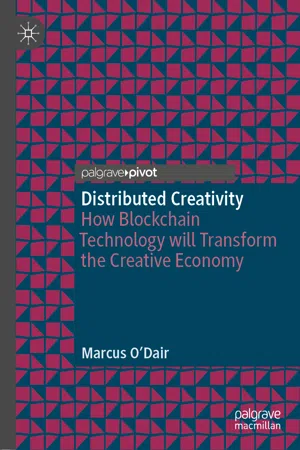
eBook - ePub
Distributed Creativity
How Blockchain Technology will Transform the Creative Economy
- English
- ePUB (mobile friendly)
- Available on iOS & Android
eBook - ePub
About this book
Information
© The Author(s) 2019
Marcus O'DairDistributed Creativityhttps://doi.org/10.1007/978-3-030-00190-2_11. Introduction
Marcus O’Dair1
(1)
Faculty of Arts and Creative Industries, Middlesex University, London, UK
Abstract
Although it is sometimes understood as a financial technology phenomenon, blockchain has the potential to transform numerous sectors—including the creative economy. We are entering a new era of distributed creativity, with blockchain technology facilitating frictionless licensing and the fair and accurate distribution of revenue from large-scale collaborative projects. Copyright data, currently held in centralised silos, could also be distributed, allowing for a single source of truth—with the result that creators receive just rewards for their work. Automated payments, executed on a blockchain, could dramatically speed up royalty payments, as well as making them more transparent. Finally, a more inclusive approach to data would encourage innovation, allowing entrepreneurs to build new services. There are, however, significant barriers to adoption. Adoption would also bring with it significant risks.
Keywords
Blockchain technologyCreative economyBlockchain opportunitiesBlockchain barriersBlockchain risksThe importance of the creative economy—of industries ranging from music to gaming to architecture—is hard to overstate. The sector is economically significant, contributing £92 billion a year, for instance, to the UK economy (DCMS 2017). To examine the creative economy in economic terms alone, however, is reductive. Firstly, the sector conveys ‘soft power ’ (Nye 2008) like no other. What is Britain if not the home of Shakespeare and The Beatles and Zaha Hadid and J. K. Rowling and Saatchi & Saatchi and Alexander McQueen? The creative economy is central to what is sometimes known as ‘brand Britain’ (although Saatchi & Saatchi, surely, could come up a better phrase). I write from a UK perspective, and the UK does tend to punch above its weight in this respect. Yet the centrality of creative works to national image is true of any country in the world. Secondly, the creative economy creates cultural value . Creative works can enhance our health and wellbeing; help overcome discrimination; and enhance our sense of community and of self. This is as true of TV shows and pop songs as it is of so-called ‘high art’. And it is priceless.
Digital technology has lowered the barriers to entry for creativity. Many of us now possess the means to record and digitally distribute music , and to make films and podcasts. Yet digital technology has also introduced a number of significant challenges, as I go on to argue. These challenges are most urgent, perhaps, if you make your living in the creative economy but, given the economic and cultural value outlined above, they should also be of serious concern to policy-makers. Finally, these challenges should concern everyone who considers themselves a fan—of art , or theatre, or literature, or TV, or a dozen other creative fields. I say this not only because, presumably, fans want creators to continue to create but also because, in an age of user-generated content (UGC), fans might well be creators themselves—and so might welcome, for instance, easier licensing of music for Youtube videos.
This book examines the potential of blockchain technology—which emerged underpinning the cryptocurrency, bitcoin, but which is now understood to have far broader applications—to solve the problems faced by the creative economy. The book has three core arguments. The first is that blockchain is far more than a financial technology—or fintech —phenomenon. As Morabito (2017, p. vii) shows, blockchain is being deployed in a range of domains and across an ever-increasing range of industries, from insurance and health to the diamond trade—and, indeed, the creative industries . I have suggested elsewhere (O’Dair and Beaven 2017) that blockchain technology could bring about a shift to what, drawing on Benkler (2006), I have called a ‘networked record industry’ for recorded music . In this book, I develop that argument: since music is by no means the only creative industry that could be transformed by blockchain technology, I suggest we are entering a broader era of distributed creativity. In fact, I would argue that much creativity is already much more distributed than we might imagine from the ‘lone genius’ creator of popular imagination: we can see this from the rise of UGC, and even from the credits on the typical film. Yet blockchain technology can make it easier to license content for derivative works and allow remuneration for large-scale collaboration to be shared between large numbers of individuals. These developments would encourage further creativity. Crucially, blockchain also allows for the distribution of data relating to creative works—which might sound boring, but it is what gets people paid—and for the speeding up (through automation) of payments and licensing . In addition, developers and entrepreneurs could build on top of a more open and inclusive data model, ushering in a second wave of distributed creativity. Fundamental to this notion of distributed creativity are decentralised, rather than centralised, networks. Blockchains, after all, are built on top of the internet —that confluence of social, technological, economic and cultural transformations that gave us the ‘networked society’ (Castells 2010). The internet, for Castells, was as disruptive as steam and electricity, and many see blockchain technology in a similar light: a classic example of what Schumpeter (2010) calls creative destruction . My first argument, then, is that blockchain technology offers significant opportunities for the creative economy; indeed, it is potentially transformative, both for individual companies and beyond. This is the argument I put forward in Chapter 3.
My second argument is that the adoption of blockchain technology will be subject to a number of macro factors. In Chapter 4, I deploy the PESTLE framework to examine political, economic, social, technological, legal and environmental barriers to adoption . I also utilise the notion of the techno-economic paradigm (Perez 2002)—in particular , the idea that the wealth-creating potential of a given technological revolution is only realised when accompanied by an adequate socio-economic framework. That there is, in some creative industries , already a sense of ‘blockchain fatigue’ is understandable, given the hype and the existence of some thoroughly unconvincing start-ups (including a few outright scams). Yet it is also dangerous: blockchain is a potentially transformative technology, but it is not going to be adopted at scale overnight. As Rogers (2003, p. 1) points out in his classic work on the diffusion of innovations, ‘getting a new idea adopted, even when it has obvious advantages, is difficult.’ The hype, in fact, could represent the greatest threat to blockchain’s long-term prospects (Mulligan et al. 2018).
My third argument is that, like any disruptive technology , widespread blockchain adoption will create losers as well as winners. I examine the risks of adopting blockchain technology in Chapter 5. What might be the unintended consequences of adoption? Which positive externalities, from which third parties currently benefit, might be lost? Could blockchain-based systems, for instance, make it harder for copyright holders to limit infringement? What would be the effect upon blanket licensing of widespread withdrawal from collection societies?
I conclude, in Chapter 6, with seven recommendations for UK policy-makers.
Blockchain Technology
I do not set out, in this book, to provide a detailed discussion of how blockchain technology works, although I provide a brief introduction to the technology in Chapter 2. Instead, the book concerns the application of blockchain technology—specifically, its application in the creative economy. This subject is addressed, albeit in less detail, in the grey literature (see, for instance, Tapscott and Tapscott 2018; Casey and Vigna 2018). It is also addressed in innumerable media articles and white papers, although these tend towards the tech-utopian—and the latter, of course, are inherently promotional. There is, however, relatively little academic literature on the impact of blockchain technology on the creative economy, despite valuable work on blockchains and copyright by De Filippi and Wright (2018), and on blockchains and art by Zeilinger (2016), O’Dwyer (2017), and Lotti (2016). Scholars associated with the Institute of Network Cultures in Amsterdam have made important contributions to the field (Gloerich et al. 2018), as have an overlapping group of researchers and artists centred around the Furtherfield Gallery in London (Catlow et al. 2017). The impact of blockchain technology on...
Table of contents
- Cover
- Front Matter
- 1. Introduction
- 2. Blockchain: The Internet of Value
- 3. Opportunities for the Creative Economy
- 4. Barriers to Adoption
- 5. Risks of Adoption
- 6. Conclusion and Recommendations
- 7. Interview Transcripts
- Back Matter
Trusted by 375,005 students
Access to over 1.5 million titles for a fair monthly price.
Study more efficiently using our study tools.
Frequently asked questions
Yes, you can cancel anytime from the Subscription tab in your account settings on the Perlego website. Your subscription will stay active until the end of your current billing period. Learn how to cancel your subscription
No, books cannot be downloaded as external files, such as PDFs, for use outside of Perlego. However, you can download books within the Perlego app for offline reading on mobile or tablet. Learn how to download books offline
Perlego offers two plans: Essential and Complete
- Essential is ideal for learners and professionals who enjoy exploring a wide range of subjects. Access the Essential Library with 800,000+ trusted titles and best-sellers across business, personal growth, and the humanities. Includes unlimited reading time and Standard Read Aloud voice.
- Complete: Perfect for advanced learners and researchers needing full, unrestricted access. Unlock 1.5M+ books across hundreds of subjects, including academic and specialized titles. The Complete Plan also includes advanced features like Premium Read Aloud and Research Assistant.
We are an online textbook subscription service, where you can get access to an entire online library for less than the price of a single book per month. With over 1.5 million books across 990+ topics, we’ve got you covered! Learn about our mission
Look out for the read-aloud symbol on your next book to see if you can listen to it. The read-aloud tool reads text aloud for you, highlighting the text as it is being read. You can pause it, speed it up and slow it down. Learn more about Read Aloud
Yes! You can use the Perlego app on both iOS and Android devices to read anytime, anywhere — even offline. Perfect for commutes or when you’re on the go.
Please note we cannot support devices running on iOS 13 and Android 7 or earlier. Learn more about using the app
Please note we cannot support devices running on iOS 13 and Android 7 or earlier. Learn more about using the app
Yes, you can access Distributed Creativity by Marcus O'Dair in PDF and/or ePUB format, as well as other popular books in Business & Business General. We have over 1.5 million books available in our catalogue for you to explore.