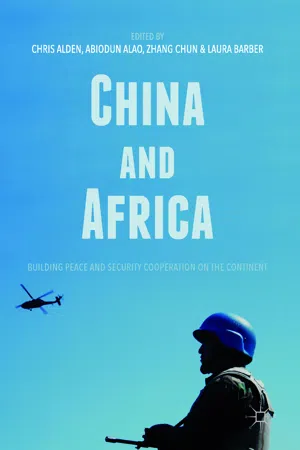
This book investigates the expanding involvement of China in security cooperation in Africa. Drawing on leading and emerging scholars in the field, the volume uses a combination of analytical insights and case studies to unpack the complexity of security challenges confronting China and the continent. It interrogates how security considerations impact upon the growing economic and social links China has developed with African states.
eBook - ePub
China and Africa
Building Peace and Security Cooperation on the Continent
- English
- ePUB (mobile friendly)
- Available on iOS & Android
eBook - ePub
China and Africa
Building Peace and Security Cooperation on the Continent
About this book
Information
© The Author(s) 2018
Chris Alden, Abiodun Alao, Zhang Chun and Laura Barber (eds.)China and Africahttps://doi.org/10.1007/978-3-319-52893-9_11. Introduction: Seeking Security: China’s Expanding Involvement in Security Cooperation in Africa
Chris Alden1 and Laura Barber2
(1)
Department of International Relations, London School of Economics and Political Science, London, United Kingdom
(2)
Political and Security Analyst, London, United Kingdom
Chris Alden
holds a Professorship at the Department of International Relations, London School of Economics and Political Science (LSE), has published widely on China-Africa issues and is a research associate of the South African Institute for International Affairs (SAIIA) and Department of Political Sciences, University of Pretoria.
Laura Barber
has a PhD from the Department of International Relations, London School of Economics and Political Science (LSE), on the topic of learning in Chinese foreign policy towards Africa with a particular focus on China-Sudan and South Sudan relations. She currently works as a political risk analyst based in London.
China’s engagement in Africa, once characterised as decidedly non-interventionist in its pursuit of economic interests, is on course to becoming more deeply involved in the region’s security landscape. While the conventions behind Chinese involvement remain bound to an economic core, the growing exposure of its interests to the vagaries of African politics and, concurrently, pressures to demonstrate greater global activism, are bringing about a reconsideration of Beijing’s sanguine approach to the region. In particular, China faces threats on three fronts to its standing in Africa: reputational risks derived from its association with certain governments; risks to its business interests posed by mercurial leaders and weak regulatory regimes; and risks faced by its citizens operating in unstable African environments. Addressing these concerns poses particular challenges for Beijing whose desire to play a larger role in continental security jostles with the complexities of doing so while preserving Chinese abiding foreign policy principles and growing economic interests on the continent.
The result is increasing involvement in African security, be it through cooperation at the level of the UN Security Council and the African Union or in terms of deploying Chinese troops and providing greater financial assistance for peace support missions. This impulse has received further support with the announcement of a China-Africa Cooperative Partnership for Peace and Security in 2012, promising an integration of security into the FOCAC process. Linking this aspirational commitment to a more institutionalised form of involvement, however, remains problematic in part because of Chinese uncertainty as to the practical implications this holds for its established interests, as well as an underlying ambivalence towards some of the normative dimensions integrated into the African Peace and Security Architecture. These concerns in turn reflect wider debates within China as to the efficacy of expanding its role within the existing structures of regional and global governance.
This volume investigates the expanding involvement of China in security cooperation in Africa. It focuses on two dimensions in particular: (i) the sources of Chinese engagement in security – ranging from burgeoning exposure of Chinese economic interests to unstable conditions to the targeting of Chinese citizens by hostile and criminal groups – and how they have shaped Chinese policies in this sector; and (ii) case studies of China’s involvement in country-specific Africa security contexts, including the content of Chinese contributions and responses of African governments and civil society to this expanding role. Finally, it provides a critical assessment of the challenges experienced by and facing the deepening of Chinese-African cooperation in security matters.
To understand China’s gradualist engagement in African security affairs, one must understand the evolving context of China-Africa relations. China’s contemporary phase of intensive engagement in African countries may have been instigated by a search for vital resources and market opportunities but its sustainability as a reliable source for China was always going to be predicated on building long-term stable relations. China’s openness to economic engagement in all parts of Africa launched a period of rapid growth in bilateral economic ties, including multi-billion-dollar concessional loans to energy- and mineral-rich African countries linked to provisions for development of local infrastructure, followed by a range of smaller loans, grants, and investments by individual Chinese entrepreneurs. While traditional Western sources had shunned investment in some of the conflict-ridden, post-conflict, or fragile states like Sudan, or World Bank and donors sought to make loans conditional on domestic policy changes in countries like Angola, the opportunity that this presented to China to gain access to untapped resources in markets viewed in Beijing as closed was seized with alacrity.
But in countries operating under conditions of fragility where the very nature of regime legitimacy itself is contested as is its ability to enforce its rule over the population and territory, the security challenges are manifold as China was to discover. Under these difficult circumstances, Chinese officials were increasingly pulled into mediation efforts in places like Sudan and, through its permanent membership on the UN Security Council, involvement in peacekeeping operations and capacity building in post-conflict situations. Chinese migration, starting as a trickle in the late 1990s but growing steadily across the continent, introduced a new element of complexity as individual citizens became exposed to violence and crime.
While academic writings on the extensive role of China in Africa continue to increase, not much attention seems to have been placed on the rapidly growing security links between the country and the African continent. Due largely to the deep involvement of the country in Africa’s natural resource politics and the controversial link it has developed with African leaders that have attained pariah status, attention has been placed on the politics of natural resource extraction and the alleged support China seems to be given to controversial African leaders like Presidents Bashir of Sudan and Robert Mugabe of Zimbabwe. Considerable interest has also been directed towards China’s development policies and, to a lesser extent, Chinese migration. But while all these are important, the increasing role of security in the complex relationship between China and Africa is hardly examined.
In fact, China’s growing role in African security has been quite profound to date, ranging from the extensive peacekeeping activities it has undertaken in a number of African states to ongoing mediation in conflicts like Sudan and even training of armed forces of some of countries. Security considerations have also come out in key controversial connections like resource-for development exchanges, and the expanding sale of armaments and the launching of satellite missions. All these apart, China’s relationship with key regional organisations in the continent also has aspects of peace and security considerations. Indeed, it is widely assumed that the extensive military links China has established with a number of African countries have now shown other emerging powers operating in the continent, especially Russia, Brazil, and India, of the unwinnable nature of their rivalry with Beijing on the African continent.
Against the background of all the above considerations, there is a compelling need for a detailed study that looks at all the complex security links between China and Africa and how Africans have perceived the intricate military relationship their governments are establishing with China. It is also important to see how security considerations have intertwined with economic and domestic considerations issues to explain the diverse links between China and African countries. Thus the key aims and objectives of the proposed book are as follows: to provide a detailed study to focus on the intricacies of the military relationship between Africa and China, especially those aspects that have been neglected from current studies; to interrogate how security considerations come into the equation of other complex economic and social links China has developed with African states; to analyse how China’s links with Africa’s continental and regional organisations, especially the African Union, also connects with security links it has developed with key African countries; and finally, to assess how Africans, especially, civil society perceive the increasing involvement of China in the continent’s security affairs.
In Chapter 2, ‘Africa’s Security Challenges and China’s Evolving approach towards Africa’s Peace and Security Architecture’, Abiodun Alao and Chris Alden provide a comprehensive overview of the issues characterising the African security environment, the associated risks facing Chinese actors across the continent, and Beijing’s emerging response to some of these challenges. This is with a view to assess whether China’s role vis-à-vis Africa’s peace and security architecture can be viewed as one of architect, builder, or sub-contractor.
In Chapter 3, ‘China’s Changing Role in Peace and Security in Africa’, Chris Alden and Zheng Yixiao assess China’s emerging role in Africa’s security sector through contextualising Beijing’s changing ambitions on the international stage and specific aspects of its policies as implemented on the continent. In particular, the authors frame the discussion within an overall picture of China’s evolving approach towards maintaining its national interests, goals, and means in the arena of security and shed light on the country’s multilateral cooperation against transnational security concerns in Africa, namely piracy and nuclear proliferation, and investigate two case studies of its military bilateral cooperation with African partners. They find that China’s enhanced role in security exposes a set of inherent tensions within the lofty aims of a rising China and its actual operational role in Africa. For instance, while Beijing presents the need to cooperate with Western partners, those countries are the same ones that are in competition on a number of fronts with China.
In Chapter 4, ‘Developmental Peace: Understanding China’s Africa Policy in Peace and Security’, Wang Xuejun argues that through China’s expanding role in African and global security more generally, the country is increasingly becoming a norm-maker rather than norm-complier. In particular, Wang asserts that China’s Africa policy regarding peace and security is guided by the uniquely Chinese concept of ‘developmental peace’, which differs from the liberal peace thesis underpinning Western approaches towards the continent. It is suggested that whereas the latter prioritises democratisation and institution-building in post-conflict environments, ‘developmental peace’ places emphasis on sovereign autonomy and embedding socioeconomic development strategies into the practices of conflict resolution and post-conflict reconstruction. As such, Beijing is introducing increasing flexibility into its ‘non-interference’ policy to ensure that it does not equate to non-involvement, yet respect for host state sovereignty and ‘African ownership’ remain the bedrock of the Chinese approach to addressing security challenges in Africa.
Meanwhile, China’s physical involvement in conflict prevention and resolution is mainly manifested in its participation in UN peacekeeping operations in line with its role as a permanent member of the UN Security Council. In Chapter 5, ‘China’s Development-Oriented Peacekeeping Strategy in Africa’, Xue Lei considers China’s goals in African peace and security affairs from the particular perspective of its participation in UNPKOs. Xue maintains that Beijing upholds a preference for development-oriented and non-coercive approaches to humanitarian intervention. At the same time, however, it is found that through developing a deeper understanding of the complexity of conflict in the field, China has begun to develop a degree of flexibility and on a case-by-case basis is supportive of more robust approaches to international peacekeeping and peace interventions in the African context.
In addition to multilateral peacekeeping efforts, China’s tangible security role can also be seen in the form of growing military ties with African states, including exchanges and assistance such as training loans for equipment. In Chapter 6, ‘On China’s Military Diplomacy in Africa’, Shen Zhixiong deepens our understanding of Sino-African security cooperation by assessing the increasingly robust and diversified nature of military diplomacy conducted by the Chinese Government and the People’s Liberation Army (PLA) since the end of the Cold War. In particular, Shen highlights the concurrent challenges that China faces amid such expanding military ties, for example, the suspicion and competition this has engendered among Western countries, particularly the United States, and the issue of managing the expectations of African governments. At the forefront of the challenges that PLA diplomacy must increasingly address, however, is the issue of protecting Chinese citizens from non-traditional security threats, such as attacks by non-state actors and state collapse, whilst at the same time adhering to China’s guiding foreign policy principle of non-interference in other states’ internal affairs.
In the seventh and final of the overview chapters, Zhang Chun argues that peace and security cooperation is and will increasingly become one of the core pillars of China-Africa relations. Indeed, at the 6th Ministerial Conference of the Forum on China-Africa Cooperation (FOCAC) in December 2015, both China and Africa promised to implement the ‘Initiative on China-Africa Cooperative Partnership for Peace and Security’, in which it is pledged to build a collective security mechanism in Africa and to jointly manage non-traditional security issues. However, Zhang assesses some of the key characteristics of such regional cooperation and challenges to its implementation in practice. In particular, such cooperation remains exclusively at the governmental level, China continues to view FOCAC primarily as a collective bilateral platform rather than a multilateral one, and policy differences between China and African states persist and emanate from opposing views on the principle of ‘non-interference’. Zhang argues that promoting cooperation with African organisations will help China to overcome the dilemma posed by deepening engagement in African security on the one hand and Beijing’s non-interference policy on the other, whilst also counterbalancing the pressures of the European Union, the United States, and other third-party cooperation with Africa.
The five chapters that comprise the second part of the book provide case studies of China’s emerging role in African peace and security. The first three of them focus on Beijing’s involvement in addressing conflict issues in Sudan and South Sudan, which has widely been viewed as a test case for China in the Africa peace and security space. In Chapter 8, ‘China in international conflict management: Darfur issue as a case’, Jian Junbo assesses Beijing’s evolving conflict resolution role vis-à-vis Sudan’s Darfur crisis that emerged in 2003, and how its policy of ‘non-interference’ became increasingly flexible in practice. Junbo details the characteristics of China’s policy as it shifted over three stages: from indifference to tentatively persuading Khartoum to accept a peacekeeping force, to finally becoming actively involved in resolving the crisis, including by engaging with the Darfur rebel groups. Finally, the author highlights how certain characteristics of China’s active approach in this case has since been replicated in other conflict zones outside of Africa, including Libya in 2011 and Syria in 2012–2013.
In Chapter 9, ‘Sudan and South Sudan: A Testing Ground for Beijing’s Peace and Security Engagement’, Daniel Large offers a comprehensive survey of China’s peace and security engagement with Sudan and South Sudan in terms of its North-South political axis and within South Sudan from 2011. In the case of South Sudan, Large argues that, besides offsetting accusations of a narrowly extractive role, or associations with arms supplies, what China has been attempting to do in the country could be regarded as representing an aspect of China’s ‘new type of big power relations’ as enacted in Africa, seen in terms of its military projection, investment protection and efforts to support a political resolution of the conflict.
In Chapter 10, ‘Lesson Learning in the Case of China-Sudan and South Sudan Relations (2005–2013)’, Laura Barber argues that many of China’s key perceptions and assumptions about the nature of conflict in Africa and its impact on its own interests have been challenged within the Sudanese conflict. She exemplifies this by drawing out the lessons that have been learnt by Chinese foreign policy actors along the trajectory of change to China’s foreign policy within the Sudanese context, as detailed in the previous two chapters. This is with a view to assess what Chinese foreign policy actors are learning about the African context and how such lesson learning has gradually led Beijing’s foreign policy institutions to reassess the nature of China’s own role in f...
Table of contents
- Cover
- Frontmatter
- 1. Introduction: Seeking Security: China’s Expanding Involvement in Security Cooperation in Africa
- 1. Africa’s Peace and Security and China’s Evolving Policy
- 2. Case Studies
- 3. Regional and Global Perspectives
- Backmatter
Trusted by 375,005 students
Access to over 1.5 million titles for a fair monthly price.
Study more efficiently using our study tools.
Frequently asked questions
Yes, you can cancel anytime from the Subscription tab in your account settings on the Perlego website. Your subscription will stay active until the end of your current billing period. Learn how to cancel your subscription
No, books cannot be downloaded as external files, such as PDFs, for use outside of Perlego. However, you can download books within the Perlego app for offline reading on mobile or tablet. Learn how to download books offline
We are an online textbook subscription service, where you can get access to an entire online library for less than the price of a single book per month. With over 1.5 million books across 990+ topics, we’ve got you covered! Learn about our mission
Look out for the read-aloud symbol on your next book to see if you can listen to it. The read-aloud tool reads text aloud for you, highlighting the text as it is being read. You can pause it, speed it up and slow it down. Learn more about Read Aloud
Yes! You can use the Perlego app on both iOS and Android devices to read anytime, anywhere — even offline. Perfect for commutes or when you’re on the go.
Please note we cannot support devices running on iOS 13 and Android 7 or earlier. Learn more about using the app
Please note we cannot support devices running on iOS 13 and Android 7 or earlier. Learn more about using the app
Yes, you can access China and Africa by Chris Alden, Abiodun Alao, Zhang Chun, Laura Barber, Chris Alden,Abiodun Alao,Zhang Chun,Laura Barber in PDF and/or ePUB format, as well as other popular books in Politik & Internationale Beziehungen & Afrikanische Politik. We have over 1.5 million books available in our catalogue for you to explore.