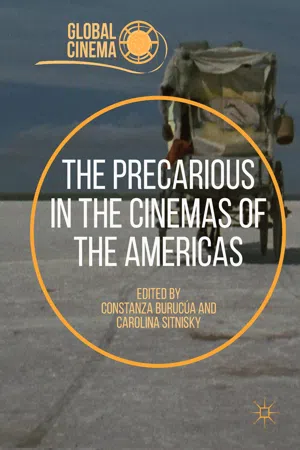
Historically, cinema in the Americas has been signed by a state of precariousness. Notwithstanding the growing accessibility to video and digital technologies, access to the material means of film production is still limited, affecting the spheres of production, distribution, and reception. Equally, questions about the precarious can be traced in cultural and archival policies, film legislations, as well as in thematic and aesthetic choices. While conventional definitions of the precarious have been associated with notions of scarcity and insecurity, this volume looks at precariousness from a non-monolithic angle, exploring its productivity and potential for original, critical approaches, with the aim of providing new readings to the variedly rich and complex cinemas of the Americas.
eBook - ePub
The Precarious in the Cinemas of the Americas
- English
- ePUB (mobile friendly)
- Available on iOS & Android
eBook - ePub
The Precarious in the Cinemas of the Americas
About this book
Information
Subtopic
Film & Video© The Author(s) 2018
Constanza Burucúa and Carolina Sitnisky (eds.)The Precarious in the Cinemas of the AmericasGlobal Cinemahttps://doi.org/10.1007/978-3-319-76807-6_11. Introduction: Forms of the Precarious in the Cinemas of the Americas
Constanza Burucúa1 and Carolina Sitnisky2
(1)
University of Western Ontario, London, ON, Canada
(2)
University of Southern California, Los Angeles, CA, USA
Constanza Burucúa (Corresponding author)
Carolina Sitnisky
When thinking about a prism, a beam of white light being refracted into a wide range of colors comes to mind. Inspired by this image, we first began to think about this project on the precarious, taking it as a complex and multifaceted notion through which new light could be shed on the study of the cinemas produced across the Americas. While the conventional definition of the precarious is associated with scarcity and insecurity, this volume looks at the idea from a non-monolithic angle, exploring its productivity and its potential for original critical approaches, with the aim of providing new readings to these varied, rich, and complex cinemas.
Historically, cinema in the Americas has been signed by a state of precariousness . Perhaps, except for the films coming out of Hollywood (an assertion that could also be challenged), 1 this condition affects every level of filmmaking, touching on the spheres of production, distribution, and reception. Notwithstanding the growing accessibility to video and digital technologies , access to the material means of film production is still limited. Equally, questions about the precarious could be traced in cultural and archival policies, film legislations , as well as in thematic and aesthetic choices.
Throughout the 1960s, the New Latin American Cinema filmmakers gathered around the concern to develop a medium true to what they saw as the common denominators of the region, namely poverty and underdevelopment . They did so not by looking up to the cinemas produced abroad, rather by generating a novel and unique discourse that originated in Latin America. 2 Both their films and manifestos straightforwardly addressed these concerns, sharing the understanding of material constraints as a catalyst for audiovisual creativity and the desire to extend their praxis into tools for social and political change. 3 Interestingly, and showing that ideas circulate in a non-linear, meandering manner, the development of the New Latin American Cinema movement and the repercussions and scholarly ramifications of Third Cinema (not just as a movement but as a theoretical concept that transcends the region) 4 somewhat coincided in time with the origins, in the 1970s, of what Rosalind Gill and Andy Pratt identify as today’s “precarity movement.” Moreover, the latter’s forms of activism, which rely on and emphasize the power of artistic interventions to “effect political change,” echo and to some extent continue the former’s trust in the potential of film to achieve similar goals. 5
While the New Latin American Cinema practitioners did not directly address the notion of the precarious in their intellectual theorizations, we argue that this idea was nonetheless constantly foregrounded in their films, as well as the structuring element and the basic assumption underlying their Weltanschaung . The notion of the precarious, often taken for granted, has not yet been considered as a focal point of interest in scholarly research on film. Dealing with this idea as a productive lens, this volume seeks to question, problematize, and conceptualize its diverse definitions and manifestations in the cinemas and diverse film cultures of the Americas. Thus, by looking at its workings and examining this concept in a wide array of case studies, the book will expose the multilayered and, in our view, productive nature of the precarious.
As Gill and Pratt have pointed out, “precariousness , precarity and precarization have recently emerged as novel territory for thinking – and intervening in – labour and life.” 6 Although apparently sharing a common horizon of meaning, the definitions and uses of these terms vary and offer an ample range of critical approaches. In broad terms, a first distinction stems from the work of scholars in the humanities and in the social sciences, who have addressed the notion from different disciplinary perspectives. While social scientists have concerned themselves with considerations on precarity and the associated processes of precarization related to labor , scholarship within the humanities has centered the attention on the precarious as an existential—ethical condition. Even if there are other working definitions of these terms, 7 we adopt Judith Butler’s 2009 identification of two separate (yet occasionally intersecting) categories of cultural and ethical analysis. Thus, whereas precarity “designates [a] politically induced condition,” 8 precariousness “implies living socially, that is, the fact that one’s life is always in some sense in the hands of the other.” 9 Even though a seemingly simple categorization, this distinction orients and informs our readings in relation to the ongoing debates on the precarious.
Butler’s contributions to these debates have been pioneering within the humanities. In Precarious Life (2004)—a collection of essays on mourning , grief , and trauma in the wake of the September 2001 events—she builds on the work of Emmanuel Levinas to explore, from an ethical perspective , “the relationship between representation and humanization ,” 10 particularly focusing on the conditions of interaction and the very possibility and communication (or lack thereof) with the Other. Central to her arguments are considerations on the structure of address, which she sees as
[…] important for understanding how moral authority is introduced and sustained if we accept not just that we address others when we speak, but that in some way we come to exist, as it were, in the moment of being addressed, and something about our existence proves precarious when that address fails. 11
When transposing Butler’s meditations on these matters to the study of film, the relevance of the notion of structure of address is key to appraise the workings of the medium in relation to these same questions, i.e. representation and humanization of the Other and the conditions and limitations for communication. In Frames of War (2009), Butler deepens her exploration of the precarious and the discursive and representational strategies around it by looking at the political implications of the act of framing as an editorial intervention. 12 In our view, this focus on framing as a non-innocent, non-inconsequential, non-candid praxis stresses the correlation between Butler’s study and one like ours, concerned as it is with assessing and understanding representations on the precarious and the material conditions for the production and circulation of film across the Americas.
Within the social sciences, Pierre Bourdieu’s 1997 seminal comments on the pervasiveness of the precarious as an inherent condition of late capitalism , affecting not only the sphere of labor but, from there, spreading into both the domains of the public and the private, became a departing point for studies on this topic. 13 The idea that “precariousness is part of a new type of domination, based on the institution of a generalized and permanent state of insecurity aimed at forcing workers to submit to the acceptance of exploitation” 14 is at the core of the work of social researchers whose work centers on the precarization of labor. In line with Bourdieu’s views, Brett Neilson and Ned Rossiter choose to work with precarity over the precarious or precariousness. For them, “[t]he term refers to all possible shapes of unsure, not guaranteed, flexible exploitation.” 15 Thus, foregrounding the political reach of the notion, they see its emergence “as a central political motif of the global movement.” 16 Of particular relevance to this study is the fact that Neilson and Rossiter ’s analysis focuses its attention on the creative sector (“[the] media worker has emerged as the figure of the precarious w...
Table of contents
- Cover
- Front Matter
- 1. Introduction: Forms of the Precarious in the Cinemas of the Americas
- Part I. Self-reflexive Considerations on the Precarious
- Part II. On Cultural Policies, Legislations and Funding
- Part III. Transnational Contexts
- Erratum to: The Precarious in the Cinemas of the Americas
- Back Matter
Trusted by 375,005 students
Access to over 1.5 million titles for a fair monthly price.
Study more efficiently using our study tools.
Frequently asked questions
Yes, you can cancel anytime from the Subscription tab in your account settings on the Perlego website. Your subscription will stay active until the end of your current billing period. Learn how to cancel your subscription
No, books cannot be downloaded as external files, such as PDFs, for use outside of Perlego. However, you can download books within the Perlego app for offline reading on mobile or tablet. Learn how to download books offline
Perlego offers two plans: Essential and Complete
- Essential is ideal for learners and professionals who enjoy exploring a wide range of subjects. Access the Essential Library with 800,000+ trusted titles and best-sellers across business, personal growth, and the humanities. Includes unlimited reading time and Standard Read Aloud voice.
- Complete: Perfect for advanced learners and researchers needing full, unrestricted access. Unlock 1.5M+ books across hundreds of subjects, including academic and specialized titles. The Complete Plan also includes advanced features like Premium Read Aloud and Research Assistant.
We are an online textbook subscription service, where you can get access to an entire online library for less than the price of a single book per month. With over 1.5 million books across 990+ topics, we’ve got you covered! Learn about our mission
Look out for the read-aloud symbol on your next book to see if you can listen to it. The read-aloud tool reads text aloud for you, highlighting the text as it is being read. You can pause it, speed it up and slow it down. Learn more about Read Aloud
Yes! You can use the Perlego app on both iOS and Android devices to read anytime, anywhere — even offline. Perfect for commutes or when you’re on the go.
Please note we cannot support devices running on iOS 13 and Android 7 or earlier. Learn more about using the app
Please note we cannot support devices running on iOS 13 and Android 7 or earlier. Learn more about using the app
Yes, you can access The Precarious in the Cinemas of the Americas by Constanza Burucúa, Carolina Sitnisky, Constanza Burucúa,Carolina Sitnisky in PDF and/or ePUB format, as well as other popular books in Media & Performing Arts & Film & Video. We have over 1.5 million books available in our catalogue for you to explore.