- English
- ePUB (mobile friendly)
- Available on iOS & Android
eBook - ePub
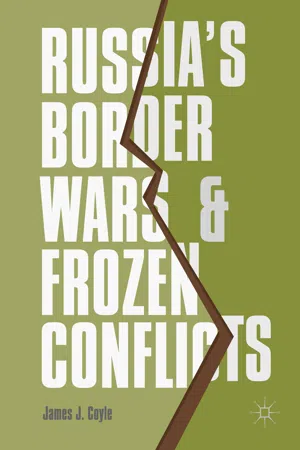
Russia's Border Wars and Frozen Conflicts
About this book
This book examines the origins and execution of Russian military and political activities in Moldova, Georgia, Ukraine, and Azerbaijan. Using a realist perspective, the author concludes that there are substantial similarities in the four case studies: Russian support for minority separatist movements, conflict, Russian intervention as peacekeepers, Russian control over the diplomatic process to prevent resolution of the conflict, and a perpetuation of Russian presence in the area. The author places the conflicts in the context of international law and nationalism theory.
Information
© The Author(s) 2018
James J. CoyleRussia's Border Wars and Frozen Conflicts 10.1007/978-3-319-52204-3_11. International Law, Realism, and Nationalism
James J. Coyle1
(1)
Center for Global Education, Chapman University, Orange, CA, USA
Introduction
On the fringes of the Russian Federation, several conflicts continuously smolder. In examining these conflicts—in Ukraine, Moldova, Georgia, and Azerbaijan/Armenia—there are two sets of actors. At the systemic level, the primary actors are nation-states. At the sub-systemic level, the actors are groups of people united by nationalisms. These nationalisms, in turn, are based on either ideology or ethnicity. It is the interaction of these actors at the different levels of analyses that have kept the conflicts alive in a relatively “frozen” state.
Liberal Democratic Analysis
The three major ways of interpreting the actions of nation-states are by using the Liberal Democratic, Constructivist, or the Realist prism to dissect their behaviors. Each theory makes a partial contribution to understanding how states behave; each theory also fails to explain every action. Since no theory is perfect, one looks for the theory with the most explanatory power.
Liberal Democratic theory stresses the advantages of cooperation, emphasizing how more interaction between countries increase the chances for peace. There is an economic component to this theory, emphasizing trade flows as a guarantor that war is too expensive. This theory does not explain a number of instances in which trading partners ended in conflict. As an example, before 1939, the USA provided Japan with most of its scrap metal and over 80% of its oil. 1
The situation quickly deteriorated after Japan seized Indo-China and President Franklin Delano Roosevelt froze Japanese assets. The rest is history. Economic ties did not prevent the rapid spiral into war as the interests of the two countries came into conflict. Other examples of the failure of economic ties to prevent war are the numerous conflicts surrounding decolonialization. Britain was an exporter of capital to India; Algerian institutions were so closely enmeshed with France that it was considered a department of the French Republic. Economic ties would have predicted that Russia and Georgia would not clash in 2008, or Russia and Ukraine in 2014.
Liberal democratic theory also emphasizes the role of institutional ties: NATO countries do not fight one another. Unfortunately, the theory does not discuss causality: Why have these countries joined these institutions in the first place? A closely related subset, democratic peace theory, actually descends to the level of tautology. Democratic countries that are committed to peaceful interaction have peaceful interactions.
Constructivism
Constructivism comes to the world of international relations from sociology. It states that social constructs have no meaning until that meaning is assigned by others. At the level of nation-state, this has the most relevance in the definition of a state. A key component of statehood is international recognition. In other words, a group of people do not become a state within the international community until other states assign the meaning of statehood to that population.
Constructivism also provides insight into US–Chinese relations. In the waning days of the Cold War, Presidents Nixon, Ford, and Carter saw China as a useful foil to use against the Soviet Union . Gradually, this paradigm shifted. Presidents George H.W. Bush and Clinton considered China as a potential economic partner, and the relationship between the two countries grew stronger. Presidents George W Bush and Obama, however, cast China as an unfair economic competitor and strains developed in the relationship.
Missing from the constructivist account are answers to two key questions: Who should be the observer imparting meaning, and why is the observer giving that particular meaning at that particular time? There is no systemic answer to the first question; answering the second requires one to delve into decision-making theory.
International Law
In both liberal democratic theory and constructivism, international law plays a huge role. For liberal democratic theory, the law provides the rules of the road that govern the interaction of nation-states. For constructivists, international law is one of the methods by which meaning is imparted to the world order. In the case of the countries under discussion, there are two legal principles of international law that often appear to conflict with one another: the inadmissibility of acquiring territory by force and the principle of self-determination for people. Unfortunately, these two principles can contradict each other.
Territory Acquired by Force
Until the end of World War I, if a country conquered territory they controlled it—either as a colony, a territory, or as part of the homeland itself. In 1928, however, the major powers signed the Kellogg-Briand Pact. In Article I, the contracting parties renounced war as an instrument of national power. In Article II, it declared that the settlement of all disputes or conflicts would be by pacific means. 2 The treaty has been widely criticized for lacking an enforcement mechanism and being unable to prevent World War II , but it established an international law that competing interests—such as the dispute over territory or support for co-ethnics in a neighboring country—could not be settled through the force of arms.
This principle has been violated many times, but the international community continues to hold it to be true. Every member of the United Nations has signed the UN Charter, whose preamble states that “armed force shall not be used, save in the common interest.” 3 Article II recognizes the “sovereign equality of all its members,” and that “all members shall settle their international disputes by peaceful means… All members shall refrain in their international relations from the threat or use of force against the territorial integrity or political independence of any state.” 4 Article 33 states “The parties to any dispute… shall, first of all seek a solution by negotiation… or other peaceful means of their own choice.” 5
A UN member such as Russia that uses its military forces against another member, ignoring that member's sovereign equality, is in violation of the Charter and international law. Whether it be a unit in Moldova, peacekeeping forces in Georgia, or special and irregular forces in Ukraine, the use of Russian forces without the expressed approval of the government of that country would appear to violate international law.
UN Security Council Resolutions , such as 242, are also clear. “The Security Council… Emphasizing the inadmissibility of the acquisition of territory by war… affirms… termination of all claims or states of belligerency and respect for and acknowledgment of the sovereignty, territorial integrity and political independence of every State in the area and their right to live in peace within secure and recognized boundaries free from threats or acts of force; Affirms further the necessity… for guaranteeing the territorial inviolability and political independence of every State in the area, through measures including the establishment of demilitarized zones.” 6
Measures designed to change the status of territory acquired by force, such as recognizing Abkhazia and South Ossetia as states or annexing Crimea , also appear to violate The Fourth Geneva Convention . Article 2 establishes that the convention applies not only to declared war, but “any other armed conflict which may arise between two or more of the High Contracting Parties, even if the state of war is not recognized by one of them. The Convention shall also apply to all cases of partial or total occupation of the territory of a High Contracting Party, even if the said occupation meets with no resistance.” 7
Article 53 prohibits an occupying power from destroying real or personal property unless it is a military necessity; Article 54 prohibits the occupying power from altering the status of public officials or judges if they refuse to fulfill their duties by reasons of conscience. Article 55 says the occupying power must make sure the occupied populations receive adequate food, medicine, and other resources. 8 In every conflict on the Russian periphery where Russian soldiers destroyed or seized property, where they set up separatist enclaves where legally appointed representatives of the central government were not able to serve, and where residents suffered long-term deprivation, these articles appear to have been violated.
This convention also prohibits the occupying power from creating the conditions that have led to massive flows of international refugees and internally displaced persons in Georgia and Azerbaijan. In this respect, Article 49 is particularly important, as it prohibits mass forcible transfer from the occupied territory, except for security reasons. In the event of a security evacuation, the population is to be returned to their homes as soon as hostilities cease. While the population is displaced, it is the occupying power’s responsibility to insure those removed have proper accommodation. 9 In the case of Georgia and Azerbaijan, the occupied countries have borne the great cost of taking care of the refugees and displaced. The article also prohibits the occupier transferring parts of its own population into the occupied territory, something that may be occurring in the Crimea and in the Donbas .
Self-Determination
It is human nature to root for the underdog, especially when the challenger poses as an embattled minority seeking the right to self-determination. American presidents as diverse as Thomas Jefferson, Woodrow Wilson, and George W. Bush have all written or spoken on the right of people to govern themselves. The American Declaration of Independence is itself a justification for self-determination. As the leaders of Transnistria, Crimea, Donbas , Abkhazia, Ossetia, and Karabakh lay claim to this mantle, it is only the most cold-hearted who would not wish them well.
Secessionists on the Russian periphery justify their actions on the basis of this principle. The UN Charter accepts as a sacred trust the need to develop self-government for non-self-governing territories. 10 This raises three important questions: What does it mean to be in a non-self-governing territory? How does one develop a self-government? What does it mean to be a people?
The questions are interrelated, as self-government is only lacking if the “people” are different from those who already govern the territory. All the separatist territories that will be discussed were recognized, and with a couple of exceptions continue to be recognized, by the international community and especially by Russia as having been part of a mother country. To give some examples, the Kremlin has implicitly accepted that the Donbas is part of its mother co...
Table of contents
- Cover
- Frontmatter
- 1. International Law, Realism, and Nationalism
- 2. Ukraine
- 3. Moldova
- 4. Georgia
- 5. Nagorno-Karabakh
- 6. Conclusion
- Backmatter
Trusted by 375,005 students
Access to over 1.5 million titles for a fair monthly price.
Study more efficiently using our study tools.
Frequently asked questions
Yes, you can cancel anytime from the Subscription tab in your account settings on the Perlego website. Your subscription will stay active until the end of your current billing period. Learn how to cancel your subscription
No, books cannot be downloaded as external files, such as PDFs, for use outside of Perlego. However, you can download books within the Perlego app for offline reading on mobile or tablet. Learn how to download books offline
Perlego offers two plans: Essential and Complete
- Essential is ideal for learners and professionals who enjoy exploring a wide range of subjects. Access the Essential Library with 800,000+ trusted titles and best-sellers across business, personal growth, and the humanities. Includes unlimited reading time and Standard Read Aloud voice.
- Complete: Perfect for advanced learners and researchers needing full, unrestricted access. Unlock 1.5M+ books across hundreds of subjects, including academic and specialized titles. The Complete Plan also includes advanced features like Premium Read Aloud and Research Assistant.
We are an online textbook subscription service, where you can get access to an entire online library for less than the price of a single book per month. With over 1.5 million books across 990+ topics, we’ve got you covered! Learn about our mission
Look out for the read-aloud symbol on your next book to see if you can listen to it. The read-aloud tool reads text aloud for you, highlighting the text as it is being read. You can pause it, speed it up and slow it down. Learn more about Read Aloud
Yes! You can use the Perlego app on both iOS and Android devices to read anytime, anywhere — even offline. Perfect for commutes or when you’re on the go.
Please note we cannot support devices running on iOS 13 and Android 7 or earlier. Learn more about using the app
Please note we cannot support devices running on iOS 13 and Android 7 or earlier. Learn more about using the app
Yes, you can access Russia's Border Wars and Frozen Conflicts by James J. Coyle in PDF and/or ePUB format, as well as other popular books in Politics & International Relations & Comparative Politics. We have over 1.5 million books available in our catalogue for you to explore.