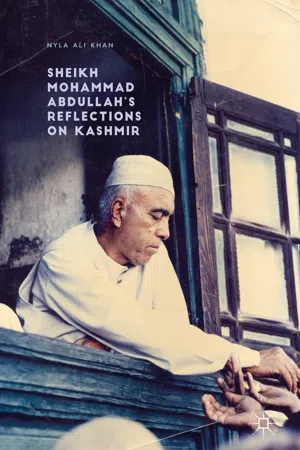
This book is a compendium of the speeches and interviews of Sheikh Mohammad Abdullah, who reigned as Prime Minister of the State of Jammu and Kashmir from 1948 to 1953, and who was a large presence on the political landscape of India for fifty years. The volume is designed to enable a student of South Asian politics, and the politics of Kashmir in particular, to analyze the ways in which experiences have been constructed historically and have changed overtime.
- English
- ePUB (mobile friendly)
- Available on iOS & Android
eBook - ePub
Sheikh Mohammad Abdullah’s Reflections on Kashmir
About this book
Information
© The Author(s) 2018
Nyla Ali KhanSheikh Mohammad Abdullah’s Reflections on Kashmirhttps://doi.org/10.1007/978-3-319-50103-1_11. Introduction
Nyla Ali Khan1
(1)
Oklahoma, USA
In my recent work, The Life of a Kashmiri Woman (New York: Palgrave Macmillan, 2014), I documented the voices of women as a way of countering the traditional narrative. Women in Kashmir, bolstered by Sheikh Mohammad Abdullah’s politics, played an important role in establishing a more inclusive democracy and new forums for citizen cooperation in the 1930s and 1940s. Female leaders led the way by offering new ideas, building broad-based political coalitions, and working to bridge organizational divides. Sheikh Mohammad Abdullah’s Reflections on Kashmir seeks to continue that kind of grassroots work.
Sheikh Mohammad Abdullah, although a paradox, had the strength to inscribe narratives of the Kashmiri people’s possibilities, ambitions, and accomplishments. He saw the people of Kashmir collectively, not individually, not ensnared in a familial framework, which wouldn’t allow for an evolving consciousness. I have attempted to study Sheikh Mohammad Abdullah as a fallible human being who, several times, found himself at crossroads and didn’t always make the most popular choice. He is not just a subject in this book of diplomatic papers, but an actor with agentive capacities as well.
A collection of Sheikh Mohammad Abdullah’s speeches and interviews has not been done before. My project seeks to rectify that lacuna. The political purpose of my project is to expose the falsity of the mode of representing the Kashmiri subject as an “other” to the self—created by the discourses of the nation-states of India and Pakistan. The primary readership will comprise students and scholars of the South Asia, not just in the United States and the United Kingdom, but in South Asia as well.
It will also interest a general audience which considers an intellectual understanding of the Kashmir issue more important than political expediencies dictated by time and situation.
In Sheikh Mohammad Abdullah’s Reflections on Kashmir, my attempt is to highlight what I consider a serious omission in the histories of independent India and Pakistan. The development of Kashmiri nationalism, prior to the independence of India and creation of Pakistan in 1947 and its further evolution in later years, has not been adequately recognized or accommodated by either India or Pakistan. A point that I have made several times and at various forums is that the foundation of Kashmiri nationalism was laid in 1931, and this nationalism recognized the heterogeneity of the nation. It was not constructed around a common language, religion, culture, and an ethnically pure majority. This process of Kashmiri nationalist self-imagining is conveniently ignored in the statist versions of the histories of India and Pakistan.
Here, I would also like to point out that there are some purportedly “subaltern” versions of the history of Kashmir which, in their ardent attempts to be deconstructionist, insidiously obliterate the process of nation-building in Kashmir in the early to mid-decades of the twentieth century, inadvertently feeding off statist and oftentimes right-wing versions of history. In romanticizing militant resistance in Kashmir, such versions fail to take into account the tremendously difficult task of restoring the selfhood of a degraded people, and also the harsh fact that a political movement which does not highlight the issues of governance, social welfare, and the resuscitation of democratic institutions ends up becoming obscurantist.
Can the evolution of Kashmiri nationalism be viewed in ways other than the determinant ones?
This book highlights different aspects of the political history of Kashmir with which the political life of Sheikh Mohammad Abdullah was intricately intertwined. Sheikh Mohammad Abdullah— the rebel, Kashmiri nationalist, and first Muslim Prime Minister of Jammu and Kashmir (J & K)—was one of the pioneers of the broadening of the political, economic, intellectual, and cultural horizon in the State and, toward the end of his life, predicted the diminishing of that horizon. Several themes regarding the politics of the antimonarchical movement in Kashmir and the politics of self-determination as well as autonomy are reiterated in the speeches that I have reproduced in this book.
Sheikh Mohammad Abdullah reigned as Prime Minister of the State of J & K from 1948 to 1953. Sheikh Mohammad Abdullah, for better or worse, was a large presence on the political landscape of India for 50 years. In a fragmented sociopolitical and religious ethos, he represented the pluralism that would bind the people of J & K together for a long time. Such personages leave indelible marks of their work and contributions on societies for which they have tirelessly worked, and their work, for the most part, traverses religious, class, and party fault lines. To associate such personages with just one political party or one religious group amounts to an inexcusable trivialization. Given the militarization and rabid fragmentation of Kashmiri society, it becomes necessary to evoke the man who symbolized Kashmiriyat or pluralism in the face of divisive politics. It also becomes necessary for federal countries to reassess and reevaluate their policies vis-à-vis border states.
Even 35 years after his death, Sheikh Mohammad Abdullah remains the most idolized as well the most reviled political personage of Kashmir. My article on this phenomenon appeared in a few newspapers a couple of weeks ago. As I observed in that article, I am still amazed to see how much the intelligence agencies of India and Pakistan, which act covertly to influence the outcome of events, continue to invest in trying to erase the name, ideology, and work of one Kashmiri nationalist, Sheikh Mohammad Abdullah. Several state and non-state actors in Kashmir can and have been coopted, mellowed, and made to toe the line of the powers that be. Yet, the unfinished business of the powers to be on both sides of the Line of Control (LOC; India and Pakistan) to ride roughshod over the history of Kashmiri nationalism and the evolution of a political consciousness in Kashmir, which began much before 1989, continues unabated.
My detractors, as I painstakingly acknowledge in the abovementioned article, level the allegation that I “eulogize” Sheikh Mohammad Abdullah, but I believe, with the force of my conviction, that he, with all his contradictions, was a force to reckon with. He succeeded in making the politics of mass mobilization credible by merging it with the institutional politics of democracy.
I would like to believe that my opinions have evolved during the course of my research. And, in all honesty, I find Sheikh Mohammad Abdullah’s politics relevant even today. He, like the rest of us, had his flaws and shortcomings, but that doesn’t take away from his commitment to Kashmir. I believe, without a shred of doubt, that in civilized societies, political dissent is not curbed and national integrity is not maintained by military interventions. I have said this earlier on other public platforms, and I am reiterating it because it is a viable conclusion to my response to this question. I reiterate that the more military officials get involved in issues of politics, governance, and national interest, the more blurred the line between national interest and hawkish national security becomes. Contrary to what the Indian military establishment is doing in J & K and the Northeast and what the Pakistani military establishment is doing in Balochistan, people must learn to work together across ethnic and ideological divides and insist that everyone be included in democratic decision-making. It is an egregious mistake and one that has severe ramifications to allow the military of a nation-state to bludgeon its democratic processes. And I cannot emphasize this point enough.
I discuss this issue in the classes that I teach and I wrote about this in my article on “Military Interventions in Democratic Spaces” as well. Instead of deterring the growth of democracy and depoliticizing the people, the goal should be to empower the populace of J & K sufficiently to induce satisfaction with the Kashmir constituency’s role within current geopolitical realities such that a dis-empowered populace does not succumb to ministrations of destructive political ideologies. In addition to addressing the political aspect of democracy, it is important to take cognizance of its economic aspect as well, which is exactly what Sheikh Mohammad Abdullah, a man far ahead of his time, did. The dominant perception of Kashmir as just an insurgent state within the Indian Union and not as a political unit with legitimate regional aspirations might benefit security hawks but will not do any long-term good.
Despite the diatribe, “quiet diplomacy,” and negotiations, has the political landscape of Kashmir, the nuclear flashpoint in South Asia, changed at all since 1953? How seriously do the governments of India and Pakistan take current regional political actors—state and non-state—in Kashmir? So, I thought I’d revisit a long-forgotten chapter of history, which, at the time, garnered tremendous international attention and condemnation of the arrogance of nation-states.
In 1947, India gained its independence from British rule and was partitioned into India and Pakistan. The State of J & K, which lies roughly north of both countries, acceded to India. The Indian government agreed to provide political and military aid to Kashmir under the condition of accession.
However, it was understood that once the warring subsided, a plebiscite would be held under United Nations auspices that would give the Kashmiri people the right to decide whether to stay with India or accede to Pakistan. Some Kashmiris felt an option for independence also should be added to the discussion since Kashmir had been autonomous before the invasion.
In 1948, my maternal grandfather, Sheikh Mohammad Abdullah, became prime minister of Kashmir, and by 1953 Abdullah, who was a strong advocate for Kashmiri independence, began to openly question whether the Indian government would organize the plebiscite since efforts had not been made to do so. Even though he took a peaceful approach, his display of skepticism—coupled with his ideas of an independent Kashmir—and the popularity it gained with others who shared his views, is what caused him to be deposed and imprisoned by the Indian government for the next 22 years, from 1953 until 1972.
He played a significant role in the consolidation of democratic elements in J & K, who had braved many a storm to bolster his fight for self-determination for the Kashmiri people. With the inception of the disintegration of the sociopolitical fabric of Kashmir in 1989, the values for which he had made great sacrifices slowly fell apart. I have watched Sheikh Mohammad Abdullah’s ideology being made redundant not only by the militarized interventions of India and Pakistan but also by the fragmentation in Kashmiri society.
As I observed in The Life of a Kashmiri Woman, while harboring his heritage, culture, and values of the past, the Sheikh was well-aware of the exigencies of the present and had the courage to translate his vision into reality, thereby signaling the end of the chapter of peasant exploitation and subservience and opening a new chapter of peasant emancipation, and further instituting educational and social schemes for marginalized sections of society. When the pledge to hold a referendum was not kept by the Government of India, his advocacy of autonomy for the State led to his imprisonment.
This project gave me a chance to collect and collate my thoughts and earlier works, some pre-published, on the political reality of Kashmir, taking on a life of its own. I am reproducing updated versions of some of those earlier works below, including excerpts from my books, Islam, Women, and Violence in Kashmir: Between India and Pakistan and The Life of a Kashmiri Woman in order to help the reader, particularly undergraduate and graduate students in South Asian Studies programs, contextualize the speeches and interviews reproduced in Sheikh Mohammad Abdullah’s Reflections on Kashmir.
I quote from Sheikh Mohammad Abdullah’s statement in the Court of the Sessions Judge in Srinagar, Kashmir, during the Quit Kashmir Trial of 1946:
The “Quit Kashmir” cry concretized the vociferous demand for the dissolution of a system of government which was in the process of being eliminated all over India. The movement for enfranchising the people was not about personal enmity or vendetta.The All India States People’s Conference has clearly laid down that the old treaties between the States and the British government or its representatives are obsolete, and must end. That applies to all treaties including the Treaty of Amritsar, which has some special and unhappy features which make it a kind of sale-deed of the territory and people of Kashmir. This treatment of a people as a commodity which can be transferred for hard cash has all along been deeply resented by the Kashmiris, whether Hindu, Sikh, or Muslim. It hurts their national dignity. In practice, the peculiar nature of the Treaty of Amritsar has led to all kinds of discrimination against Kashmiris, resulting in their treatment as some kind of lower class. (“The Statement of Sher-e-Kashmir in the Court of the Sessions Judge, Srinagar,” in Kashmir on Trial: State vs. Sheikh Abdullah)
The defense counsel, Mr. Asif Ali, began his defense of the accused, Sheikh Mohammad Abdullah, with the main question, which
[i]n this case is whether it is the right of a people to demand responsible government even in emphatic terms if necessary …. Is it a crime to say that the basis of the government of this State should be the will of the people and not a treaty which is a hundred years old and which is impungable in the highest International Court of Justice? This is the issue involved in this case and nothing less. (“The Statement of Sher-e-Kashmir in the Court of the Sessions Judge, Srinagar,” in Kashmir on Trial: State vs. Sheikh Abdullah)
In an endeavor to enable the formation of representative governments in Indian states, the All India States People’s Conference (AISPC) adopted a constitution in 1939 that underlined deploying legitimate means to help the people of the State form a responsible and representative government under the aegis of the monarch. Once the AISPC drafted and proclaimed its objectives, a number of organizations were...
Table of contents
- Cover
- Front Matter
- 1. Introduction
- 2. Letters
- 3. Speeches
- 4. Press
- 5. Concluding Remarks
- Back Matter
Trusted by 375,005 students
Access to over 1.5 million titles for a fair monthly price.
Study more efficiently using our study tools.
Frequently asked questions
Yes, you can cancel anytime from the Subscription tab in your account settings on the Perlego website. Your subscription will stay active until the end of your current billing period. Learn how to cancel your subscription
No, books cannot be downloaded as external files, such as PDFs, for use outside of Perlego. However, you can download books within the Perlego app for offline reading on mobile or tablet. Learn how to download books offline
Perlego offers two plans: Essential and Complete
- Essential is ideal for learners and professionals who enjoy exploring a wide range of subjects. Access the Essential Library with 800,000+ trusted titles and best-sellers across business, personal growth, and the humanities. Includes unlimited reading time and Standard Read Aloud voice.
- Complete: Perfect for advanced learners and researchers needing full, unrestricted access. Unlock 1.5M+ books across hundreds of subjects, including academic and specialized titles. The Complete Plan also includes advanced features like Premium Read Aloud and Research Assistant.
We are an online textbook subscription service, where you can get access to an entire online library for less than the price of a single book per month. With over 1.5 million books across 990+ topics, we’ve got you covered! Learn about our mission
Look out for the read-aloud symbol on your next book to see if you can listen to it. The read-aloud tool reads text aloud for you, highlighting the text as it is being read. You can pause it, speed it up and slow it down. Learn more about Read Aloud
Yes! You can use the Perlego app on both iOS and Android devices to read anytime, anywhere — even offline. Perfect for commutes or when you’re on the go.
Please note we cannot support devices running on iOS 13 and Android 7 or earlier. Learn more about using the app
Please note we cannot support devices running on iOS 13 and Android 7 or earlier. Learn more about using the app
Yes, you can access Sheikh Mohammad Abdullah’s Reflections on Kashmir by Nyla Ali Khan in PDF and/or ePUB format, as well as other popular books in Politics & International Relations & Asian Politics. We have over 1.5 million books available in our catalogue for you to explore.