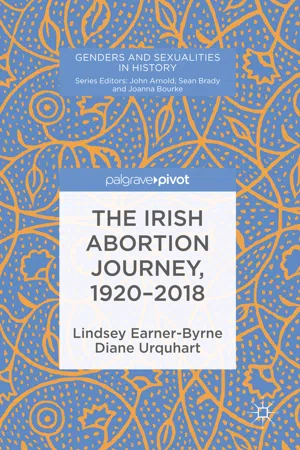
This book reframes the Irish abortion narrative within the history of women's reproductive health and explores the similarities and differences that shaped the history of abortion within the two states on the island of Ireland. Since the legalisation of abortion in Britain in 1967, an estimated 200,000 women have travelled from Ireland to England for an abortion. However, this abortion trail is at least a century old and began with women migrating to Britain to flee moral intolerance in Ireland towards unmarried mothers and their offspring. This study highlights how attitudes to unmarried motherhood reflected a broader cultural acceptance that morality should trump concerns regarding maternal health. This rationale bled into social and political responses to birth control and abortion and was underpinned by an acknowledgement that in prioritising morality some women would die.
- English
- ePUB (mobile friendly)
- Available on iOS & Android
eBook - ePub
The Irish Abortion Journey, 1920–2018
About this book
Information
© The Author(s) 2019
Lindsey Earner-Byrne and Diane UrquhartThe Irish Abortion Journey, 1920–2018Genders and Sexualities in Historyhttps://doi.org/10.1007/978-3-030-03855-7_11. Introduction
Lindsey Earner-Byrne1 and Diane Urquhart2
(1)
School of History, University College Dublin, Dublin, Ireland
(2)
Institute of Irish Studies, University of Liverpool, Liverpool, UK
Lindsey Earner-Byrne
Abstract
This chapter outlines the current position regarding abortion in Northern Ireland and the Republic of Ireland and provides a brief explanation of the history of abortion law in Ireland. It explains why the book adopts a historical and an all-island approach to the analysis of abortion in Ireland arguing that both provide the necessary context required to understand this complex and ‘live’ issue as part of a broader history of women’s health and female agency.
Keywords
AbortionEighth amendmentCriminalisedSection 58Republic of IrelandNorthern IrelandFrom 2019, abortion up to twelve weeks gestation will be legal in the Republic of Ireland. It is hard to overestimate the significance of this change, or the irony that the often-lamented socially conservative part of the island has become more liberal than its northern neighbour. Abortion remains illegal in Northern Ireland (except in very narrowly defined circumstances), but the issue is rarely considered either in an all-island or a historical context.1 While the restrictive nature of abortion law on the island of Ireland has made it anomalous in Western Europe, it is in fact in keeping with the conservative nature of both jurisdictions, in particular, in relation to the status of women, reproductive rights and sexual morality . The abortion question is often reduced to a ‘Catholic issue’ in the Republic and a rallying point of rare political consensus in Northern Ireland, but neither interpretation fully reflects the complexity of the history of the Irish abortion journey. This book considers the history of Irish abortion against a broader backdrop of female agency since the foundation of both states on the island of Ireland to the present day. It disentangles the tropes and myths, which have been recycled and rehashed since the earliest discussions on women’s sexuality and reproduction in Ireland, and considers why some of these still endure.
The Legal Framework
Since the mid-twentieth century there has been a period of transnational abortion reform with ‘a wave of amendments … where most countries spell out exceptions under which induced abortion is not subject to penalties’.2 Reform was, for example, introduced in the Soviet Bloc , Western and Central Asia and Eastern, Northern and Southern Europe in the early- to mid-1950s and in the developed and developing world including China , Cuba , India and Tunisia in the 1960–1970s. By the mid-1980s abortion was legal in most of Europe and North America and from 1985 to 2010 nearly all remaining European countries removed restrictions alongside South Africa , Cambodia , Nepal , Vietnam , Guyana and Mexico . Collectively this amounted to a ‘slow and steady historical shift’, but the reform process was not universal. Andorra , Malta and San Marino were the only developed regions without provision for abortion alongside twenty-three countries in developing regions and as a recent world report on access to safe abortion noted: ‘Abortion is explicitly permitted in only the most dire of circumstances – when needed to save a woman’s life – in 39 countries; of those, only (Ireland) is in the developed world’.3
Abortion was not unknown in eighteenth and nineteenth-century Ireland, but it was seemingly uncommon and closely associated with single motherhood , shame and surreptitious procedures.4 As the historian, Kenneth H. Connell suggested, ‘Abortion … was no matter for general discussion: the slenderness … of the evidence probably indicates the rarity of the practice’.5 Abortion was, however, sufficiently worrying to legislators and moralists to prompt the passage of the Offences Against the Person Act of 1861 , section 58 of which read:
Every woman, being with child, who, with intent to procure her own miscarriage , shall unlawfully administer to herself any poison or other noxious thing, or shall unlawfully use any instrument or other means whatsoever with the like intent, and whosoever, with intent to procure the miscarriage of any woman, whether she be or be not with child, shall unlawfully administer to her or cause to be taken by her any poison or other noxious thing, or shall unlawfully use any instrument or other means whatsoever with the like intent, shall be guilty of felony, and being convicted thereof shall be liable … to be kept in penal servitude for life.
Section 59 of the act criminalised those who assisted with an abortion and ‘unlawfully supply or procure any poison or other noxious thing…with the intent to procure the miscarriage of any woman, whether she be or be not with child, shall be guilty of a misdemeanour’.6 This act covered the island of Ireland as a constituent part of the UK at the time of its passage and it remained in force following the partition of Ireland in 1921.7
The Historical Framework
The creation of the state of Northern Ireland in 1921 and the establishment of the Irish Free State in 1922 allowed both parts of the island to forge their own policies in relation to sexuality and reproductive issues.8 The religious make-up of both states was very different; the Irish Free State was overwhelmingly Roman Catholic and the Northern Irish State was made up of a majority of Protestant religions (mainly Presbyterian, Church of Ireland and Methodists) and a significant minority of Roman Catholics.9 The tendency in political discourse and scholarship has been to accentuate and focus on those differences, however, this book is equally interested in what both parts of the island shared. Socially, there was, in fact much common ground until at least the 1990s. The island of Ireland was overwhelmingly Christian conservative and religion was considered a vital attribute of identity for much of the twentieth century. Although there were differences in degree and inflection between the denominations on the island, there was also much agreement in relation to sexual morality and other social issues. Crucially, there was a strongly held conviction that faith should inform social values and state policy. This book explores how a conservative moral climate came to dominate decision-making in relation to legislation concerning women and sexuality in both states on the island. Throughout the 1920s and 1930s, as Britain embarked on a path of gradual liberalisation in relation to issues such as birth control and divorce ,10 both jurisdictions in Ireland consciously battened down the moral hatches.11 While the two nascent states began crafting identities based, in part at least, on difference and hostility to one another, they also came to reflect each other’s anxieties in relation to rising crime and violence, ebbing moral standards, decreasing parental control and increasing sexual promiscuity . People who deviated from the stringent moral codes pertaining in both states had limited options and often found themselves ostracised, incarcerated and exiled. Indeed, many exercised the limited agency they had and migrated. This book charts the historical roots of this moral intolerance and its impact on women’s health. In particular, it explores how the treatment of unmarried mothers in both parts of the island reflected the status of all women and their bodily autonomy. At its most pernicious this was a divide and conquer morality ; ‘legitimate’ and ‘illegitimate’ women, implicitly and sometimes explicitly, were pitched against each other and all women were potentially endangered by the prioritisation of morality over health.12
This book examines how and why women’s health was consciously sidelined in Ireland from the beginning of the reproductive debates...
Table of contents
- Cover
- Front Matter
- 1. Introduction
- 2. Maternity and Moral Migration, 1920s–1960s
- 3. Legality and Irish Abortion, 1920s–1960s
- 4. Contraceptive Mentalities, 1960s–1980s
- 5. Pro-life States of Mind, 1967–2000s
- 6. Abortion in Exile, 1967–2018
- 7. Trusting Women, 2000–2018
- 8. Conclusion
- Back Matter
Trusted by 375,005 students
Access to over 1.5 million titles for a fair monthly price.
Study more efficiently using our study tools.
Frequently asked questions
Yes, you can cancel anytime from the Subscription tab in your account settings on the Perlego website. Your subscription will stay active until the end of your current billing period. Learn how to cancel your subscription
No, books cannot be downloaded as external files, such as PDFs, for use outside of Perlego. However, you can download books within the Perlego app for offline reading on mobile or tablet. Learn how to download books offline
Perlego offers two plans: Essential and Complete
- Essential is ideal for learners and professionals who enjoy exploring a wide range of subjects. Access the Essential Library with 800,000+ trusted titles and best-sellers across business, personal growth, and the humanities. Includes unlimited reading time and Standard Read Aloud voice.
- Complete: Perfect for advanced learners and researchers needing full, unrestricted access. Unlock 1.5M+ books across hundreds of subjects, including academic and specialized titles. The Complete Plan also includes advanced features like Premium Read Aloud and Research Assistant.
We are an online textbook subscription service, where you can get access to an entire online library for less than the price of a single book per month. With over 1.5 million books across 990+ topics, we’ve got you covered! Learn about our mission
Look out for the read-aloud symbol on your next book to see if you can listen to it. The read-aloud tool reads text aloud for you, highlighting the text as it is being read. You can pause it, speed it up and slow it down. Learn more about Read Aloud
Yes! You can use the Perlego app on both iOS and Android devices to read anytime, anywhere — even offline. Perfect for commutes or when you’re on the go.
Please note we cannot support devices running on iOS 13 and Android 7 or earlier. Learn more about using the app
Please note we cannot support devices running on iOS 13 and Android 7 or earlier. Learn more about using the app
Yes, you can access The Irish Abortion Journey, 1920–2018 by Lindsey Earner-Byrne,Diane Urquhart in PDF and/or ePUB format, as well as other popular books in History & British History. We have over 1.5 million books available in our catalogue for you to explore.