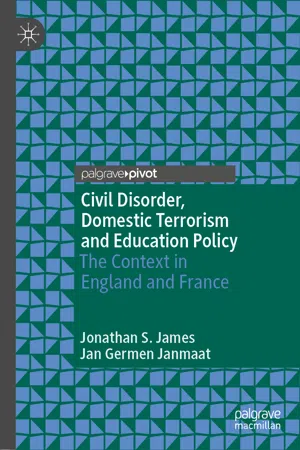
This book explores the links between education policy and occurrences of civil disorder and domestic terrorism in England and France. Since 2001, both England and France have experienced outbreaks of rioting in which young people of immigrant origin have been implicated: both have also been the targets of domestic terror attacks perpetrated by their own citizens. Both countries have had similar experiences of immigration since the end of the Second World War, but they are considered to have taken divergent approaches to immigrant integration and education. While Britain has tended towards a multicultural race relations approach, France veers towards a Republican assimilationist approach. Through the analysis of policy discourse and documents, the authors seek to establish whether these distinct approaches to immigrant integration and education policy have been maintained or whether they are converging. This book will appeal to students and scholars of education policy as well as immigration and integration in both France and England.
eBook - ePub
Civil Disorder, Domestic Terrorism and Education Policy
The Context in England and France
- English
- ePUB (mobile friendly)
- Available on iOS & Android
eBook - ePub
Civil Disorder, Domestic Terrorism and Education Policy
The Context in England and France
About this book
Information
Topic
EducationSubtopic
Education Theory & Practice© The Author(s) 2019
J. S. James, J. G. JanmaatCivil Disorder, Domestic Terrorism and Education Policyhttps://doi.org/10.1007/978-3-030-31642-6_11. Introduction
Jonathan S. James1 and Jan Germen Janmaat1
(1)
UCL Institute of Education, London, UK
Abstract
James and Janmaat set out the rationale for the study taking the January 2015 attacks in Paris as a starting point. While Britain and France are often considered to have taken divergent approaches to immigrant integration, both have been the site of occurrences of civil disorder and domestic terrorism since 2001. In both cases, such incidents have raised questions about the success of the countries’ models of immigrant integration, with the education system often being the focus of such debates. This leads to the central question of whether, given the commonalities in the challenges they face, the two countries are converging in their approaches to immigrant integration and to the schooling of migrants and their children in particular.
Keywords
Immigrant integrationCivil disorderIslamist terrorismBackground, Significance, and Aims of the Study
On the 7th January 2015, Said and Charif Kouachi opened fire in the offices of the satirical magazine Charlie Hebdo , killing twelve of its employees. So began three days of terror, which left a total of eighteen dead, and during which France’s security services, as well its population, were on high alert. Two other French citizens—Amedy Coulibaly and Hayat Boumedienne—were later revealed to be involved. Coulibaly took hostages in the kosher supermarket HyperCacher and claimed four victims in what appears to have been a racially motivated attack (see BBC 2015; Chrisafis 2015).
The attacks caused shockwaves that reverberated beyond France, and anxieties that transcended the immediate security risk. The four perpetrators were the children of immigrants from Mali and Algeria, but had grown up and been educated in deprived banlieues (suburbs) to the north of Paris. For large numbers of French people, Charlie Hebdo represents a French tradition of freedom of speech and irreverence towards religion. Some felt it was these traditions, as well as France’s capital city, that were under attack. The anti-Semitic dimension of the HyperCacher attacks rightly provoked concern in a country with the world’s third largest Jewish population. There was a sense that the perpetrators of the attacks did not share the values of liberté, égalité, and fraternité that underpin France’s constitution, as well as its understanding of itself.
This sense of ‘failed integration’ only deepened in the days following the attacks, as it became clear that the international outpouring of grief and solidarity manifested in the Je suis Charlie movement was not shared by large numbers of young French people. In schools across France, there were confrontations between students and teachers as some students refused to join in the minute’s silence in honour of the victims, and others appeared to qualify or justify the attacks. Many more were affronted by the magazine’s publication of cartoons of the prophet Mohamed and its often stereotyped and provocative portrayals of Islam (see Pélabay 2017; Moran 2017; Wesselhoeft 2017; Durpaire and Mabilon-Bonfils 2016; Lorcerie and Moignard 2017). Others suggested the attacks were the result of a Jewish conspiracy (Battaglia and Floch 2015). This raised concerns that it was not only the four attackers who had ambivalent feelings about what Charlie Hebdo represented.
These attacks and the debates they engendered point to bigger questions about social cohesion and national identity in multi-ethnic societies. When the children of immigrants commit acts of terrorism against the nations in which they were born and raised, their loyalty, and the loyalty of other second and third-generation immigrants, is often called into question. This is particularly true in the case of Muslims in Europe, where belonging to the transnational Islamic umma is seen by some to conflict with the idea of loyalty to the nation (Archer 2009). More than this, the confrontations taking place in classrooms in the days following the attacks seemed to speak to an unbridgeable divide between working class minority ethnic students and their largely white and middle class teachers (see Banks 2015; Lorcerie and Moignard 2017; Wesselhoeft 2017; Orange 2017). This seemed to suggest that France had failed to meet the challenges of promoting solidarity and a sense of belonging in the context of cultural diversity (see Dahl 1967; Lipset 1994; Rose 1969; Green and Janmaat 2011).
Questions of this nature are often particularly salient in times of crisis such as the occurrences of civil disorder and domestic terrorism that are the focus of this study. In the English case, riots in 2001, terrorist attacks in 2005, and further urban riots in 2011 raised concerns about the identities and loyalties of young people from immigrant backgrounds, and their adherence to ‘British’ values and norms. These concerns were mirrored in France after riots in deprived urban areas in 2005, and after more recent terrorist attacks in January and November 2015. In both cases, such concerns have fed into the debate on immigration, integration, and citizenship.
Public institutions such as schools have historically played a key role in integrating immigrants and their children. Schools in particular play an important role in acculturating young people into the values of the wider society. At the same time, the knowledge, skills, and qualifications young people gain in compulsory education condition their point of entry into the labour market and should facilitate economic integration (see Hochschild and Cropper 2010; Schnepf 2007). As was the case in January 2015, schools often feature in public debates in the wake of riots or terrorist attacks arising either as the solution to—or even the cause of—the crisis that has arisen.
France and the United Kingdom stand out as two countries that, in spite of their close proximity and similar immigration histories, appear to have taken historically different approaches to the schooling of the children of immigrants, and to the question of immigrant integration in general. While the British approach has been broadly described as ‘liberal’ or ‘multicultural’, the French ‘republican’ model has often been characterised as more prescriptive and assimilationist (see Favell 2001; Qureshi and Janmaat 2014; Koopmans et al. 2005; Bleich 1998; Olser and Starkey 2009; Meer et al. 2009). In sharp contrast to these scholars, Joppke (2004, 2007) has argued that there is policy convergence among Western states towards civic integration, which he defines as policies that encourage the full participation of immigrants but that pose greater requirements on them in terms of mastering the host country language and embracing civic values than previous policies. This view is echoed by Tonkens and Duyvendak (2016), who discern an increasing ‘culturalisation’ of citizenship policies and public debates on immigration. They use this term to refer to ever more cultural demands placed on immigrants with regards to their identification with, expressions of loyalty towards, and knowledge of the host country, its institutions and its values.
It is interesting to see whether the response of the two states to the occurrences of civil disorder and domestic terrorism reflects a continuation of these historically different approaches or a drawing closer along the lines suggested above. This, in a nutshell, is the key question this book seeks to answer. It will trace the impact of these occurrences—and the subsequent debate on immigration, integration, and nationality—on education policy in England and France in the period after 2001. It will consider the extent to which perceived weaknesses of the British and the French models of integration have led to their breakdown. It also aims to identify the ways in which commonalities in the challenges faced by the two nation-states has led to convergence in their approaches, and to assess to what extent this convergence is towards a civic integration approach.
The broader relevance of this question is that it can shed light on how changeable policy frameworks are and, more particularly, how conditioned and confined they are by national traditions. Only a comparison of polic...
Table of contents
- Cover
- Front Matter
- 1. Introduction
- 2. Understanding Variation in Approaches to Immigrant Integration
- 3. Civil Disorder, Domestic Terrorism, and Education Policy in England (2001–Present)
- 4. Civil Disorder, Domestic Terrorism, and Education Policy in France (2001–Present)
- 5. Multicultural Race Relations, French Republican Integration, Civic Integration, and Education as National Security
- Back Matter
Trusted by 375,005 students
Access to over 1.5 million titles for a fair monthly price.
Study more efficiently using our study tools.
Frequently asked questions
Yes, you can cancel anytime from the Subscription tab in your account settings on the Perlego website. Your subscription will stay active until the end of your current billing period. Learn how to cancel your subscription
No, books cannot be downloaded as external files, such as PDFs, for use outside of Perlego. However, you can download books within the Perlego app for offline reading on mobile or tablet. Learn how to download books offline
Perlego offers two plans: Essential and Complete
- Essential is ideal for learners and professionals who enjoy exploring a wide range of subjects. Access the Essential Library with 800,000+ trusted titles and best-sellers across business, personal growth, and the humanities. Includes unlimited reading time and Standard Read Aloud voice.
- Complete: Perfect for advanced learners and researchers needing full, unrestricted access. Unlock 1.5M+ books across hundreds of subjects, including academic and specialized titles. The Complete Plan also includes advanced features like Premium Read Aloud and Research Assistant.
We are an online textbook subscription service, where you can get access to an entire online library for less than the price of a single book per month. With over 1.5 million books across 990+ topics, we’ve got you covered! Learn about our mission
Look out for the read-aloud symbol on your next book to see if you can listen to it. The read-aloud tool reads text aloud for you, highlighting the text as it is being read. You can pause it, speed it up and slow it down. Learn more about Read Aloud
Yes! You can use the Perlego app on both iOS and Android devices to read anytime, anywhere — even offline. Perfect for commutes or when you’re on the go.
Please note we cannot support devices running on iOS 13 and Android 7 or earlier. Learn more about using the app
Please note we cannot support devices running on iOS 13 and Android 7 or earlier. Learn more about using the app
Yes, you can access Civil Disorder, Domestic Terrorism and Education Policy by Jonathan S. James,Jan Germen Janmaat in PDF and/or ePUB format, as well as other popular books in Education & Education Theory & Practice. We have over 1.5 million books available in our catalogue for you to explore.