eBook - ePub
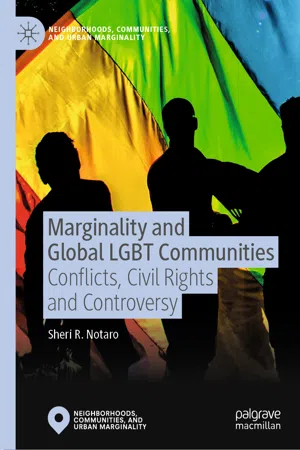
Marginality and Global LGBT Communities
Conflicts, Civil Rights and Controversy
- English
- ePUB (mobile friendly)
- Available on iOS & Android
eBook - ePub
About this book
This book examines the interconnectedness of LGBT civil and political rights, bias, discrimination, homophobia, and LGBT health disparities both in the United States and globally. According to Notaro, the failure to extend equitable civil and political rights to LGBT individuals—combined with recent reversal of past gains—will continue to be associated with bias, stigma and discrimination toward the LGBT community. In turn, this sustained bias and stigma fosters a host of LGBT health disparities, including access to culturally competent health care, HIV/AIDS, substance use, homelessness, suicide, and violence. Thus, the bias and discrimination levied at the LGBT community is discussed as a major explanatory factor in life-threatening health disparities experienced by the community, particularly in urban areas worldwide. The volume provides a framework for considering future research that must identify ways to prevent these health disparities, being mindful of and harnessing the protective factors and supports that exist within the diverse LGBT community.
Information
© The Author(s) 2020
S. R. NotaroMarginality and Global LGBT Communities Neighborhoods, Communities, and Urban Marginalityhttps://doi.org/10.1007/978-3-030-22415-8_11. Objectives and Significance of the Volume
Sheri R. Notaro1
(1)
Washington University in St. Louis, St. Louis, MO, USA
Alice Walker, a poet and writer, provides a lens into the main objectives of this volume:
Please remember, especially in these times of group-think and the right-on chorus, that no person is your friend (or kin) who demands your silence, or denies your right to grow and be perceived as fully blossomed as you were intended. (Alice Walker, 1983, In Search of Our Mothers’ Gardens: Womanist Prose)
This volume has several objectives, all of which focus on the marginality of persons identifying as lesbian, gay, bisexual, and transgender (LGBT) both in the United States and globally. The volume will illuminate the ways in which health disparities and inequities experienced by the LGBT population stem from historical and political struggles and at times violent persecutions faced by LGBT persons throughout the world. Specifically, the objectives of the volume are to illuminate the marginalization of the LGBT community in its many forms and societal structures while also discussing progress and movement from the margins of society to the mainstream in both the United States and globally.
This chapter will present the origins, definition of homosexuality, estimates of the LGBT population, an abridged history of homosexuality, and the foundation for LGBT civil rights formed by the Stonewall Inn riots. This chapter explicates that although the Stonewall Inn was a turning point and catalyst for gains in LGBT civil and political rights, the remainder of the volume will demonstrate that significant challenges stemming from discrimination, bias, and stigmatization persist among the LGBT community in the United States and globally. The ensuing chapters of the volume will provide ample evidence of significant barriers to full inclusion of the LGBT community into society, with focused attention on legal challenges, access to health care, health disparities, and violence (e.g., U.S. Department of Health and Human Services [DHHS], 2010).
Throughout the volume, care will be taken to emphasize and analyze the variations within this community that influence the uneven distribution of both health risk and protective factors and resiliency. The topic of LGBT marginalization is relevant and timely given that the 50th anniversary of the Stonewall Inn uprising provides a moment to pause and reflect upon ways in which the struggles for human rights of one group are indicative of the struggles for us all. Full inclusion of LGBT persons affects the lived experiences of all peoples. Limitations of the volume include the sometimes uneven focus on the United States, given the lack of comparative data sets globally as well as the inability to capture the full breadth of experience of individuals within the LGBT community.
The minority stress model (e.g., Meyer, 2003, 2010) will be discussed throughout the volume as an important conceptualization of the ways in which marginalization negatively impacts health outcomes. The model offers a framework for understanding and examining the impact of bias, discrimination, homophobia, and marginality on the unequal and poor health outcomes of L G B T individuals. Meyer (2003) emphasizes that minority stress theory is based upon several sociological and psychological theories (e.g., Allport, 1954; Goffman, 1963) that discuss the negative effects of social conditions such as prejudice and discrimination. Minority stress theory posits that health disparities among LGBTQ individuals or sexual minorities (e.g., psychological distress, substance use, HIV risk) can be partially explained by the stressors associated with experiencing a lifetime of homophobia, discrimination, bias, and harassment (Meyer, 2010). The minority stress theory posits that these stressors are not experienced by majority or non-stigmatized groups, are chronic, and are socially based in terms of institutional structures (Meyer, 2003). The model explores the variability within sexual minority communities by explicitly investigating the intersectional and overlapping identities within the LGBTQ community—e.g., LGBTQ individuals of color who hold unified identities as racial/ethnic minorities as well as sexual minorities. Research has demonstrated that, at least in the United States, LGBT individuals of color have a long and rich history of involvement in the “mainstream” gay rights movement (e.g., Stonewall), as well as within LGBT communities of color (Meyer, 2010). These communities of support serve as protective factors or buffers against homophobia, harassment, and discrimination and in turn, lower the risk of health disparities (Meyer, 2010).
Origins of Homosexuality
The origins of homosexuality have been formally debated among psychologists and psychiatrists for decades, with some claims that homosexuality results from unhealthy relationships between parents and children (Edsall, 2003). While research has examined a number of biological, genetic, and cultural factors that may influence sexual orientation, no definitive conclusions have been reached on this issue (American Psychological Association, 2016). There is fairly widespread agreement, however, that both biological and environmental factors impact the development of sexual orientation, leaving the individual with little or no choice in the matter (American Psychological Association, 2016). It was not until 1973 that the American Psychiatric Association ceased to classify homosexuality as a mental illness. The decision to remove homosexuality from the Diagnostic and Statistical Manual (DSM) was partly influenced by gay activism as well as the failure of established psychiatric tests such as the Rorshach to distinguish heterosexual men and women from homosexual men and women.
Defining Homosexuality
The origins of the terms homosexuality and heterosexuality are attributed to a letter written in 1869 by Karl Maria-Kertbeny, a Hungarian journalist and human rights activist The terminology applied to the homosexual community has changed over time and put into view the struggle to positively self-define one’s community in the face of discriminatory and pejorative labels imposed by anti-gay sentiment. In an attempt to mitigate stigma associated with the term homosexual, some gay and lesbian activists in the late 1940s and early 1950s created the “homophile” or “loving the same” movement (Carter, 2004). In direct opposition to the homophile attempt at positive self-identification, Carter (2004) details terminology applied to homosexuals that suggested either weakness (e.g., “fag” and “limp-wrist”) or inappropriate expressions of gender (e.g., “drag queens” ...
Table of contents
- Cover
- Front Matter
- 1. Objectives and Significance of the Volume
- 2. Legal Status and Challenges to Homosexuality
- 3. Access to Health Care
- 4. HIV/AIDS
- 5. Substance Use and Abuse
- 6. Mental Health
- 7. Violence
- 8. A Framework for the Future
- Back Matter
Trusted by 375,005 students
Access to over 1.5 million titles for a fair monthly price.
Study more efficiently using our study tools.
Frequently asked questions
Yes, you can cancel anytime from the Subscription tab in your account settings on the Perlego website. Your subscription will stay active until the end of your current billing period. Learn how to cancel your subscription
No, books cannot be downloaded as external files, such as PDFs, for use outside of Perlego. However, you can download books within the Perlego app for offline reading on mobile or tablet. Learn how to download books offline
Perlego offers two plans: Essential and Complete
- Essential is ideal for learners and professionals who enjoy exploring a wide range of subjects. Access the Essential Library with 800,000+ trusted titles and best-sellers across business, personal growth, and the humanities. Includes unlimited reading time and Standard Read Aloud voice.
- Complete: Perfect for advanced learners and researchers needing full, unrestricted access. Unlock 1.5M+ books across hundreds of subjects, including academic and specialized titles. The Complete Plan also includes advanced features like Premium Read Aloud and Research Assistant.
We are an online textbook subscription service, where you can get access to an entire online library for less than the price of a single book per month. With over 1.5 million books across 990+ topics, we’ve got you covered! Learn about our mission
Look out for the read-aloud symbol on your next book to see if you can listen to it. The read-aloud tool reads text aloud for you, highlighting the text as it is being read. You can pause it, speed it up and slow it down. Learn more about Read Aloud
Yes! You can use the Perlego app on both iOS and Android devices to read anytime, anywhere — even offline. Perfect for commutes or when you’re on the go.
Please note we cannot support devices running on iOS 13 and Android 7 or earlier. Learn more about using the app
Please note we cannot support devices running on iOS 13 and Android 7 or earlier. Learn more about using the app
Yes, you can access Marginality and Global LGBT Communities by Sheri R. Notaro in PDF and/or ePUB format, as well as other popular books in Social Sciences & Politics. We have over 1.5 million books available in our catalogue for you to explore.