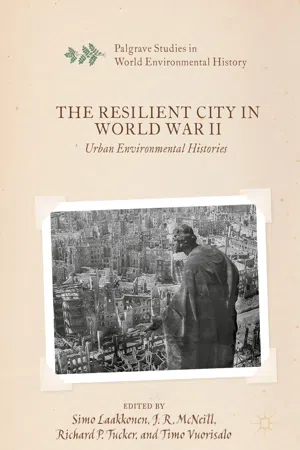
The fate of towns and cities stands at the center of the environmental history of World War II. Broad swaths of cityscapes were destroyed by the bombing of targets such as transport hubs, electrical grids, and industrial districts, and across Europe, Asia, and the Americas, urban environments were transformed by the massive mobilization of human and natural resources to support the conflict. But at the same time, the war saw remarkable resilience among the human and non-human residents of cities. Foregrounding the concept of urban resilience, this collection uncovers the creative survival strategies that city-dwellers of all kinds turned to in the midst of environmental devastation. As the first major study at the intersection of environmental, urban, and military history, The Resilient City in World War II lays the groundwork for an improved understanding of rapid change in urban environments, and how societies may adapt.
S. Laakkonen et al. (eds.)The Resilient City in World War IIPalgrave Studies in World Environmental Historyhttps://doi.org/10.1007/978-3-030-17439-2_6
Begin Abstract
6. Guerrilla Gardening?
Urban Agriculture and the Environment
Rauno Lahtinen1
(1)
University of Turku, Turku, Finland
End Abstract
During World War II, almost all of the European and Asian countries at war were threatened by a severe decline in agricultural production. Securing the procurement of foodstuffs for the civilian populace in particular was critical in order to maintain public health as well as overall morale and military production. Many countries saw the establishment of various programs intended to increase agricultural production. In England, the catch phrase “Dig for Victory” became a call to urban residents to import agriculture into the cities. The moat of the royal prison, the Tower of London, was adopted for cultivation, a step that symbolized the importance of agriculture for the entire commonwealth. In the United States, the “Victory Garden” planted by Eleanor Roosevelt in the White House gardens inspired the cultivation of small garden plots to support households and the wartime economy.1 Slogans such as “Eat what you can, and can what you can’t eat” steered citizens toward self-sufficiency. In countries destroyed by the war, urban agriculture continued to prove important even after hostilities came to an end. In post-war Germany, the residents of Berlin claimed the land fronting the destroyed Reichstag to grow potatoes.2 Such cultivation continued in the war-ravaged country, and it was not until the resurgence of the economy that citizens who had survived the war were faced with a completely new phenomenon: the overproduction of foodstuffs, obesity, and the “throwaway” society.3
Swedish historian of urban agriculture, Annika Björklund has emphasized that urban agriculture can be characterized as an anomalous condition, even a contradiction in relation to the urban-rural dichotomy. This is so because the location of agriculture in towns and cities is in opposition to the general function of urban economies’ focus on non-agricultural provision. Urban agriculture is also in opposition to the characteristic high settlement density in towns and cities because large-scale agriculture demands access to substantial areas of undeveloped land. However, according to Björklund, there are a number of other factors that affect how widely urban agriculture is practiced. On the one hand, social safety nets, fast and cheap transport, settlement expansion, and market economy discourage urban agriculture, while insecure or irregular income sources, transport difficulties, subsistence economy, and environmental concerns encourage it.4 In conclusion urban agriculture is highly dependent on the overall development of societies, their booms and busts, and here warfare steps in (Fig. 6.1).
Fig. 6.1
Public institutions supported urban agriculture in all belligerent countries. Victory gardens located across from San Francisco City Hall during World War II. (Source: San Francisco History Center, San Francisco Public Library)
Research on wartime agricultural history has focused on larger nations and has, understandably, particularly stressed the perspectives of troop munitions and the military economy.5 But what sort of role did urban agriculture play in smaller countries during the war, and what sort of effect did agriculture have on the environment and its conservation? This article delves into these issues in Turku, a coastal town of southwestern Finland and the nation’s third-largest city during the world wars. Although this article focuses on the period of World War II, it also briefly touches on the World War I era, because the experiences of this previous war were still fresh in people’s minds during the later war and played a role in how the populace adapted to wartime conditions.6
Agriculture has been practiced in Finnish and other Nordic cities for centuries.7 As late as the end of the nineteenth century, herds of cows being moved to their summer pastures were a common sight on city streets, while horses were needed to transport people and goods. Cows, pigs, chickens, sheep, and later also rabbits were raised in the courtyards of urban buildings. In addition, herds of cattle on their way to the slaughterhouse as well as plenty of stray dogs and cats wandered the streets. City-dwellers cultivated fields that were located right at the edges of the gridiron zone. In addition, plants for household use were grown in the yards of urban buildings. Manure men transported waste from the city to nearby fields, from where it was hauled off to farmers’ fields for fertilizer.8 Prior to the rapid industrialization of the late nineteenth century, then, cities were in many ways simply large villages. In the early 1900s, Finnish cities were still very small in terms of surface area, encompassing little more than the zoned areas.
Domestic animals were commonly kept in cities at the turn of the twentieth century, but tightening hygiene requirements made animal husbandry less desirable in the eyes of the authorities. In 1890, Turku residents owned 655 horses, 344 cows, and 308 pigs within the gridiron zone. By the end of the decade, the number of domestic animals in urban areas was clearly on the decline, a development that accelerated in the early years of the 1900s.9 Horses, on the other hand, were needed as traffic increased. In Turku, the number of horses was greatest in 1909, when streetcars had just been introduced. At that time, there were 758 horses in the gridiron zone.10 As automobile and streetcar traffic spread, horses became less common. Agriculture within the limits of Finland’s largest cities was almost entirely abandoned during the 1930s, primarily for reasons of hygiene. But when the acquisition of foodstuffs grew more difficult during the world wars, agriculture flooded back in urban areas. Agriculture gradually disappeared from the big cities following World War II, but in smaller towns it continued to exist; for instance, cows were still kept in the center of one small town in the 1970s.11
Urban agriculture and its effects have not been properly studied in Finland—or anywhere else, for that matter—from the perspective of environmental history, as periods of war have often been dismissed as brief and, in terms of nature, insignificant. With this article, I attempt to demonstrate that war and urban agriculture have had significant, long-term effects on urban streetscapes, land use, and resident lifestyles.12
As my primary source of data, I have relied on Turku-area newspapers. I went through Turku’s largest Finnish-language newspapers (in terms of chronology, Aura, Uusi Aura, and Turun Sanomat) from 1890 to 1950 and gathered articles and editorials related to the urban environment. During both world wars, the newspapers were shaped by military censorship, which limited writing on topics that were considered negative. Although censorship more clearly affected reporting on military developments, it also affected discussion of environmental issues, because the censors did not want to bog readers down with problems in their local environment.13 In reviewing archi...
Table of contents
Cover
Front Matter
Section I. Introduction
Section II. Urban Environment
Section III. Urban Nature
Section IV. Urban Society
Section V. Conclusions
Back Matter
Trusted by 375,005 students
Access to over 1.5 million titles for a fair monthly price.
Study more efficiently using our study tools.
Frequently asked questions
Yes, you can cancel anytime from the Subscription tab in your account settings on the Perlego website. Your subscription will stay active until the end of your current billing period. Learn how to cancel your subscription
No, books cannot be downloaded as external files, such as PDFs, for use outside of Perlego. However, you can download books within the Perlego app for offline reading on mobile or tablet. Learn how to download books offline
Perlego offers two plans: Essential and Complete
Essential is ideal for learners and professionals who enjoy exploring a wide range of subjects. Access the Essential Library with 800,000+ trusted titles and best-sellers across business, personal growth, and the humanities. Includes unlimited reading time and Standard Read Aloud voice.
Complete: Perfect for advanced learners and researchers needing full, unrestricted access. Unlock 1.5M+ books across hundreds of subjects, including academic and specialized titles. The Complete Plan also includes advanced features like Premium Read Aloud and Research Assistant.
Both plans are available with monthly, semester, or annual billing cycles.
We are an online textbook subscription service, where you can get access to an entire online library for less than the price of a single book per month. With over 1.5 million books across 990+ topics, we’ve got you covered! Learn about our mission
Look out for the read-aloud symbol on your next book to see if you can listen to it. The read-aloud tool reads text aloud for you, highlighting the text as it is being read. You can pause it, speed it up and slow it down. Learn more about Read Aloud
Yes! You can use the Perlego app on both iOS and Android devices to read anytime, anywhere — even offline. Perfect for commutes or when you’re on the go. Please note we cannot support devices running on iOS 13 and Android 7 or earlier. Learn more about using the app
Yes, you can access The Resilient City in World War II by Simo Laakkonen, J. R. McNeill, Richard P. Tucker, Timo Vuorisalo, Simo Laakkonen,J. R. McNeill,Richard P. Tucker,Timo Vuorisalo in PDF and/or ePUB format, as well as other popular books in Storia & Storia militare e marittima. We have over 1.5 million books available in our catalogue for you to explore.